Eurodollar Bonds
Eurodollar bonds are U.S. Dollar-denominated international debt securities issued, underwritten, and traded outside the United States by American corporations, foreign multinationals, or sovereign governments to access offshore capital without domestic SEC registration.
What Are Eurodollar Bonds?
Eurodollar bonds are international fixed-income debt securities denominated in United States Dollars (USD) that are originated, syndicated, and traded outside the domestic borders and regulatory jurisdiction of the United States. They represent the largest, most liquid sub-category of the broader Eurobond market.
When a multinational corporation (such as an American technology firm or a German automaker) or a foreign sovereign government wishes to raise long-term capital in U.S. Dollars without undergoing the costly and time-consuming registration process with the U.S. Securities and Exchange Commission (SEC), it issues Eurodollar bonds in premier offshore financial centers like London, Frankfurt, or Singapore.
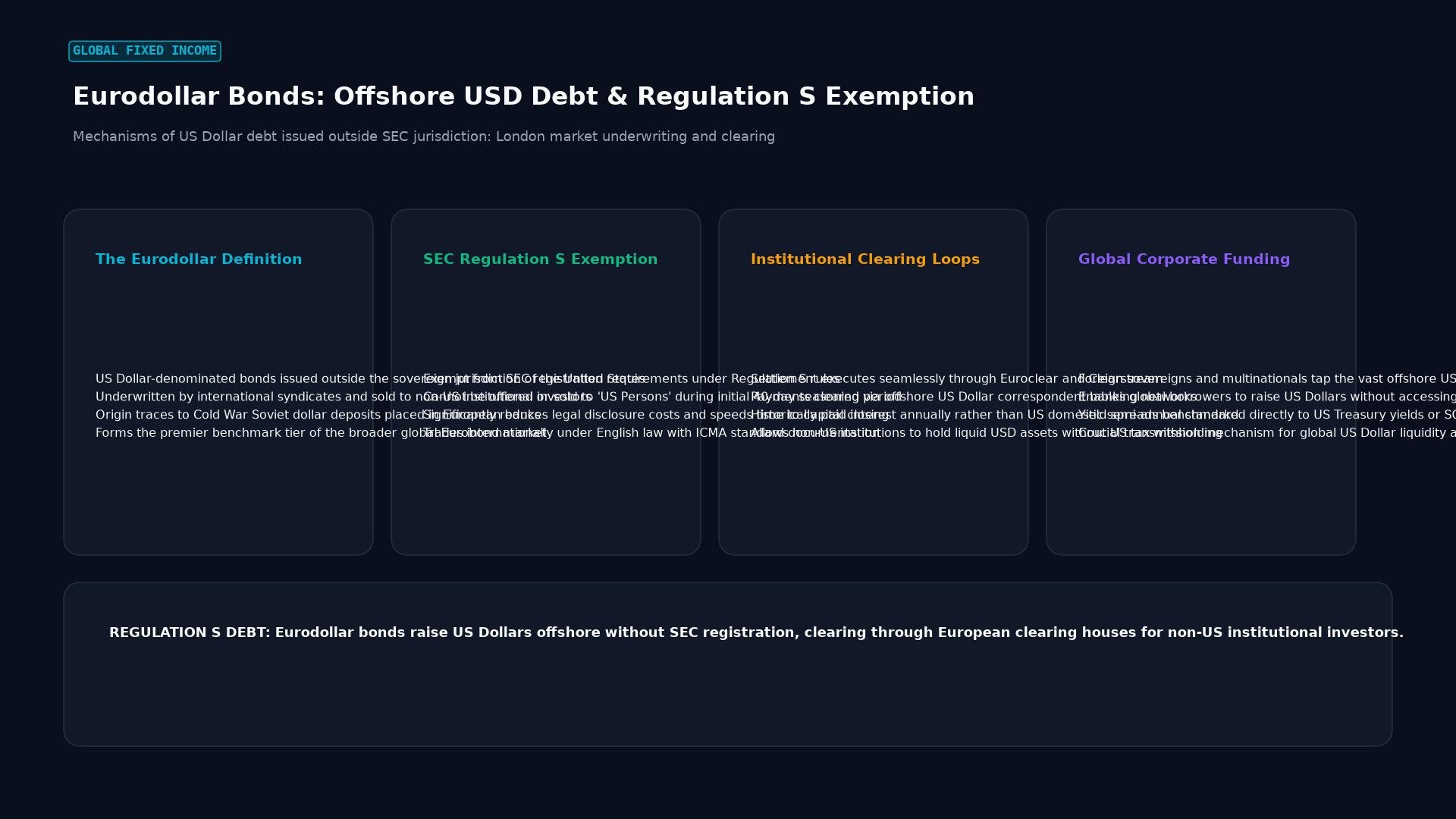 Figure: Mechanisms of US Dollar debt issued outside SEC jurisdiction: London market underwriting and clearing
Key Takeaways
- Denominated in USD, Issued Offshore: The defining trait of a Eurodollar bond is that it pays interest coupons and principal in U.S. Dollars, but is sold to investors outside the United States.
- SEC Registration Exemption: These bonds are issued under exemptions such as the SEC’s Regulation S, meaning issuers avoid rigorous U.S. domestic reporting requirements and legal liabilities.
- Gross Coupon Payments: Interest is paid gross to international bondholders without U.S. withholding tax deductions.
- Foreign Exchange Exposure: For non-U.S. issuers, Eurodollar bonds create significant structural currency risk: if the issuer earns revenue in a depreciating domestic currency, servicing USD debt becomes progressively more expensive unless hedged via cross-currency swaps.
Eurodollar Bonds vs. Yankee Bonds vs. Domestic U.S. Bonds
Institutional fixed-income investors classify dollar-denominated debt according to issuing jurisdiction and regulatory filing:
| Feature | Domestic U.S. Corporate Bond | Yankee Bond | Eurodollar Bond |
|---|---|---|---|
| Issuer | U.S. domestic corporation | Foreign corporate or sovereign | U.S. or foreign multinational entity |
| Issuance Location | Inside the United States | Inside the United States | Outside the United States (Offshore) |
| Denominated Currency | U.S. Dollar (USD) | U.S. Dollar (USD) | U.S. Dollar (USD) |
| SEC Registration | Mandatory (Form S-1 / S-3) | Mandatory (Form 20-F / F-1) | Exempt (Reg S offshore safe harbor) |
| Primary Clearing House | Depository Trust Company (DTC) | Depository Trust Company (DTC) | Euroclear & Clearstream |
| Investor Base | U.S. domestic asset managers | U.S. institutional accounts | Global central banks, offshore funds |
Strategic Motivations for Issuing Eurodollar Bonds
1. Cost Efficiency and Speed of Execution
Preparing a public domestic debt offering in the United States requires extensive accounting reconciliations (U.S. GAAP compliance) and months of regulatory review. Eurodollar bond offerings can be launched, priced, and closed in a matter of days under standard International Capital Market Association (ICMA) guidelines.
2. Tapping Global Dollar Liquidity Pools
Trillions of U.S. Dollars reside outside the United States in central bank foreign exchange reserve portfolios, sovereign wealth funds (e.g., in the Middle East and Norway), and global asset management firms. Eurodollar bonds provide a direct pipeline to tap this offshore capital pool.
3. Exploiting Cross-Currency Basis Arbitrage
Often, due to supply-and-demand imbalances in local credit markets, a non-U.S. borrower can issue Eurodollar bonds at a narrower credit spread than in its home currency. By combining the Eurodollar bond issuance with a long-term currency swap (FX Swap), the borrower achieves a synthetic domestic borrowing rate lower than domestic bank financing.
Currency Risk: The Sovereign Debt Vulnerability
While Eurodollar bonds offer attractive borrowing costs, they present severe systemic risks for emerging market corporate and sovereign issuers:
The Dollar Debt Trap:
1. Emerging market sovereign issues $1 Billion in 10-year Eurodollar bonds.
2. The Federal Reserve embarks on a rapid interest rate hiking cycle.
3. The U.S. Dollar surges; local emerging market currency depreciates by 30%.
4. Debt service cost in local currency explodes by 30% without any change in coupon.
5. Sovereign faces fiscal crisis, credit rating downgrades, or debt restructuring.
Frequently Asked Questions
Can U.S. citizens buy Eurodollar bonds?
Under SEC Regulation S rules, newly issued Eurodollar bonds cannot be sold to U.S. persons during an initial seasoning period (typically 40 days) to prevent issuers from bypassing SEC public registration rules. After the seasoning period expires, U.S. investors can trade these bonds on the secondary market.
What is the typical denomination of a Eurodollar bond?
Eurodollar bonds are designed for institutional wholesale trading rather than retail savers. They are typically issued in minimum denominations of $100,000 or $200,000, with secondary trading increments of $1,000.
Are Eurodollar bonds tied to Eurodollar futures?
While both involve offshore U.S. Dollars, they are distinct instruments. A Eurodollar bond is a long-term fixed-income debt instrument (maturities of 3 to 30 years). Eurodollar futures (historically traded on the CME and now transitioned to SOFR futures) were short-term 3-month interest rate derivative contracts used to hedge short-term interbank borrowing rates.
Ready to trade forex?
Open a free demo account with a regulated broker. Practice with virtual funds before risking real money.