European Union
The European Union (EU) is a supranational economic and political partnership of 27 democratic member states that operates a borderless single internal market, unified external trade policies, and a shared regulatory framework, with 20 member states adopting the Euro.
What Is the European Union?
The European Union (EU) is an institutional, political, and economic union comprising 27 sovereign member states located primarily on the European continent. Operating as a unique supranational confederation, the EU governs through a hybrid system of intergovernmental negotiation and supranational decision-making.
Economically, the European Union represents one of the largest economic blocs in the world, generating approximately 15% of global Gross Domestic Product (GDP). At the heart of the union is the Internal Single Market, which guarantees the “Four Freedoms”: the free, unrestricted movement of goods, services, capital, and labor across internal member state borders without tariffs or regulatory barriers.
For currency and financial market traders, the European Union is a primary geopolitical engine. Its economic statistics, regulatory directives (such as MiFID II / MiFIR), trade negotiations, and central banking policies directly dictate the valuation of the Euro (EUR), the British Pound (GBP), the Swiss Franc (CHF), and Central European currencies like the Polish Złoty (PLN).
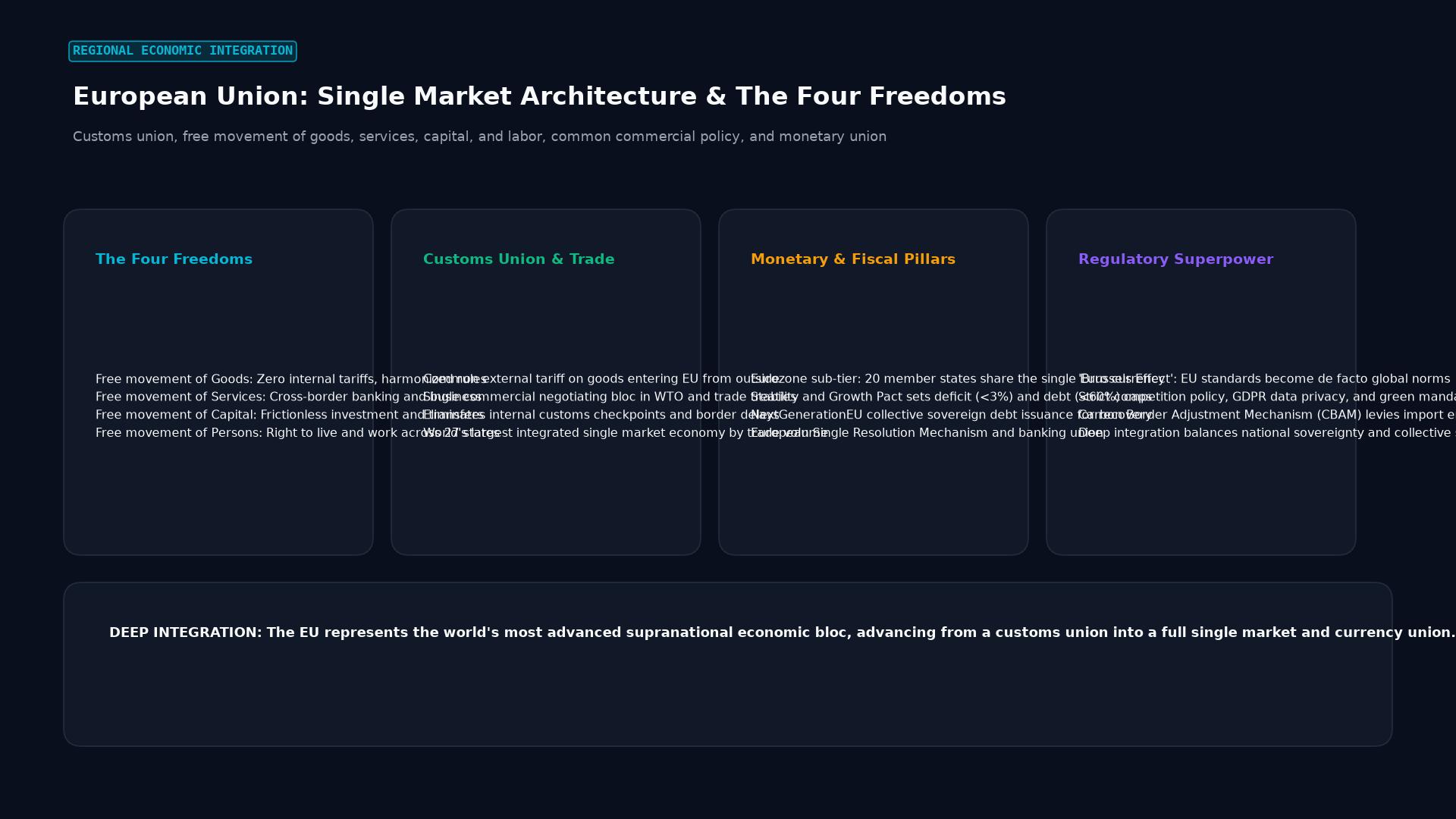 Figure: Customs union, free movement of goods, services, capital, and labor, common commercial policy, and monetary union
Key Takeaways
- Single Market Integration: The EU operates as a unified economic territory, eliminating internal customs duties and harmonizing product safety, environmental, and financial services standards.
- The EU vs. The Eurozone: While all 27 nations belong to the European Union, only 20 member states comprise the Eurozone and utilize the Euro as legal tender.
- Global Trade Titan: The EU acts as a single entity in international trade negotiations via the European Commission, giving it immense geopolitical bargaining power alongside the U.S. and China.
- Financial Regulatory Powerhouse: Directives established by the EU and enforced by the European Securities and Markets Authority (ESMA) set global benchmarks for retail forex leverage limits (1:30 caps), derivatives clearing (EMIR), and investor protection.
The EU vs. The Eurozone: The Monetary Divide
Traders must not confuse European Union membership with participation in the single currency:
| Dimension | European Union (EU) | The Eurozone (EMU) |
|---|---|---|
| Membership | 27 Sovereign States | 20 Member States |
| Guiding Treaty | Treaty on European Union (Lisbon Treaty) | Maastricht Treaty (Convergence Criteria) |
| Monetary Authority | National Central Banks retain local oversight | European Central Bank (ECB) in Frankfurt |
| Currencies Used | EUR, PLN, SEK, HUF, CZK, RON, BGN, DKK | Euro (EUR) exclusively |
| Fiscal Governance | Stability and Growth Pact guidelines | Strict Eurozone fiscal surveillance + ESM backstop |
| Exchange Rate Regimes | Free floating, crawling pegs, or ERM II | Single unified floating exchange rate |
Note on Non-Euro EU States: Several prominent EU economies retain their own sovereign currencies, including Poland (PLN), Sweden (SEK), Hungary (HUF), the Czech Republic (CZK), and Denmark (DKK, which maintains a fixed band against the Euro under ERM II).
Historical Milestones Shaping Global FX Markets
- 1992 Maastricht Treaty: Formally established the European Union and paved the path for the European Monetary Union (EMU) and the launch of the single currency.
- 2004 Big Bang Enlargement: Ten Central and Eastern European nations joined the EU, expanding the single market eastward and creating deep economic interdependencies across Central European currencies.
- 2016–2020 Brexit: The United Kingdom voted to leave the European Union in June 2016, triggering a historic 1,500-pip collapse in GBP/USD, introducing cross-border trade friction, and permanently reshaping European financial clearing hubs.
- 2020 NextGenerationEU Fund: In response to the pandemic, the EU broke historical precedent by authorizing €750+ billion in joint supranational debt issuance, creating a massive new pool of AAA-rated European sovereign bonds to rival U.S. Treasuries.
The EU’s Regulatory Influence on Forex Brokerage
The European Union exercises rigorous oversight over retail currency trading through ESMA:
- Leverage Restrictions: In 2018, ESMA introduced strict leverage limits on retail CFD and forex accounts: 1:30 on major currency pairs, 1:20 on non-major pairs, and 1:2 on cryptocurrencies.
- Negative Balance Protection: All brokers operating under EU licenses (such as CySEC in Cyprus or BaFin in Germany) must legally guarantee that retail traders cannot lose more than their deposited capital.
- Standardized Risk Warnings: Brokers must disclose the exact historical percentage of retail client accounts that lose money trading CFDs.
Frequently Asked Questions
Is Switzerland a member of the European Union?
No. Switzerland is not a member of the EU or the European Economic Area (EEA). Instead, Switzerland accesses the EU Single Market through a network of dozens of bilateral treaties. It retains full monetary sovereignty over the Swiss Franc (CHF) through the Swiss National Bank (SNB).
Can an EU country leave the union?
Yes. Article 50 of the Treaty on European Union outlines the formal, legal two-year notification process by which any member state may withdraw. The United Kingdom invoked Article 50 in March 2017 and formally departed the EU on January 31, 2020.
How does EU economic data impact EUR/USD?
Traders closely watch harmonized Eurozone-wide data released by Eurostat, particularly the Harmonized Index of Consumer Prices (HICP), Eurozone GDP estimates, and composite Purchasing Managers’ Indices (PMIs). Because Germany and France represent roughly 50% of total Eurozone GDP, unexpected weakness in German industrial or export data triggers immediate selling pressure on the Euro.
Ready to trade forex?
Open a free demo account with a regulated broker. Practice with virtual funds before risking real money.