Excess Margin Deposits
Excess margin deposits (or excess margin) represent the surplus capital and equity in a trading account that exceeds the broker's mandatory initial and maintenance margin requirements, providing a buffer against liquidation and enabling additional positions.
What Are Excess Margin Deposits?
In leveraged foreign exchange and derivatives trading, excess margin deposits—more commonly referred to as excess margin or free margin—denote the surplus equity remaining in an investor’s brokerage account beyond the statutory capital legally required to support active open trades. It represents the financial breathing room available before an account is subjected to margin calls or forced liquidation by the broker.
Whenever an investor opens a leveraged position, the broker ring-fences a portion of account capital as collateral (known as used margin or required initial margin). Any account equity sitting above this collateral threshold constitutes excess margin. If market prices move against open positions, floating mark-to-market losses diminish the excess margin pool first, protecting the fundamental margin base.
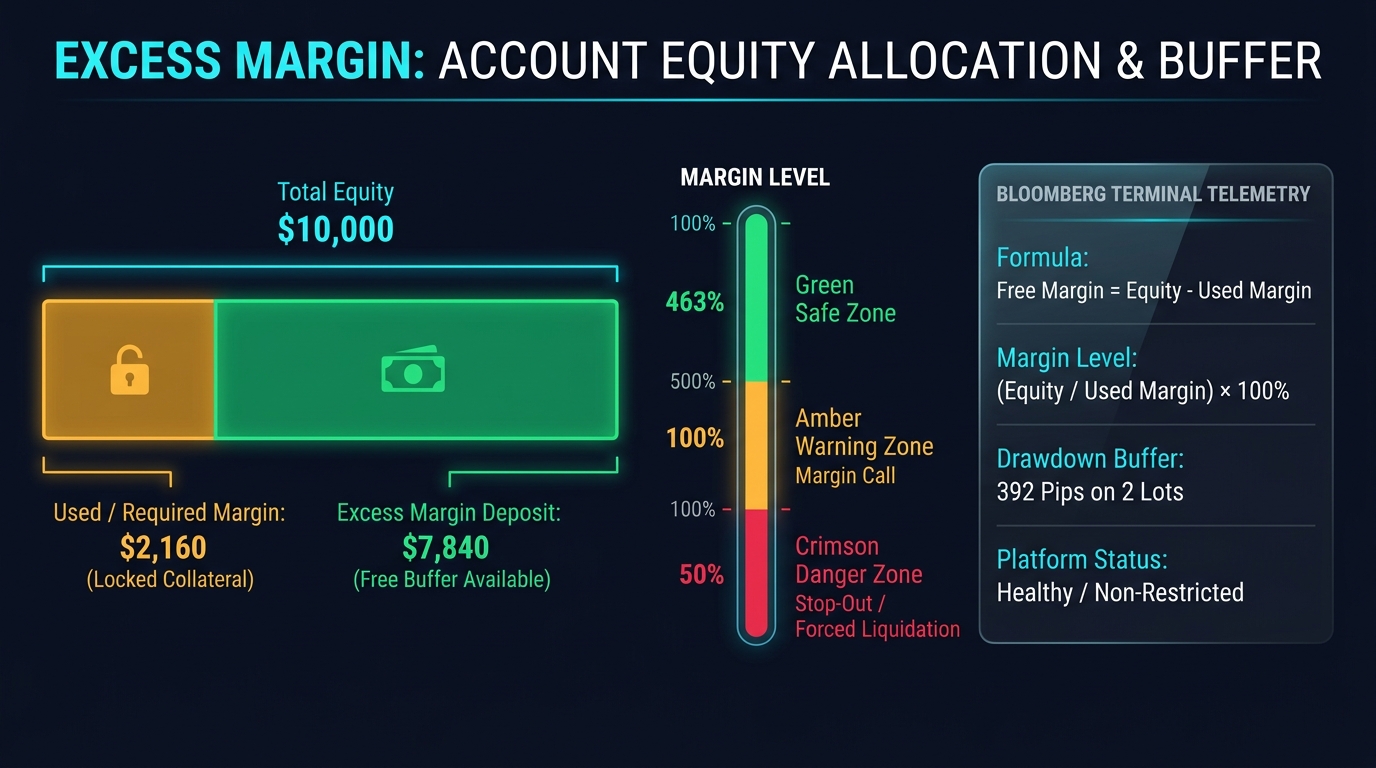
Margin Account Capital Architecture:
┌────────────────────────────────────────────────────────┐
│                   TOTAL ACCOUNT EQUITY                 │
│              (Balance + Floating Open P&L)             │
└──────────────────────────┬─────────────────────────────┘
                           │
       ┌───────────────────┴───────────────────┐
       ▼                                       ▼
┌──────────────────────────────┐ ┌──────────────────────────────┐
│        REQUIRED MARGIN       │ │     EXCESS MARGIN DEPOSIT    │
│         (Used Margin)        │ │         (Free Margin)        │
│ • Collateral locked by broker│ │ • Available to open trades   │
│ • Determined by leverage ratio│ │ • Eligible for cash withdraw │
│ • Non-withdrawable while     │ │ • Absorbs daily adverse      │
│   positions remain open      │ │   market drawdown swings     │
└──────────────────────────────┘ └──────────────────────────────┘
Key Takeaways
- The Free Capital Measure: Excess margin measures the exact amount of capital a trader can withdraw from the brokerage or deploy into opening new currency positions.
- The Liquidation Buffer: A healthy cushion of excess margin protects accounts from abrupt margin calls, stop-out thresholds, and forced market liquidations during volatile news spikes.
- Formula: $\text{Excess Margin} = \text{Account Equity} - \text{Used Margin}$.
- Margin Level Ratio: Trading platforms (such as MetaTrader, cTrader, and institutional prime portals) display the account safety ratio as the Margin Level Percentage: $(\text{Equity} / \text{Used Margin}) \times 100%$.
Mathematical Formulation and Real-World Example
To understand how excess margin behaves during market fluctuations, consider a retail trader with an account balance of $10,000 trading EUR/USD with 1:100 leverage (requiring a 1.0% initial margin):
1. Opening the Position
The trader buys 2 standard lots of EUR/USD (total notional value: €200,000) at an exchange rate of 1.0800 ($216,000 notional value):
- Required Margin (Used Margin): $$\text{Used Margin} = \frac{$216,000}{100} = $2,160$$
- Account Equity: $$10,000$ (assuming zero initial floating P&L).
- Excess Margin (Free Margin): $$\text{Excess Margin} = $10,000 - $2,160 = $7,840$$
- Margin Level Percentage: $$\text{Margin Level} = \left(\frac{$10,000}{$2,160}\right) \times 100% = 462.96%$$
The trader has $7,840 of excess margin available to absorb adverse market movements or to withdraw as cash.
2. Adverse Drawdown Scenario
EUR/USD unexpectedly plunges 150 pips. A 1-pip move on 2 standard lots equals $20; a 150-pip drop produces a $3,000 floating paper loss:
- New Account Equity: $$10,000 - $3,000 = $7,000$.
- Required Margin: Remains unchanged at $$2,160$.
- Depleted Excess Margin: $$\text{Excess Margin} = $7,000 - $2,160 = $4,840$$
- New Margin Level: $$\text{Margin Level} = \left(\frac{$7,000}{$2,160}\right) \times 100% = 324.07%$$
While the position is deeply underwater, the $4,840 of remaining excess margin safely prevents a margin call.
Excess Margin Across Trading Environments
| Feature | Retail Forex Brokerage | Exchange-Traded Futures (CME) | Institutional Prime Brokerage |
|---|---|---|---|
| Terminology | Free Margin | Excess Performance Bond | Unencumbered Cash / Excess Collateral |
| Calculation Timing | Real-time, continuous tick-by-tick | Intraday and end-of-day SPAN settlement | Real-time credit limits and daily EOD fix |
| Over-the-Limit Action | Automated stop-out at 50% margin level | Formal Margin Call (24-hour cure window) | Bilateral margin call under ISDA CSA |
| Interest Accrual | Usually 0% on excess balance | Often earns short-term Treasury yield | Earns overnight risk-free benchmark (€STR/SOFR) |
Strategic Risk Management Rules for Excess Margin
- Maintain a 300%+ Margin Level Minimum: Professional traders ensure their Margin Level never falls below 300% to 500% during normal market conditions. Entering trades when excess margin is razor-thin leaves the account defenseless against overnight liquidity gaps or weekend spread blowouts.
- Never Use 100% of Available Margin: Using all available excess margin to open new positions is known as “over-leveraging.” A minor 20-to-30-pip adverse tick will immediately push the account into a margin call.
- Withdraw Excess Capital Regularly: Experienced traders periodically withdraw excess margin profits to secure gains in external bank accounts, rather than allowing excessive unneeded capital to sit at risk in high-leverage brokerage accounts.
Frequently Asked Questions
What happens when excess margin drops to zero?
When excess margin hits $0.00, your Account Equity exactly equals your Required Used Margin (a 100% Margin Level). At this point, the trading platform will block you from opening any new positions. If losses continue, the broker will trigger a margin call warning and eventually execute an automatic forced liquidation (stop-out) once equity hits the broker’s stop-out threshold (typically 50% or 20%).
Can I withdraw funds while I have open trades?
Yes, but you can only withdraw capital up to your Excess Margin amount. Brokers will reject any withdrawal request that exceeds your free margin, because withdrawing used margin would instantly trigger a margin liquidation of your open positions.
Does deposit currency affect excess margin calculations?
Yes. If your trading account is denominated in Euros or British Pounds while trading USD-quoted pairs, your broker’s system dynamically converts your excess margin balance into your base deposit currency in real time using prevailing spot exchange rates.
Ready to trade forex?
Open a free demo account with a regulated broker. Practice with virtual funds before risking real money.