Exposure
Exposure is the total monetary value or portfolio proportion subjected to the risk of financial loss from market price fluctuations, interest rate shifts, currency exchange rate movements, or counterparty default.
What Is Exposure?
In financial risk management and foreign exchange trading, exposure represents the total quantum of capital, open position value, or contractual cash flows vulnerable to changes in external market variables. If a market participant holds an asset or liability whose value fluctuates when exchange rates, interest rates, equity prices, or credit spreads shift, that participant holds market exposure.
Managing currency exposure is the primary objective of both institutional corporate treasurers and speculative FX traders. In institutional finance, unhedged currency exposure leaves balance sheets, operating margins, and corporate earnings directly exposed to the unpredictable volatility of global foreign exchange markets.
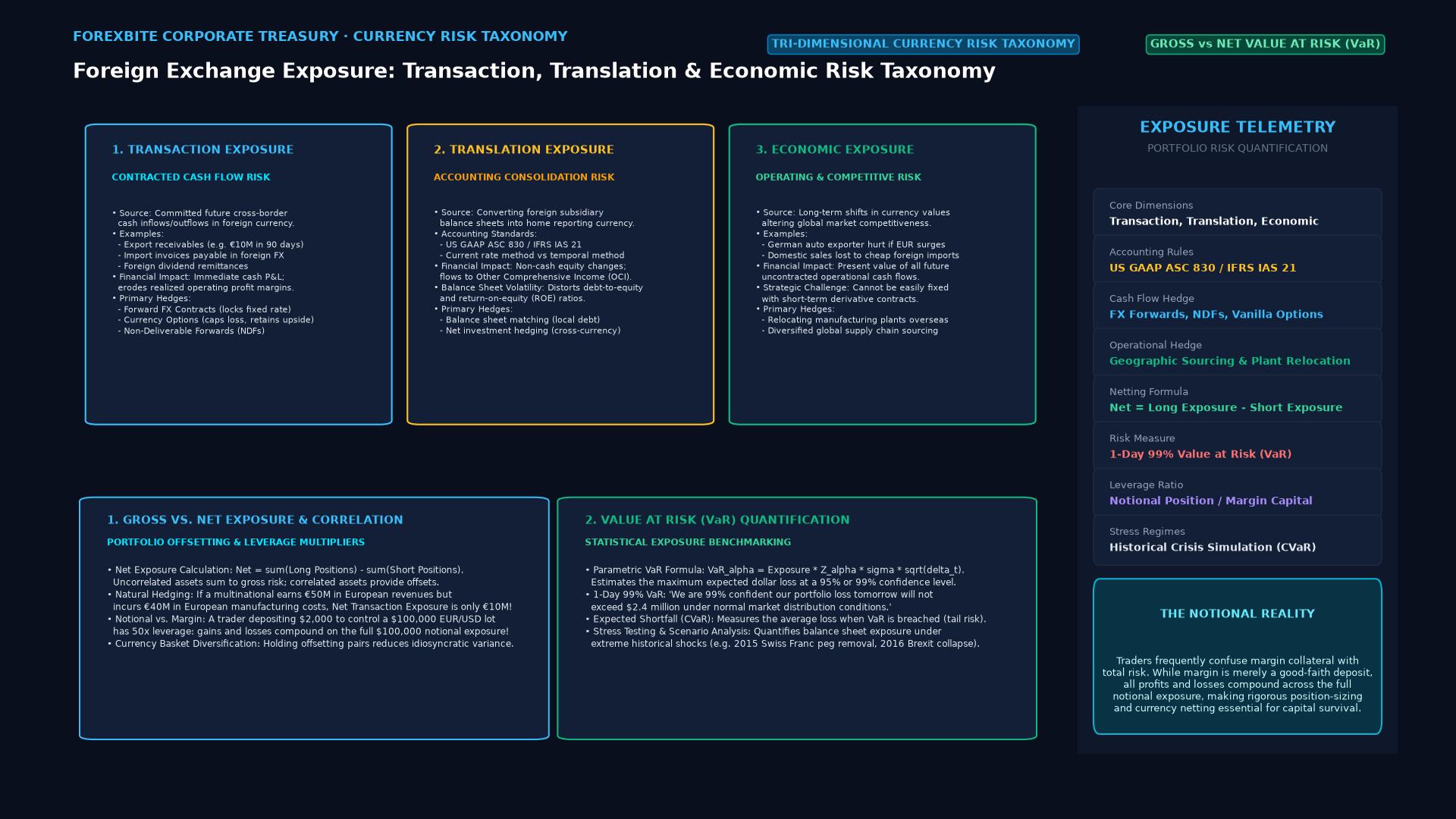 Figure: Tri-dimensional foreign exchange exposure taxonomy: transaction exposure (contracted cash flows), translation exposure (balance sheet consolidation), and economic exposure (competitive position).
Key Takeaways
- Three Core Types: Corporate FX exposure is divided into Transaction Exposure (actual cash contracts), Translation Exposure (accounting balance sheet consolidation), and Economic Exposure (long-term corporate competitiveness).
- Net Exposure Calculation: Portfolio exposure is calculated on a net basis across correlated assets: $\text{Net Exposure} = \sum \text{Long Positions} - \sum \text{Short Positions}$.
- Notional vs. Margin Exposure: A trader depositing $5,000 to trade a $100,000 currency lot has a $5,000 cash outlay but holds $100,000 of notional currency exposure.
- Quantification via VaR: Institutional desks measure aggregate portfolio exposure using Value at Risk (VaR), estimating the maximum expected dollar loss over a defined horizon at a specific statistical confidence level (e.g., 99%).
The Three Dimensions of Foreign Exchange Exposure
1. Transaction Exposure (Cash Flow Risk)
Transaction exposure arises from committed cross-border commercial transactions denominated in a foreign currency that will settle on a future date:
- Example: An American electronics retailer signs a contract to purchase components from a Japanese supplier for ¥150,000,000 payable in 90 days.
- The Risk: If the Japanese Yen appreciates against the U.S. Dollar over those 90 days (e.g., USD/JPY drops from 150.00 to 135.00), the dollar cost to settle the invoice surges from $1,000,000 to $1,111,111—eroding corporate profit margins.
- Mitigation: The firm hedges transaction exposure using FX Forward contracts, locking in an exact exchange rate today.
2. Translation Exposure (Accounting Risk)
Translation exposure (also called balance sheet exposure) occurs when a multinational corporation consolidates the financial statements of its foreign subsidiaries into its home reporting currency:
- Under international accounting standards (IFRS and U.S. GAAP ASC 830), foreign assets and liabilities must be retranslated at the closing balance sheet exchange rate.
- Fluctuations do not immediately impact cash flows, but create paper gains or losses reported under Cumulative Translation Adjustment (CTA) in shareholder equity.
3. Economic Exposure (Operating Risk)
Economic exposure measures how unexpected, multi-year currency trends impact a company’s market share, pricing power, and future discounted cash flows.
- If the Euro experiences a structural multi-year appreciation, European aircraft manufacturers find their products significantly more expensive than American competitors, impacting multi-year sales pipelines.
Net Currency Exposure in Trading Portfolios
Active currency traders often hold multiple open positions across different currency pairs simultaneously, creating unintended cross-currency exposure:
| Open Trade Position | Gross Notional Position | EUR Net Exposure | USD Net Exposure | JPY Net Exposure |
|---|---|---|---|---|
| Long 1 Lot EUR/USD | +€100,000 / -$108,000 | +€100,000 | -$108,000 | $0 |
| Short 1 Lot USD/JPY | -$100,000 / +¥15,000,000 | €0 | -$100,000 | +¥15,000,000 |
| Long 1 Lot EUR/JPY | +€100,000 / -¥16,200,000 | +€100,000 | $0 | -¥16,200,000 |
| Portfolio Net Totals | — | +€200,000 Long | -$208,000 Short | -¥1,200,000 Short |
Analysis: A trader holding these three separate trades believes they are diversified, but their net exposure reveals a massive concentrated short dollar and long euro bet. A sudden surge in the U.S. Dollar will produce simultaneous losses across the portfolio.
Techniques for Mitigating Exposure
- Natural Hedging: Matching foreign currency revenue streams with local currency expenses (e.g., a European manufacturer opening a plant in the United States so its U.S. sales directly cover local USD wages and material costs).
- Financial Derivative Hedging: Utilizing currency forwards, futures, and currency options to lock in exchange rates or cap downside losses.
- Currency Invoicing: Demanding that international clients pay invoices strictly in the company’s domestic home currency, effectively shifting all transaction exposure onto the foreign buyer.
Frequently Asked Questions
What is the difference between gross exposure and net exposure?
Gross exposure is the absolute sum of all open positions regardless of direction ($\text{Longs} + \text{Shorts}$), measuring total leverage and counterparty footprint. Net exposure is the difference between long and short positions ($\text{Longs} - \text{Shorts}$), measuring the portfolio’s directional vulnerability to market trends.
How does leverage affect currency exposure?
Leverage magnifies exposure without increasing committed cash. With 1:100 leverage, a trader depositing $1,000 controls $100,000 of currency exposure; a 1.0% adverse move in the spot market wipes out 100% of the trader’s invested capital.
What is counterparty exposure?
Counterparty exposure is the risk that the other party to a financial contract (such as an OTC forward or swap counterparty bank) will default before settlement, failing to honor its financial delivery obligations.
Ready to trade forex?
Open a free demo account with a regulated broker. Practice with virtual funds before risking real money.