Face Value
Face value (also known as par value or nominal value) is the stated principal amount of a financial instrument printed on the security, representing the capital sum repaid to a debt holder at maturity or the nominal accounting value assigned to equity shares.
What Is Face Value?
In finance and investment, face value—interchangeably termed par value or nominal value—is the explicit monetary denomination assigned to a financial instrument by its issuer. The term originates from historic physical paper certificates, where the denomination was prominently engraved onto the physical “face” of the document.
The significance of face value varies fundamentally between debt and equity securities:
- In Fixed-Income Bonds: Face value represents the legal principal amount the borrower promises to repay to the bondholder upon the security’s final maturity date. Furthermore, periodic interest (coupon) payments are calculated as a fixed percentage of this face value.
- In Corporate Equities: Face value is a nominal accounting figure (often set arbitrarily low, such as $0.01 per share) established in a corporation’s charter, bearing virtually no relationship to the stock’s actual trading price on open secondary markets.
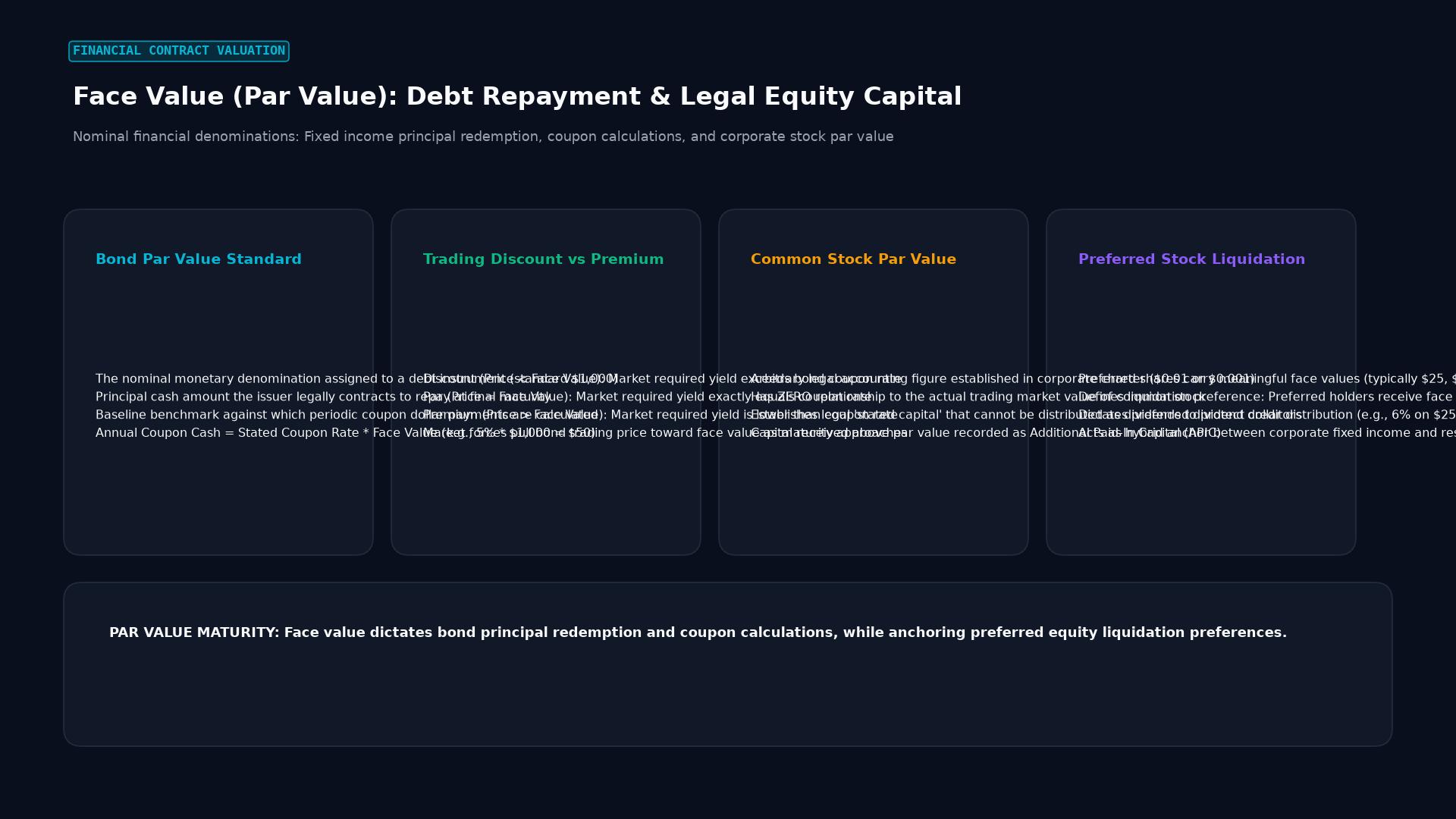 Figure: Nominal financial denominations: Fixed income principal redemption, coupon calculations, and corporate stock par value
Key Takeaways
- Bond Redemption Anchor: When a sovereign or corporate bond reaches maturity, the issuer must redeem the bond and return 100% of the face value to the investor.
- Coupon Calculation Basis: Annual interest payments are mathematically tied to face value, not current market price: $\text{Annual Coupon Payment} = \text{Coupon Rate} \times \text{Face Value}$.
- Market vs. Face Value Divergence: While face value is static throughout the security’s lifespan, secondary market prices fluctuate continuously based on prevailing central bank benchmark interest rates, credit rating shifts, and inflation expectations.
- Quotation Convention: Global bond markets quote prices as a percentage of face value (e.g., a bond quoted at “98.50” trades at 98.5% of par, or $985 per $1,000 face value).
Face Value vs. Market Value vs. Book Value
| Dimension | Face Value (Par Value) | Market Value | Book Value |
|---|---|---|---|
| Definition | Nominal statutory value set by the issuer | The live clearing price in secondary markets | The net accounting value on the balance sheet |
| Variability | Fixed and unchanging until redemption | Fluctuates second-by-second | Adjusted periodically per accounting standards |
| Determination | Issuer contractual agreement | Open market supply and demand forces | Historical cost minus accumulated depreciation |
| Stock Significance | Purely legal/accounting formality (e.g., $0.001) | Represents true market capitalization | Assets minus total corporate liabilities |
Bond Pricing Mechanics: Par, Premium, and Discount
Because bond coupons are fixed to face value at issuance, subsequent changes in market interest rates cause bond market prices to detach from par:
1. Trading at Par (Price = Face Value)
When a bond’s coupon rate exactly matches prevailing market interest rates for issuers of comparable credit risk, the bond trades at 100% of its face value ($P = \text{Par}$).
2. Trading at a Premium (Price > Face Value)
If the central bank lowers interest rates, newly issued bonds offer lower coupon yields. Existing older bonds paying higher historical coupons become highly sought after; investors bid up their market price above face value ($P > \text{Par}$).
- Yield to Maturity (YTM): The investor’s effective annual yield will be lower than the stated coupon rate because they paid a premium that amortizes down to face value at maturity.
3. Trading at a Discount (Price < Face Value)
If the central bank hikes interest rates aggressively, older bonds paying low coupons become unattractive. Their prices plunge below face value ($P < \text{Par}$).
- Yield to Maturity (YTM): The investor’s effective yield will be higher than the coupon rate because they receive periodic coupons plus capital appreciation from the discounted purchase price up to the full face value at maturity.
Zero-Coupon Bonds and Original Issue Discount (OID)
A unique application of face value occurs in Zero-Coupon Bonds (such as U.S. Treasury Bills):
- These securities pay zero periodic coupon interest.
- They are issued at a deep discount to face value (e.g., paying $950 for a 1-year Treasury Bill with a $1,000 face value).
- The investor’s entire return consists of the difference between the discounted purchase price and the full $1,000 face value repaid at maturity.
Frequently Asked Questions
Can a bond’s face value change during its life?
In standard fixed-rate bonds, face value remains fixed. However, in inflation-protected bonds—such as Treasury Inflation-Protected Securities (TIPS) in the U.S. or Index-Linked Gilts in the UK—the principal face value is adjusted semi-annually based on changes in the Consumer Price Index (CPI) to protect investors against inflation.
What is the standard face value of a corporate bond?
In institutional wholesale bond markets, the standard face value is typically $1,000 or $10,000 for U.S. corporate and municipal bonds. In the offshore Eurobond market, minimum face value denominations are typically higher, commonly $100,000 or €100,000, to prevent retail participation.
Does the face value of a common stock impact an investor’s returns?
No. For common stock shareholders, par value is irrelevant to investment returns. Dividends, capital appreciation, and corporate valuations are driven entirely by corporate earnings, cash flows, and free-market share prices.
Ready to trade forex?
Open a free demo account with a regulated broker. Practice with virtual funds before risking real money.