Fact Book
A fact book is a comprehensive statistical and reference publication containing systematically organized verified data about a specific subject, organization, industry, or country, designed as a definitive reference tool for researchers, investors, and policy analysts.
What Is a Fact Book?
In finance, investment research, and international affairs, a fact book (also spelled “factbook”) is a systematically compiled, periodically updated reference publication that organizes and presents verified statistical data, key metrics, and factual information about a defined subject — such as a specific country, an industry sector, a stock exchange, or a publicly traded corporation.
The term most commonly refers to two primary applications in financial and geopolitical research:
-
The World Factbook (CIA Publication): The flagship annual reference publication produced by the US Central Intelligence Agency, providing standardized socioeconomic, demographic, political, and geographic data for every recognized country, territory, and ocean on Earth — the definitive starting point for country-risk analysis used by international investment banks, sovereign debt analysts, and development finance institutions.
-
Exchange/Corporate Fact Books: Statistical annuals published by stock exchanges (e.g., NYSE Fact Book, Nasdaq FactBook) and investor relations departments, cataloging key trading volume statistics, listed company data, market capitalization figures, and performance metrics.
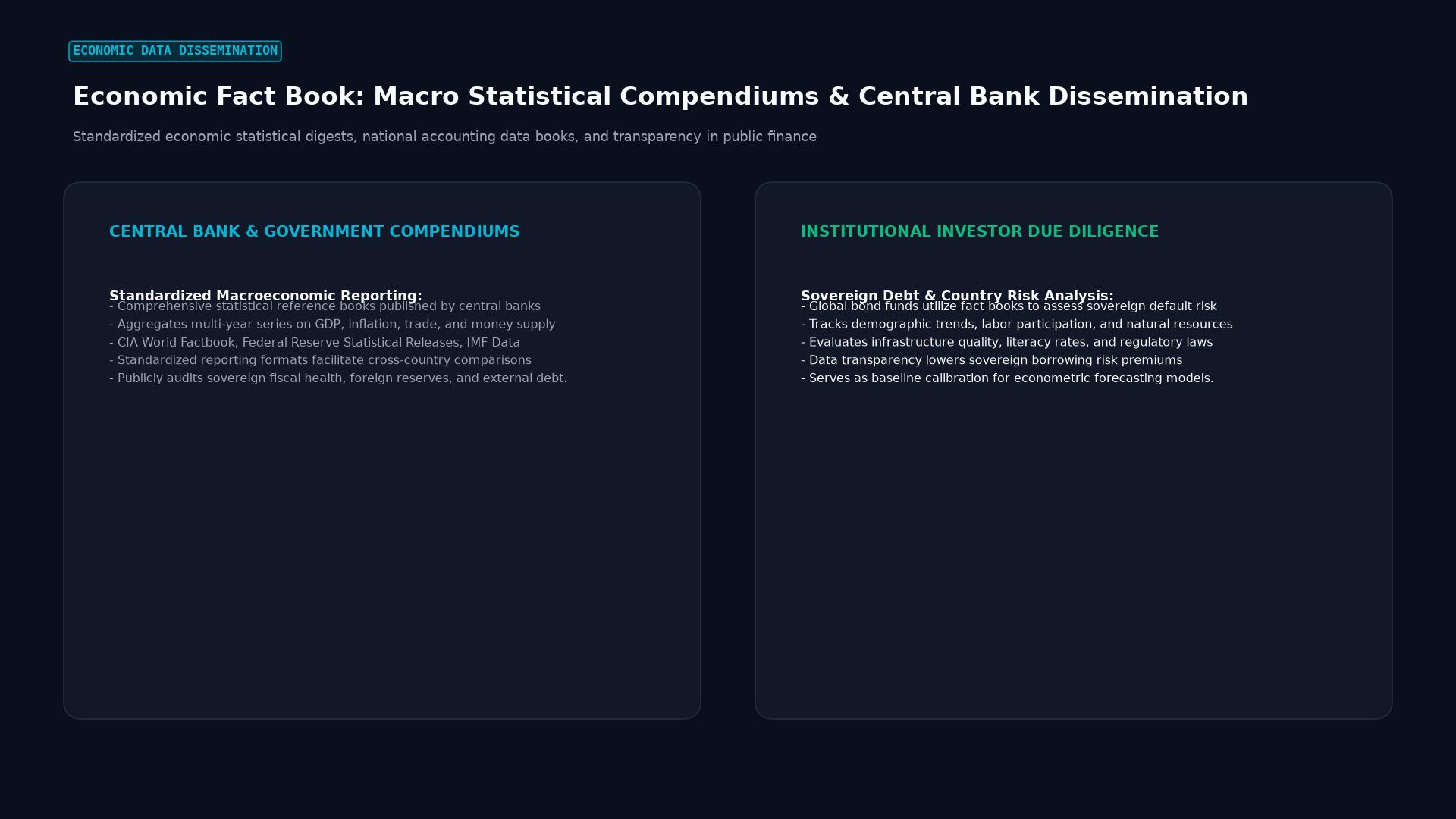 Figure: Standardized economic statistical digests, national accounting data books, and transparency in public finance
The CIA World Factbook: Institutional Financial Significance
The CIA World Factbook (available at www.cia.gov/the-world-factbook) functions as the primary geopolitical data source for:
Country Risk Assessment for Emerging Market Investment
Sovereign bond portfolio managers and direct equity investors in frontier and emerging markets utilize World Factbook GDP growth, public debt, and current account data as baseline inputs for:
$$\text{Country Risk Premium (CRP)} = \text{Sovereign Default Spread} + \text{Relative Equity Market Volatility Premium}$$
Trade Flow Analysis for Commodity Currency Models
Forex analysts constructing commodity-currency correlation models (USD/CAD vs. crude oil; AUD/USD vs. iron ore) use Factbook trade balance and export composition data to calibrate long-run equilibrium models.
Corporate IR Fact Books: Exchange-Listed Applications
| Fact Book Type | Publisher | Key Data Points | Primary User |
|---|---|---|---|
| CIA World Factbook | US Central Intelligence Agency | 250+ countries: GDP, debt, demographics, trade | Country risk analysts, EM investors |
| NYSE Fact Book | New York Stock Exchange | Market cap, trading volume, listed companies | Brokers, academic researchers |
| S&P 500 Fact Book | S&P Global | Index constituents, sector weights, returns | ETF managers, index fund investors |
| Corporate Investor Fact Sheet | Corporate IR Department | Revenue, employees, products, guidance | Retail investors, equity analysts |
Frequently Asked Questions (FAQ)
How often is the CIA World Factbook updated and how reliable is the data?
The CIA World Factbook is updated on a continuous rolling basis, with individual country profiles refreshed multiple times per year. Economic statistics are sourced from official government statistical agencies, international organizations (World Bank, IMF, UN Statistics Division), and verified CIA field research. Data reliability varies significantly by country — advanced economies (US, EU, Japan) report high-quality official statistics, while data from conflict zones, authoritarian regimes, or heavily sanctioned states (North Korea, Venezuela) may be estimated or significantly lagged.
What is the difference between a corporate Fact Book and an Annual Report?
A corporate Annual Report (Form 10-K) is a formal SEC-regulated legal document providing audited financial statements, risk disclosures, management discussion, and full footnotes as required by securities law. A corporate Fact Book is an informal, investor-relations-produced marketing supplement designed for quick reference — featuring graphical presentations of revenue trends, employee counts, product lines, and market share data in a visually accessible format, without the legal reporting obligations of an Annual Report.
Do forex and commodity traders regularly use country fact books in their analysis?
Yes, particularly for emerging market currencies and commodity-driven economies. Traders building models for currency pairs such as USD/BRL (US Dollar / Brazilian Real) or USD/ZAR (US Dollar / South African Rand) extensively reference World Factbook data on each country’s export composition, foreign exchange reserves-to-GDP ratio, current account deficit trends, and public debt-to-GDP trajectory — since these structural fundamentals drive the long-run purchasing power and creditworthiness of the respective currencies.
Ready to trade forex?
Open a free demo account with a regulated broker. Practice with virtual funds before risking real money.