Factor's Lien
A factor's lien is a statutory legal security interest that grants a factoring company the right to retain possession of and assert a priority claim against a client's accounts receivable, inventory, or other designated collateral assets until the factor has received full repayment of all outstanding advances, fees, and obligations.
What Is a Factor’s Lien?
In commercial secured lending and factoring law, a factor’s lien (also designated as a factor’s security interest) is a statutory legal claim created in favor of a factoring company, giving it a perfected, priority security interest in a client business’s accounts receivable, inventory, and other personal property collateral — allowing the factor to retain possession of or recover those assets if the client fails to repay outstanding advances or defaults on obligations.
The factor’s lien is the legal enforcement mechanism underlying the entire accounts receivable financing industry. Without a perfected lien, a factor advancing cash against invoices would be a general unsecured creditor in any bankruptcy — typically recovering cents on the dollar. A properly perfected factor’s lien elevates the factor to secured creditor status, dramatically improving recovery prospects.
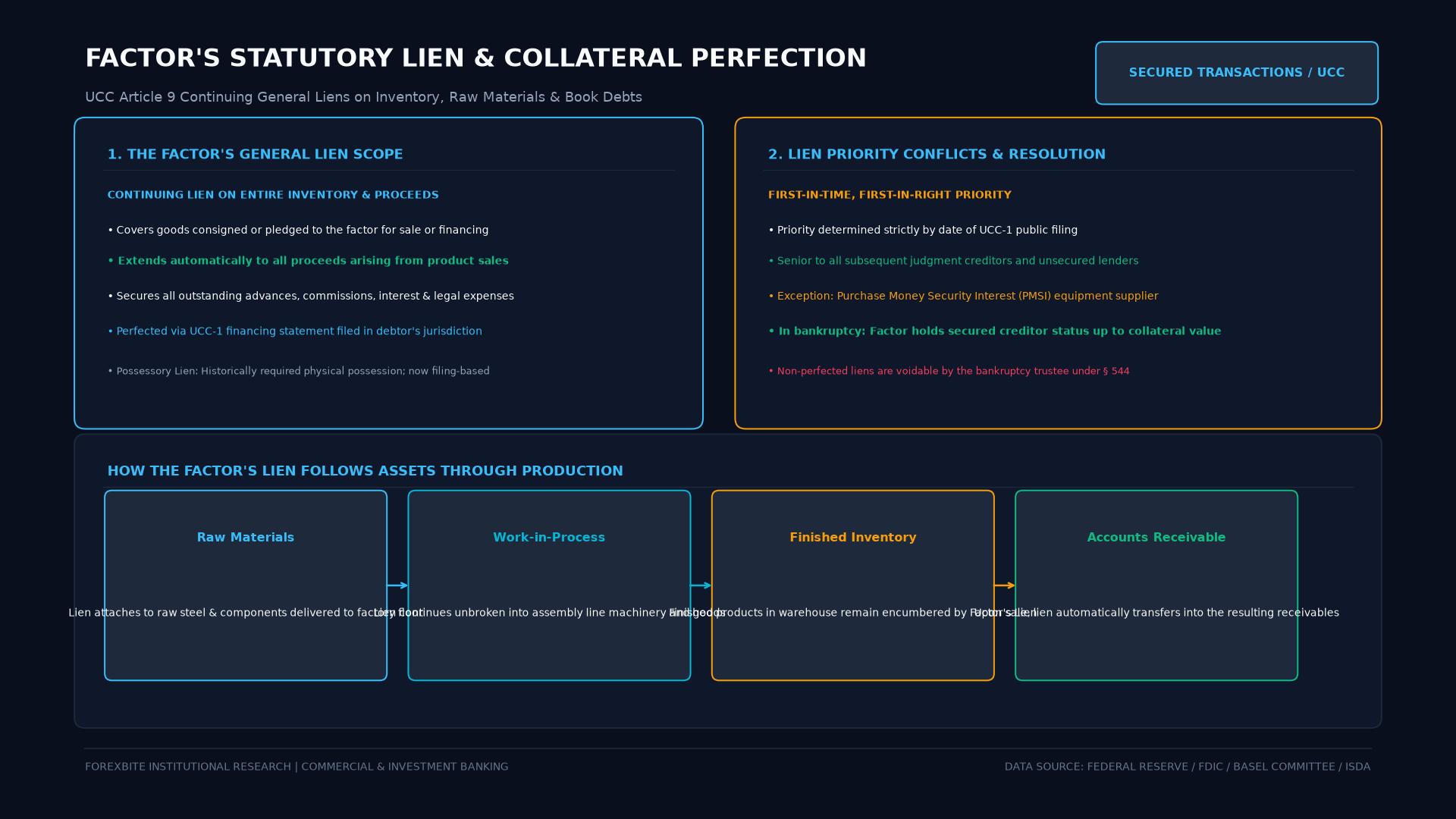 Figure: Comprehensive floating lien mechanics: blanket pledge of raw materials, work-in-progress, finished inventory, and resulting accounts receivable.
Legal Mechanics: UCC Article 9 Perfection
Under the Uniform Commercial Code (UCC) Article 9, which governs secured transactions across all US states, a factor perfects its lien through a multi-step process:
Step 1: Authenticate a Security Agreement
The client business signs a Security Agreement granting the factor a security interest in specifically described collateral: “all accounts receivable, chattel paper, instruments, and general intangibles now existing or hereafter arising.”
Step 2: Attachment
The security interest attaches (becomes enforceable between the parties) when:
- The client has signed an authenticated security agreement.
- The factor has provided value (advanced cash against the receivables).
- The client has rights in the collateral.
Step 3: Perfection via UCC-1 Filing
$$\text{Priority Date} = \text{UCC-1 Filing Timestamp in Secretary of State Records}$$
The factor files a UCC-1 Financing Statement in the appropriate state filing office (typically the Secretary of State where the debtor is incorporated). Filing creates public constructive notice to all subsequent creditors and establishes a priority date using the “first to file wins” rule.
Comparative Matrix: Secured Lender Priority
| Claim Type | Legal Basis | Priority Level | Recovery in Bankruptcy |
|---|---|---|---|
| Super-Priority DIP Financing | Bankruptcy Code § 364 | Highest | Near 100% (court-ordered) |
| First-Lien Secured Lender | UCC-1, Mortgage | Very High | Typically 80–95% |
| Factor’s Lien | UCC-1 (Article 9) | High (if first on AR) | 60–90% on AR collateral |
| Equipment Lessor | UCC-1 (chattel paper) | Medium | Recovers equipment value |
| General Unsecured | Contract / Trade payable | Lowest | Typically 5–30% recovery |
Real-World Case Study: Toys “R” Us Bankruptcy (2017)
The strategic importance of factor’s liens became painfully apparent during the Toys “R” Us Chapter 11 bankruptcy filing in September 2017.
The Factor's Lien Crisis in Retail Bankruptcy:
1. The Setup: Toys "R" Us owed hundreds of millions of dollars to toy manufacturers (Mattel, Hasbro, LEGO). These manufacturers had sold their products on 60 to 90-day open credit terms — effectively becoming unsecured creditors.
2. The Factor Protection Gap: Several smaller toy manufacturers had factored their Toys "R" Us receivables to factoring companies. Those factors held perfected UCC-1 liens on specific Toys "R" Us accounts payable.
3. The Bankruptcy Impact: When Toys "R" Us filed Chapter 11, general trade creditors (unsecured manufacturers) were immediately exposed to enormous loss. Factored receivables protected by valid factors' liens had legal priority to payment.
4. The Domino Effect: Alarmed factoring companies started reducing or eliminating credit lines for any retailer with weakening financials, starving the broader specialty retail sector of working capital and accelerating a wave of subsequent retail bankruptcies (Payless ShoeSource, Pier 1, Tuesday Morning).
Frequently Asked Questions (FAQ)
What is the difference between a “factor’s lien” and a bank’s security interest?
Functionally, both a factor’s lien and a bank’s security interest are UCC Article 9 perfected security interests in personal property collateral. The critical differences are: (1) Focus — a factor’s lien is specifically calibrated to accounts receivable and the proceeds thereof, while bank security interests often cover all business assets broadly; (2) Dynamic collateral — factor liens attach to a constantly changing, self-liquidating pool of receivables (old invoices are paid off as new invoices are generated), requiring specialized monitoring and advance rate calculations.
Can a factor’s lien survive if the client business files for bankruptcy?
Under US bankruptcy law (11 USC § 544), the bankruptcy trustee has the power to avoid (nullify) unperfected security interests. A properly perfected factor’s lien (via timely UCC-1 filing) survives bankruptcy and maintains its priority. An unperfected lien (e.g., where the factor failed to file or filed in the wrong jurisdiction) is avoidable by the bankruptcy trustee — converting the factor from a secured creditor to a general unsecured creditor with dramatically reduced recovery prospects.
What happens to a factor’s lien when the client’s customer (account debtor) pays the invoice?
When a customer pays a factored invoice directly to the factor, the payment proceeds are applied against the outstanding advance balance — releasing that portion of the lien. Most factoring agreements require account debtors to receive a Notice of Assignment — a formal written notification instructing customers to remit all future invoice payments directly to the factor’s lockbox account rather than to the original business — ensuring the factor receives the cash before the client can intercept it.
Ready to trade forex?
Open a free demo account with a regulated broker. Practice with virtual funds before risking real money.