Factory Orders
Factory Orders is a monthly macroeconomic indicator published by the U.S. Census Bureau that measures the total monetary value of new orders, shipments, unfilled backlogs, and inventories recorded by domestic industrial manufacturers.
What Are Factory Orders?
The Factory Orders report (officially titled the Manufacturers’ Shipments, Inventories, and Orders report) is a key monthly macroeconomic indicator released by the U.S. Census Bureau, a statistical division of the U.S. Department of Commerce. The report aggregates survey data from thousands of domestic manufacturing establishments across dozens of industrial sectors to measure the overall health, demand velocity, and output momentum of the industrial economy.
Unlike the earlier Durable Goods Orders report, which focuses exclusively on long-lasting manufactured items, Factory Orders provides a comprehensive snapshot by capturing new purchase contracts for both durable goods (items intended to last three years or longer, such as computers, aircraft, and heavy machinery) and nondurable goods (fast-moving consumables like packaged food, pharmaceuticals, and refined petroleum products).
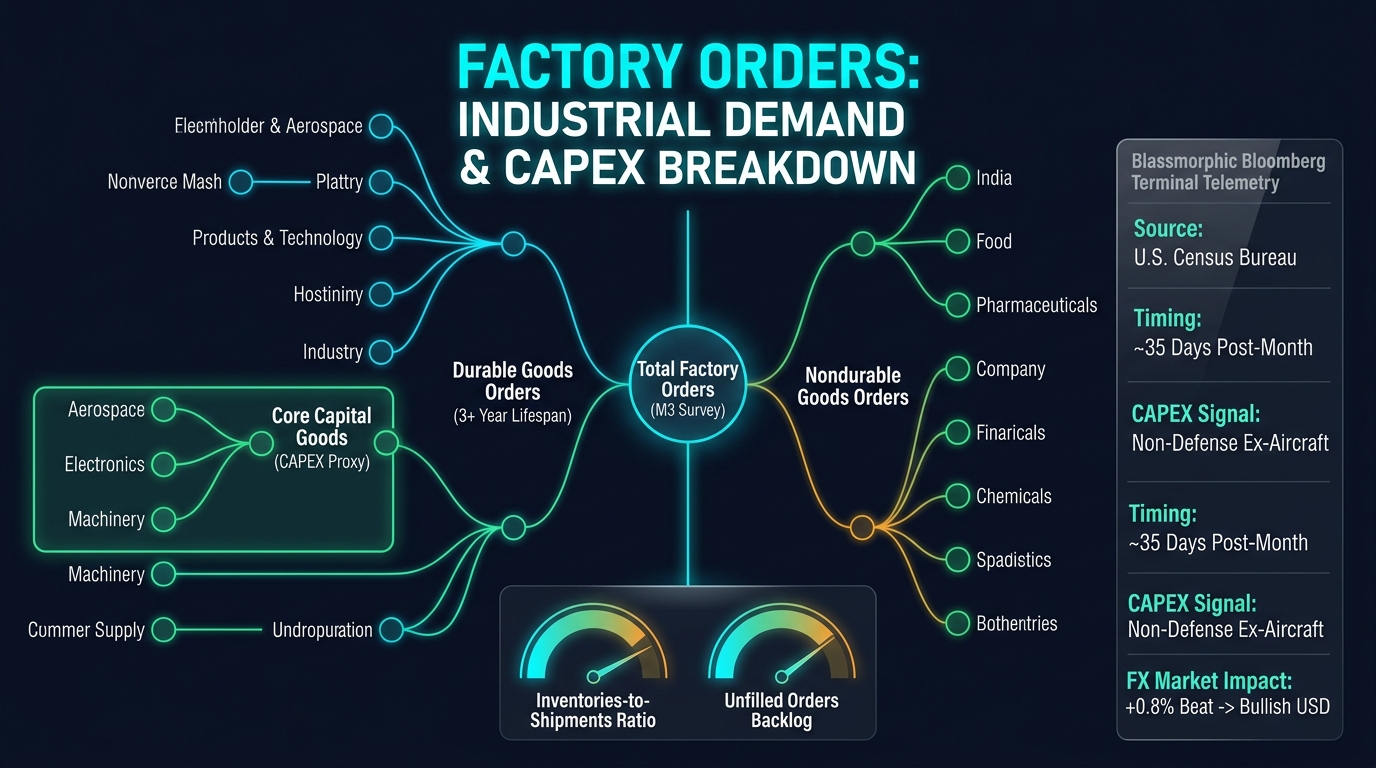
Structure of the U.S. Factory Orders Report:
┌────────────────────────────────────────────────────────┐
│                   TOTAL FACTORY ORDERS                 │
└──────────────────────────┬─────────────────────────────┘
                           │
       ┌───────────────────┴───────────────────┐
       ▼                                       ▼
┌──────────────────────────────┐ ┌──────────────────────────────┐
│     DURABLE GOODS ORDERS     │ │    NONDURABLE GOODS ORDERS   │
│  (Products lasting 3+ Years) │ │ (Consumables & Rapid Use)    │
├──────────────────────────────┤ ├──────────────────────────────┤
│ • Commercial & Defense Plns  │ │ • Food & Beverage products   │
│ • Automotive & Transportation│ │ • Petrochemicals & Fuel      │
│ • Computers & Electronics    │ │ • Pharmaceuticals & Medicine │
│ • CORE CAPITAL GOODS:        │ │ • Textiles & Paper products  │
│   Non-defense ex-aircraft    │ │                              │
│   (Business CAPEX benchmark) │ │ (Less volatile; short cycles)│
└──────────────────────────────┘ └──────────────────────────────┘
Key Takeaways
- Comprehensive Industrial Scope: Factory Orders covers both durable and nondurable manufacturing sectors, accounting for roughly half of total industrial activity.
- The Core Capital Goods Signal: Economists look beyond headline figures to Non-defense Capital Goods Excluding Aircraft—the most authoritative economic proxy for forward-looking corporate capital expenditure (CAPEX).
- Two-Stage Data Release: The Durable Goods portion is published as an advance estimate roughly one week prior; the full Factory Orders report provides critical revisions and completes the industrial picture.
- Forex Market Impact: Stronger-than-expected factory orders signal robust industrial production, bolstering economic growth forecasts and historically supporting the U.S. Dollar.
Factory Orders vs. Durable Goods vs. Industrial Production
| Economic Report | Publishing Bureau | Scope & Coverage | Release Timing | Market Volatility Impact |
|---|---|---|---|---|
| Durable Goods Orders | U.S. Census Bureau | New orders for goods designed to last 3+ years | ~26 days post-month-end | High: Primary market mover due to first-look status |
| Factory Orders | U.S. Census Bureau | Full manufacturing (Durable + Nondurable goods) | ~35 days post-month-end | Moderate: Often confirms or revises advance durable data |
| Industrial Production | Federal Reserve Board | Measures physical factory, mining, and utility output | Mid-month (~15th) | High: Directly feeds into quarterly GDP growth calculations |
Analytical Components Monitored by Desk Traders
Macro analysts analyze four internal metrics within the monthly Factory Orders release:
- New Orders: Measures forward demand. Expanding new orders signal increasing production schedules and hiring in upcoming quarters.
- Shipments: Reflects current economic revenue generated by manufacturers; directly inputs into the GDP calculation for private domestic investment.
- Unfilled Orders (Backlogs): A rising backlog indicates that factory capacity is strained, signaling potential supply-chain bottlenecks and emerging producer price inflation.
- Inventories-to-Shipments Ratio: High inventory ratios indicate unsold stock accumulating on factory floors, signaling that manufacturers may cut production and staff in subsequent months.
Impact on Foreign Exchange and Interest Rates
Foreign exchange traders evaluate Factory Orders through the lens of economic surprises:
$$\text{Factory Orders Surprise} = \text{Actual MoM % Change} - \text{Consensus Forecast}$$
- Upside Surprise (Bullish for USD): A reading substantially above consensus indicates that business investment remains resilient. Bond traders reprice higher terminal interest rates for the Federal Reserve, driving Treasury yields up and strengthening the U.S. Dollar against low-yielding currencies like EUR and JPY.
- Downside Miss (Bearish for USD): Consecutive negative prints indicate corporate retrenchment, weakening industrial activity, and rising recessionary probabilities, prompting institutional traders to price in dovish monetary policy easing.
Frequently Asked Questions
Why does the Durable Goods report cause more market volatility than Factory Orders?
Because the Advance Durable Goods report is published approximately one to two weeks before the full Factory Orders release. Financial markets price in fresh economic data instantaneously; by the time the full Factory Orders report arrives, traders have already discounted the durable component, reacting only if major data revisions are revealed.
What are “Nondurable Goods”?
Nondurable goods are defined by economists as tangible products whose economic lifespan is less than three years. Common examples include packaged foods, livestock feed, clothing, chemical solvents, plastics, and petroleum products. Demand for nondurables is generally stable and non-cyclical compared to expensive durable machinery.
How does the ISM Manufacturing PMI correlate with Factory Orders?
The ISM Manufacturing Index is a soft-data survey tracking purchasing managers’ sentiment, released on the first business day of the month. Factory Orders is hard, empirical accounting data released a month later. Traders use the ISM report as a leading indicator to forecast whether upcoming Factory Orders figures will beat or miss market expectations.
Ready to trade forex?
Open a free demo account with a regulated broker. Practice with virtual funds before risking real money.