Fair Price
In financial markets and derivatives trading, fair price (theoretical fair value) is the equilibrium price of an asset, commodity, or futures contract at which supply matches demand and no riskless cash-and-carry arbitrage opportunities exist, calculated via the cost-of-carry model.
What Is Fair Price in Financial Markets?
In securities trading, financial engineering, and derivatives markets, fair price (often referred to as theoretical fair value) represents the calculated mathematical price at which an asset, currency pair, or derivative contract should trade in a frictionless, efficient market.
While spot market prices are determined in real-time by continuous order flow on central limit order books, derivative instruments—such as equity index futures, currency forward contracts, and commodity swaps—derive their economic price from an underlying asset. The fair price of a futures contract is the exact price that balances the cost of holding the physical or spot asset against purchasing a future delivery contract, eliminating riskless profit opportunities through cash-and-carry arbitrage.
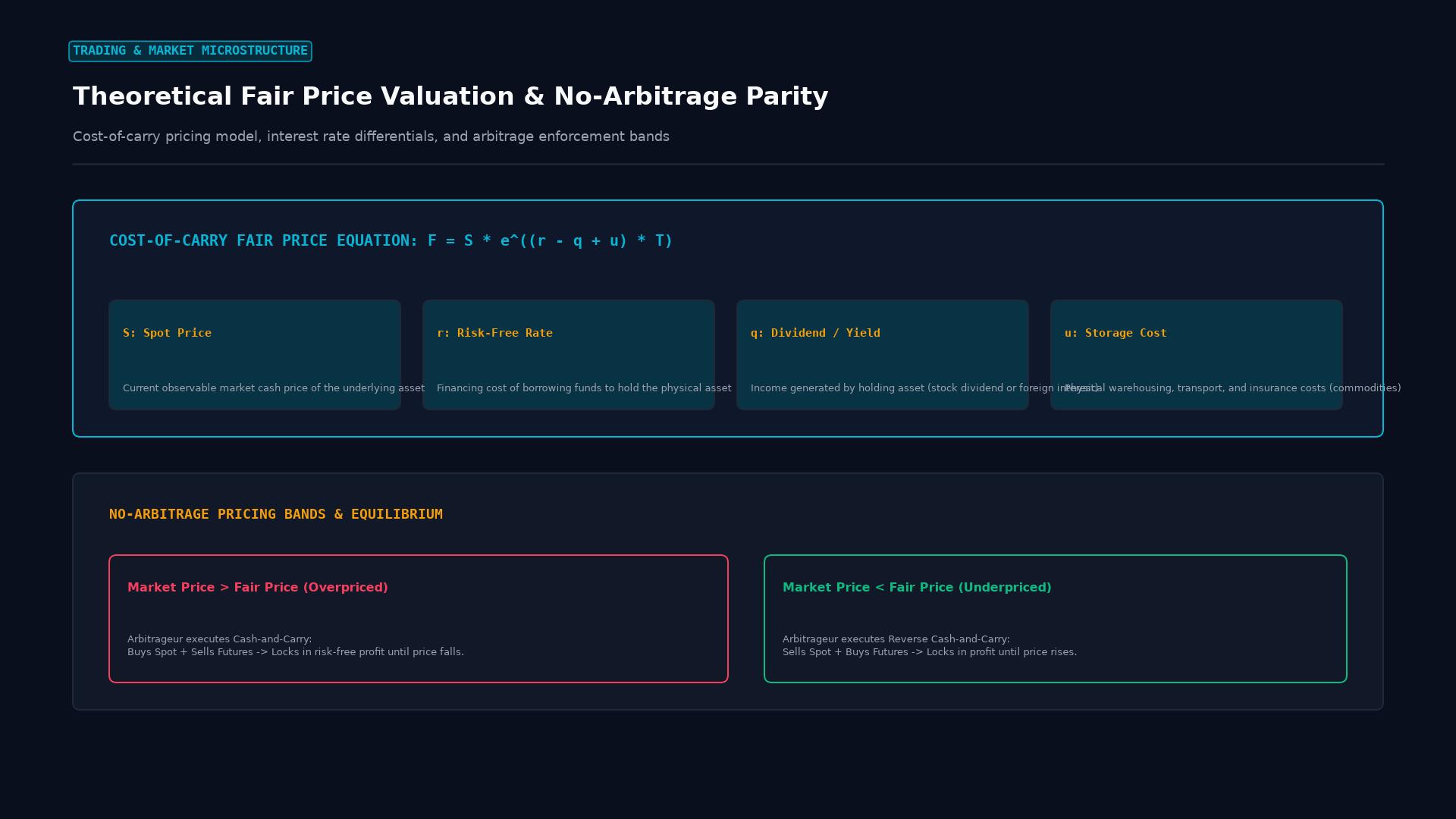 Figure: Derivative fair value pricing based on the cost-of-carry model: spot prices compounded by interest, storage, and dividends, bound by cash-and-carry arbitrage bands.
Technical Mechanics & Valuation Formulas
The standard benchmark for determining the fair price of forward and futures contracts is the Cost-of-Carry Model:
1. Equity Index Futures Fair Price
For a financial equity index (such as the S&P 500 or FTSE 100), the futures fair price accounts for financing costs and anticipated dividend yields:
$$F^* = S_0 e^{(r - q)T}$$
Where:
- $F^*$ = Theoretical Fair Price of the futures contract
- $S_0$ = Current spot index price
- $r$ = Continuously compounded risk-free interest rate
- $q$ = Annualized continuous dividend yield of the index constituents
- $T$ = Time to contract maturity (in years)
2. Commodity Futures Fair Price
For physical commodities (crude oil, gold, agricultural products), physical carrying costs and convenience yields are integrated:
$$F^* = S_0 e^{(r + u - y)T}$$
Where:
- $u$ = Storage, insurance, and warehouse delivery costs (as a percentage)
- $y$ = Convenience yield (the economic benefit of physically holding physical inventory during shortages)
3. The Arbitrage Band
In liquid electronic exchanges, transaction costs and borrowing fees establish a boundary around fair price: $$\text{Lower Bound} \le \text{Market Futures Price} \le \text{Upper Bound}$$ If market prices breach these boundaries:
- Above Upper Bound ($F > F^*$): Arbitrageurs execute a Cash-and-Carry Arbitrage (borrow cash, buy spot stock, sell overpriced futures).
- Below Lower Bound ($F < F^*$): Arbitrageurs execute a Reverse Cash-and-Carry Arbitrage (short spot stock, invest proceeds, buy underpriced futures).
Comparative Matrix: Pricing Concepts in Finance
| Valuation Metric | Formula / Source | Market Role | Influenced By | Speed of Adjustment |
|---|---|---|---|---|
| Fair Price (Futures) | $F^* = S_0 e^{(r - q)T}$ | Baseline benchmark for derivative valuation | Interest rates, dividend yield, time decay | Milliseconds (algorithmic arbitrage) |
| Market Price | Last executed trade | Actual transaction price executed | Order book liquidity, immediate demand | Real-time tick-by-tick |
| Fair Market Value (FMV) | Willing buyer / willing seller assessment | Asset appraisal and taxation standard | Independent valuation, comparable sales | Periodic (appraisals, quarterly) |
| Book Value | Total Assets minus Total Liabilities | Historical accounting balance sheet equity | Depreciation, historical purchase cost | Quarterly accounting cycles |
Real-World Case Study: Morning “Fair Value” Indicators on Wall Street
Every morning before the New York Stock Exchange opens at 9:30 AM EST, financial news networks report whether index futures are trading “above” or “below” fair value:
- The Spot & Futures Setup: At 8:30 AM, the S&P 500 cash index closed the previous day at 5,000.00. The risk-free 3-month Treasury bill rate is 5.00%, the index dividend yield is 1.50%, and 30 days ($T = 30/365 = 0.0822$) remain until futures expiration.
- Calculating Fair Value: $$F^* = 5,000 \times e^{(0.050 - 0.015) \times 0.0822} = 5,000 \times e^{0.002877} \approx \mathbf{5,014.39}$$ The theoretical fair price of the futures contract is 5,014.39 (a +14.39 point premium over cash).
- Interpreting the Market Spread: If the active S&P 500 E-mini futures contract is trading at 5,030.00, it is trading +15.61 points above fair value.
- Market Implication: Institutional market-making algorithms interpret this premium as strong net institutional buying interest, indicating the cash stock market will open higher at the opening bell.
Frequently Asked Questions (FAQ)
What does “trading above fair value” mean for retail investors?
When a futures contract trades above fair value, it indicates that current pre-market speculative sentiment is bullish relative to yesterday’s cash close, signaling that the underlying stock market will likely open higher to close the gap.
Why do futures trade at a discount to fair value?
Futures trade at a discount to fair value when markets price in negative geopolitical developments, impending unexpected interest rate hikes, or corporate dividend announcements that reduce forward contract expectations.
How does high interest rate policy affect fair price?
Higher benchmark central bank interest rates increase the financing cost ($r$) in the cost-of-carry formula, expanding the spread between the spot price and the theoretical fair price of futures contracts (widening contango).
Ready to trade forex?
Open a free demo account with a regulated broker. Practice with virtual funds before risking real money.