Fair Rate of Return
In public utility regulation and infrastructure economics, the fair rate of return is the legally sanctioned percentage return that a government regulatory commission permits a regulated utility monopoly to earn on its invested capital (rate base) to maintain financial solvency and attract capital while safeguarding consumer tariffs.
What Is a Fair Rate of Return?
In public utility regulation, infrastructure finance, and administrative law, the fair rate of return is the maximum allowable percentage yield that regulatory oversight commissions (such as the Federal Energy Regulatory Commission [FERC] or state Public Utility Commissions [PUCs]) permit a regulated natural monopoly—such as an electricity grid operator, natural gas pipeline, or municipal water utility—to earn on its net capital investments.
Because natural monopolies operate with high barriers to entry and lack direct market competition, free-market pricing would lead to excessive monopoly profits. Conversely, setting prices too low would starve utilities of the capital required to maintain infrastructure, upgrade power grids, and replace aging pipelines.
A fair rate of return strikes an economic balance: it allows the utility company to generate sufficient revenue to cover operating expenses, service its debt, and provide a competitive dividend to equity shareholders commensurate with the company’s operating risk.
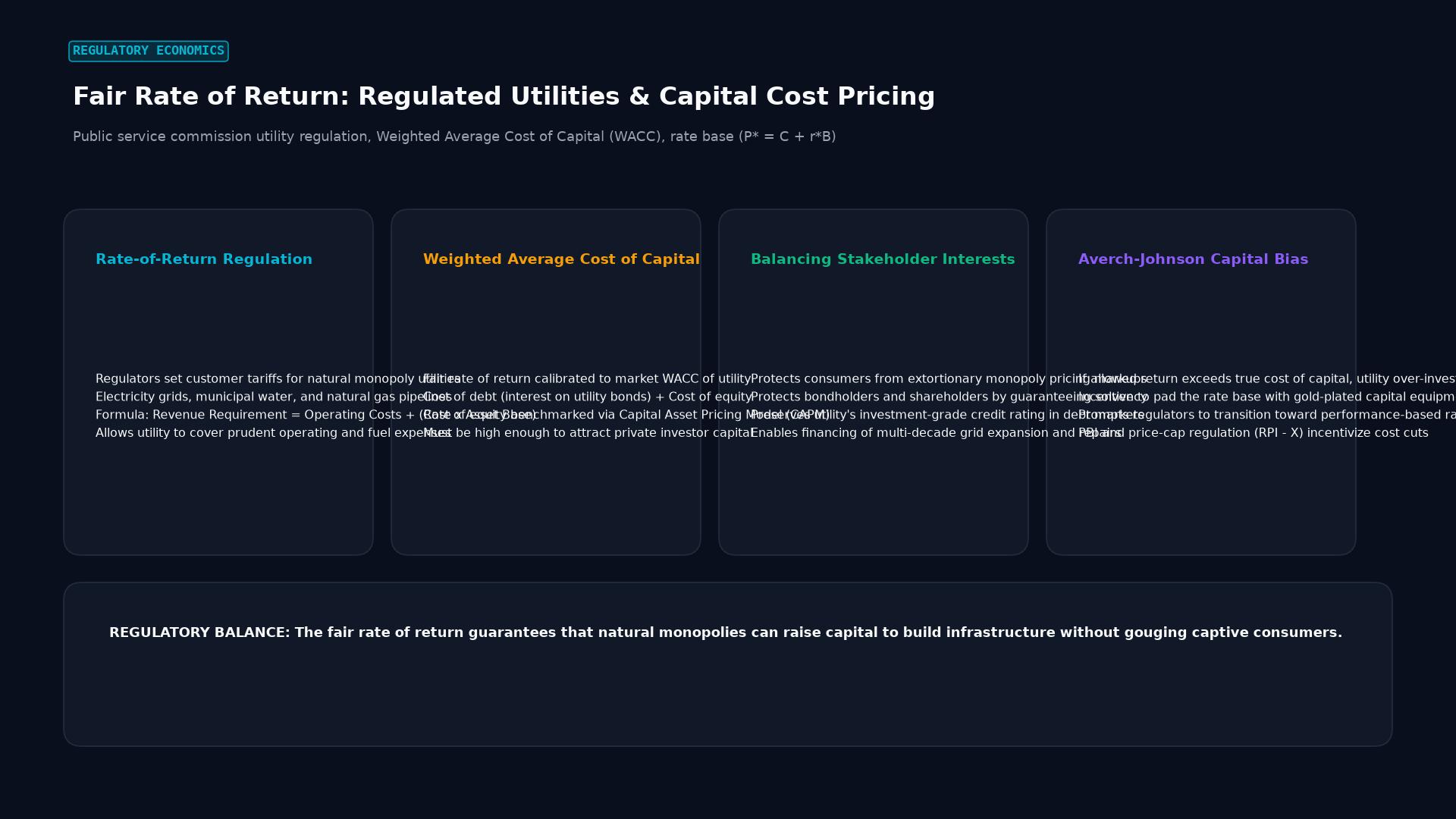 Figure: Public service commission utility regulation, Weighted Average Cost of Capital (WACC), rate base (P = C + rB)
Technical Mechanics & Legal Precedent
Under constitutional jurisprudence in the United States, the determination of a fair rate of return is governed by two landmark US Supreme Court rulings:
- Bluefield Water Works & Improvement Co. v. Public Service Commission (1923): Established that a utility is entitled to earn a return equal to that generally being made on investments in other business undertakings with corresponding risks.
- FPC v. Hope Natural Gas Co. (1944): Affirmed the “end-result doctrine”—the crucial test is not the valuation formula used, but whether the allowed rate of return enables the company to maintain financial integrity, preserve credit ratings, and attract long-term investment capital.
Weighted Average Cost of Capital (WACC) Calculation
The fair rate of return ($r$) is determined using the utility’s capital structure:
$$r = w_d \cdot r_d \cdot (1 - \tau) + w_e \cdot r_e$$
Where:
- $w_d, w_e$ = Weights of long-term debt and common equity in the approved capital structure
- $r_d$ = Embedded cost of corporate debt
- $\tau$ = Effective marginal corporate tax rate
- $r_e$ = Allowed Return on Equity (ROE), calculated via the Capital Asset Pricing Model (CAPM): $$r_e = R_f + \beta (R_m - R_f)$$
Comparative Matrix: Utility Regulatory Frameworks
| Regulatory Model | Return Determination | Incentive Structure | Consumer Protection | Risk Allocation |
|---|---|---|---|---|
| Cost-of-Service (Fair Return) | Cost of capital applied to verified rate base | Encourages infrastructure investment (Gold-plating risk) | Strong tariff stability and transparent hearings | Regulatory risk borne by consumers |
| Performance-Based Regulation (PBR) | Tied to reliability, efficiency, and carbon metrics | Incentivizes technological innovation and cost cutting | Shared financial savings between utility and ratepayers | Balanced risk sharing |
| Price-Cap Regulation (RPI - X) | Price increases indexed to inflation minus expected efficiency gains | Maximizes aggressive cost reduction | High risk of deferred maintenance | Operating risk borne entirely by utility |
| Deregulated Market | Market-clearing price via wholesale auction | Market-driven supply response | Subject to extreme wholesale volatility (e.g., ERCOT spikes) | Market risk borne by investors |
Real-World Case Study: Regulating a $3 Billion Power Grid Modernization
In 2024, a major investor-owned electric utility in the eastern United States filed a comprehensive rate case with its state Public Utility Commission to recover the costs of a $3.0 billion smart-grid transmission upgrade:
- Rate Base Audit: The commission audited the utility’s capital expenditures, disallowing $150 million in cost overruns as imprudent, establishing a verified Net Rate Base ($B$) of $2.85 billion.
- Cost of Capital Analysis: The utility requested an allowed ROE of 10.50%. Ratepayer advocacy groups argued that low market risk warranted 8.75%.
- Commission Ruling: The Commission settled on an authorized ROE of 9.60% with a capital structure of 50% debt (at 4.80% cost) and 50% equity. $$r = (0.50 \times 4.80%) + (0.50 \times 9.60%) = 2.40% + 4.80% = \mathbf{7.20%}$$
- Consumer Impact: The approved 7.20% fair rate of return provided the utility with $205.2 million in annual net return on its rate base, securing an ‘A-’ credit rating from S&P while limiting average household electricity bill increases to $4.15 per month.
Frequently Asked Questions (FAQ)
What happens if a utility earns more than its fair rate of return?
Under traditional rate-making statutes, if a utility earns in excess of its allowed return due to unforeseen volume increases or weather anomalies, the commission may trigger an earnings sharing mechanism (ESM), refunding excess profits to consumers through bill credits.
What is the “Averch-Johnson Effect”?
The Averch-Johnson Effect is an economic phenomenon where a regulated utility whose allowed fair rate of return exceeds its actual cost of capital has a perverse incentive to over-invest in physical capital assets (“gold-plating” the rate base) rather than adopting more cost-effective operational solutions.
Why does a higher fair rate of return matter to equity investors?
A higher authorized Return on Equity (ROE) directly increases a utility’s earnings per share (EPS) and dividend-paying capacity, driving institutional inflows into utility stocks from pension funds and income-oriented portfolios.
Ready to trade forex?
Open a free demo account with a regulated broker. Practice with virtual funds before risking real money.