Fair Rental Value Coverage
In property insurance and real estate investment, fair rental value coverage (Coverage D) is an essential policy provision that indemnifies a landlord for lost gross rental revenue while a tenant-occupied property undergoes repair following damage from a covered peril, minus any non-continuing operational expenses.
What Is Fair Rental Value Coverage?
In real estate underwriting, landlord risk management, and property insurance, fair rental value coverage (classified under standard Insurance Services Office [ISO] forms as Coverage D) is an insurance benefit that protects property investors from cash flow insolvency when a rental dwelling is rendered uninhabitable by a covered hazard, such as fire, lightning, windstorm, or plumbing rupture.
When a residential apartment or commercial building suffers structural damage, tenants are legally entitled to abate rent and vacate the premises until the property is restored to habitable condition under municipal building codes. Without fair rental value insurance, a landlord must continue paying mortgage debt service, property taxes, and insurance premiums out of pocket without incoming rent.
Fair rental value coverage steps in to replace that lost income stream for the duration of the reconstruction period, maintaining the landlord’s debt service coverage ratio (DSCR) and preventing loan default.
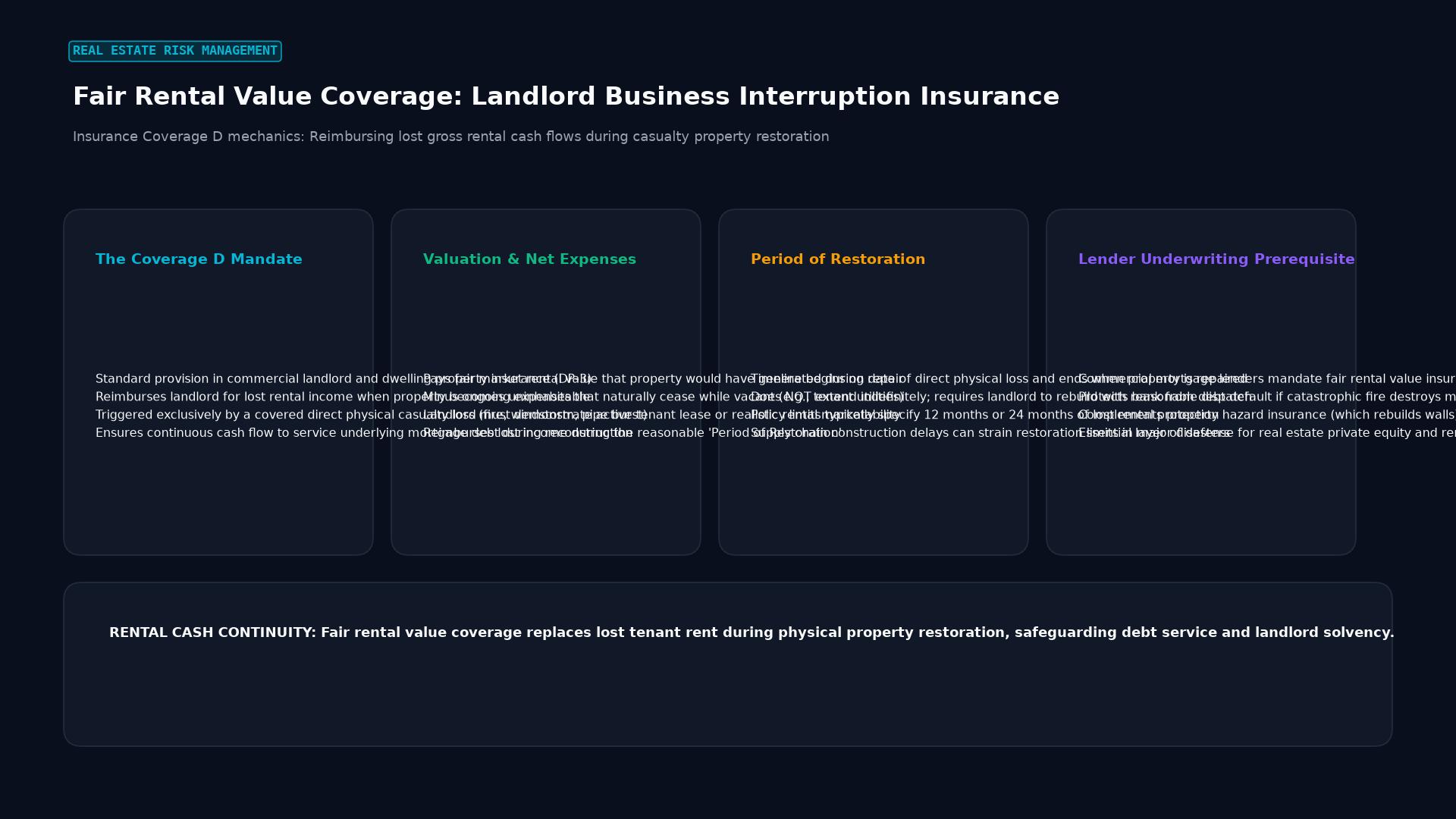 Figure: Insurance Coverage D mechanics: Reimbursing lost gross rental cash flows during casualty property restoration
Technical Mechanics & Claim Calculations
Under standard DP-3 (Dwelling Property) and ISO commercial property contracts, fair rental value reimbursement is calculated using the following legal principles:
1. Net Indemnity Formula
$$\text{Reimbursement Payout} = \text{Gross Fair Market Rent} - \text{Discontinued Operating Expenses}$$
Where:
- Gross Fair Market Rent is substantiated by existing written leases or, in the case of a vacant unit undergoing active marketing, local comparable market rents.
- Discontinued Operating Expenses include utility costs, common area cleaning, and maintenance services that temporarily cease during the rebuild period.
2. Time-Element Limits
Most policies limit reimbursement to the reasonable time required to repair or replace the damaged dwelling, or to a maximum duration (typically 12 to 24 consecutive months). In residential homeowner policies (HO-3), Coverage D is commonly capped at 10% to 20% of the dwelling’s total replacement cost limit (Coverage A).
Comparative Matrix: Loss of Income Coverages
| Policy Form | Target Policyholder | Coverage Scope | Primary Payout Basis | Example Peril Covered |
|---|---|---|---|---|
| Fair Rental Value (Coverage D) | Landlord / Real Estate Investor | Replaces lost tenant rent while uninhabitable | Gross contract rent minus non-continuing costs | Fire damage to leased duplex |
| Additional Living Expense (ALE) | Owner-Occupant Homeowner | Reimburses hotel, restaurant, and relocation expenses | Incremental living costs above normal budget | Furnace explosion in primary residence |
| Business Interruption (BI) | Commercial Operating Enterprise | Replaces lost net business income and payroll | Historical net profit plus ongoing fixed costs | Factory shutdown due to tornado |
| Rent Guarantee Insurance | Landlord | Protects against tenant non-payment/eviction | Defaulted monthly tenant rent | Tenant job loss and refusal to pay |
Real-World Case Study: 4-Unit Multifamily Property Fire
An investor owned a four-plex residential property in Chicago generating $2,200 per unit in monthly rent ($8,800 total monthly gross income). The property carried a DP-3 landlord policy with $800,000 in dwelling coverage and Fair Rental Value coverage capped at $160,000 (20% of Coverage A).
- The Peril: In December, a second-floor pipe burst, causing extensive water damage across two upper units and short-circuiting electrical lines, rendering two of the four units legally uninhabitable.
- The Rent Abatement: Two tenant families evacuated to alternative housing, legally abating their $4,400 monthly rent.
- The Expense Adjustment: The insurance adjuster verified that owner-paid water and gas bills dropped by $400 per month during vacancy, resulting in an eligible claim of $4,000 per month.
- The Settlement: Reconstruction and structural dry-out required six months. The insurer issued monthly indemnity checks totaling $24,000, enabling the investor to service the property’s $5,100 monthly mortgage payment on time without tapping emergency reserves.
Frequently Asked Questions (FAQ)
Does fair rental value cover rent loss if a tenant simply defaults or gets evicted?
No. Fair rental value coverage only applies when the physical structure is damaged and made uninhabitable by a covered insurance peril (such as fire, storm, or flood if endorsed). Tenant defaults and eviction disputes require separate Rent Guarantee Insurance.
Can an owner collect fair rental value if the apartment was vacant when the fire occurred?
Yes, provided the landlord can document that the unit was being actively marketed for rent at fair market rates prior to the disaster. If the property was permanently abandoned or condemned prior to the event, the claim will be denied.
What are non-continuing expenses?
Non-continuing expenses are operational costs that the landlord stops incurring while the building is empty, such as tenant utilities, commercial laundry servicing, or unit-specific pest control. These savings are subtracted from the gross rental payout to prevent the insured from profiting from the loss.
Ready to trade forex?
Open a free demo account with a regulated broker. Practice with virtual funds before risking real money.