FairTax
The FairTax is a sweeping United States fiscal legislative proposal designed to abolish all federal individual income taxes, corporate income taxes, payroll taxes, capital gains taxes, and estate taxes, replacing them with a single national retail sales tax on personal consumption combined with a universal monthly rebate ('prebate') to exempt spending up to the poverty level.
What Is the FairTax Proposal?
In macroeconomics, public finance, and taxation policy, the FairTax (introduced in the United States Congress as the Fair Tax Act) is a proposal to overhaul the federal revenue system. The plan advocates for the complete repeal of the 16th Amendment, the abolition of the Internal Revenue Service (IRS), and the elimination of:
- Personal federal income taxes
- Corporate income taxes
- Payroll taxes (Social Security and Medicare FICA contributions)
- Capital gains taxes
- Gift and estate (“death”) taxes
In their place, the FairTax institutes a single, uniform National Retail Sales Tax (NRST) collected exclusively at the point of final retail purchase for all new goods and services. Used goods (such as secondary home sales or used cars) and business-to-business wholesale inputs are exempt to prevent cascading tax burdens.
To prevent the consumption tax from being regressive to lower-income households, the FairTax features a universal monthly cash payment known as the “prebate”, which effectively reimburses every legal household for the sales tax paid on necessities up to the Department of Health and Human Services (HHS) federal poverty guideline.
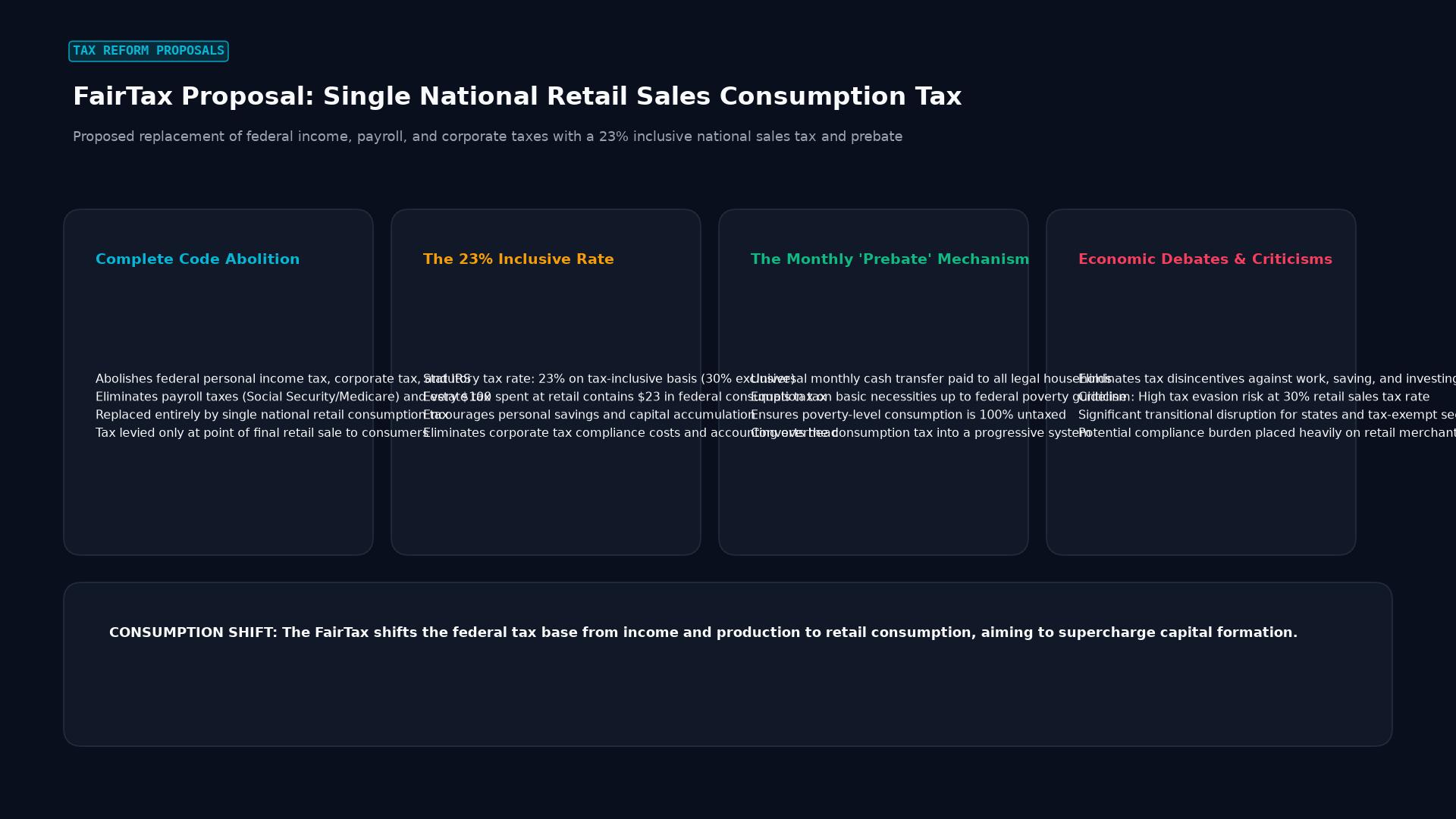 Figure: Proposed replacement of federal income, payroll, and corporate taxes with a 23% inclusive national sales tax and prebate
Technical Mechanics: Inclusive vs. Exclusive Tax Rates
A primary debate surrounding the FairTax centers on how its statutory rate is quoted:
1. Inclusive vs. Exclusive Mathematics
Under the legislation, the headline rate is quoted as 23% on a tax-inclusive basis, matching how income tax rates are traditionally communicated:
- Tax-Inclusive: If an item costs $100 at the cash register, $23 represents federal sales tax and $77 represents the pre-tax merchant price ($23 / 100 = 23%$).
- Tax-Exclusive: In traditional state sales tax terms, an item priced on the shelf at $77 incurs $23 in sales tax, representing a 29.87% tax-exclusive rate ($23 / 77 \approx 29.87%$).
$$\text{Rate}{\text{exclusive}} = \frac{\text{Rate}{\text{inclusive}}}{1 - \text{Rate}_{\text{inclusive}}} = \frac{0.23}{1 - 0.23} = 29.87%$$
2. The Monthly Prebate Calculation
For a family of four with an official poverty threshold of $31,200: $$\text{Annual Prebate} = $31,200 \times 23% = $7,176$$ $$\text{Monthly Prebate Check} = \frac{$7,176}{12} = $598.00$$
Every dollar spent up to $31,200 is effectively untaxed, providing a progressive rebate buffer.
Comparative Matrix: Major Tax Reform Frameworks
| Taxation System | Tax Base | Treatment of Savings & Investment | Administrative Mechanism | Impact on Capital Formation |
|---|---|---|---|---|
| FairTax (NRST) | Final personal retail consumption only | 100% tax-free (no capital gains or dividend tax) | State retail sales tax authorities + monthly prebate | Highly positive (maximum incentive to save) |
| Current US Income Tax | Global income (wages, corporate, capital gains) | Double taxation of dividends and capital gains | IRS filing of individual/corporate tax forms | Moderate (penalizes savings through capital gains tax) |
| Flat Tax (Hall-Rabushka) | Wage income + business cash flow | Investment expensed immediately; dividends untaxed | Simplified postcard IRS tax return | Positive |
| Value-Added Tax (VAT) | Value added at each stage of production | Varies by country; usually combined with income tax | Multi-stage invoicing across supply chains | Moderate to positive |
Real-World Economic Case Study: Border Adjustability & Global Trade
Proponents of the FairTax, including economists from the National Bureau of Economic Research (NBER), emphasize its potential impact on international competitiveness:
- Elimination of Embedded Taxes: Under the current system, US-manufactured goods bear an estimated 15% to 22% embedded tax cost (corporate taxes, employer payroll taxes, legal compliance) incorporated into factory-gate export prices.
- Border-Adjusted Consumption: Under the FairTax, exports leaving US ports are not sold at domestic retail, meaning they leave the country 100% tax-free.
- Equalization of Imports: Foreign imports entering the US (such as electronics or automobiles) face the identical 23% national retail sales tax at checkout as domestic goods, ending the competitive tax advantage historically enjoyed by foreign manufacturers operating under VAT refund regimes.
Frequently Asked Questions (FAQ)
Would the FairTax cause prices to jump by 23% to 30% immediately?
Not necessarily. While the sales tax is added at checkout, the elimination of employer payroll taxes, corporate income taxes, and compliance overhead reduces the wholesale production cost of domestic goods, offsetting much of the consumer price increase at the retail shelf.
What prevents black-market tax evasion under the FairTax?
Because the tax is collected only at the final retail register, compliance relies on auditing retail commercial merchants rather than 150 million individual workers. Retailers are given a 0.25% administrative fee deduction from collected taxes as an incentive for timely reporting.
How does the FairTax fund Social Security and Medicare?
The FairTax statutory revenues are legally ear-marked by formula: a dedicated statutory percentage of every collected dollar is automatically credited to the Social Security and Medicare Trust Funds, eliminating the need for separate payroll deductions.
Ready to trade forex?
Open a free demo account with a regulated broker. Practice with virtual funds before risking real money.