Fair Trade
In international development economics and global commodity trade, Fair Trade is an institutional certification system and commercial model designed to secure fair economic terms, guaranteed price floors, and community development premiums for smallholder agricultural producers in developing nations, protecting them from predatory intermediaries and global commodity price shocks.
What Is Fair Trade?
In international economics, developmental policy, and ethical supply chain management, Fair Trade refers to an institutional trading partnership and certification framework that promotes greater equity in international trade.
In conventional global agricultural supply chains (particularly coffee, cocoa, tea, sugar, and cotton), millions of smallholder farmers in developing nations face extreme price volatility on global commodity exchanges (such as the ICE Futures US exchange), monopolistic local middlemen (“coyotes”), and asymmetric information. When global futures prices plunge below production costs, farmers face debt spirals, child labor pressures, and land abandonment.
Fair Trade standards establish structural market interventions: a guaranteed Fairtrade Minimum Price acting as a safety net during market crashes, an additional Fairtrade Social Premium paid directly to producer cooperatives for democratic community investment, direct long-term commercial contracts, and rigorous environmental prohibitions against hazardous agrochemicals and deforestation.
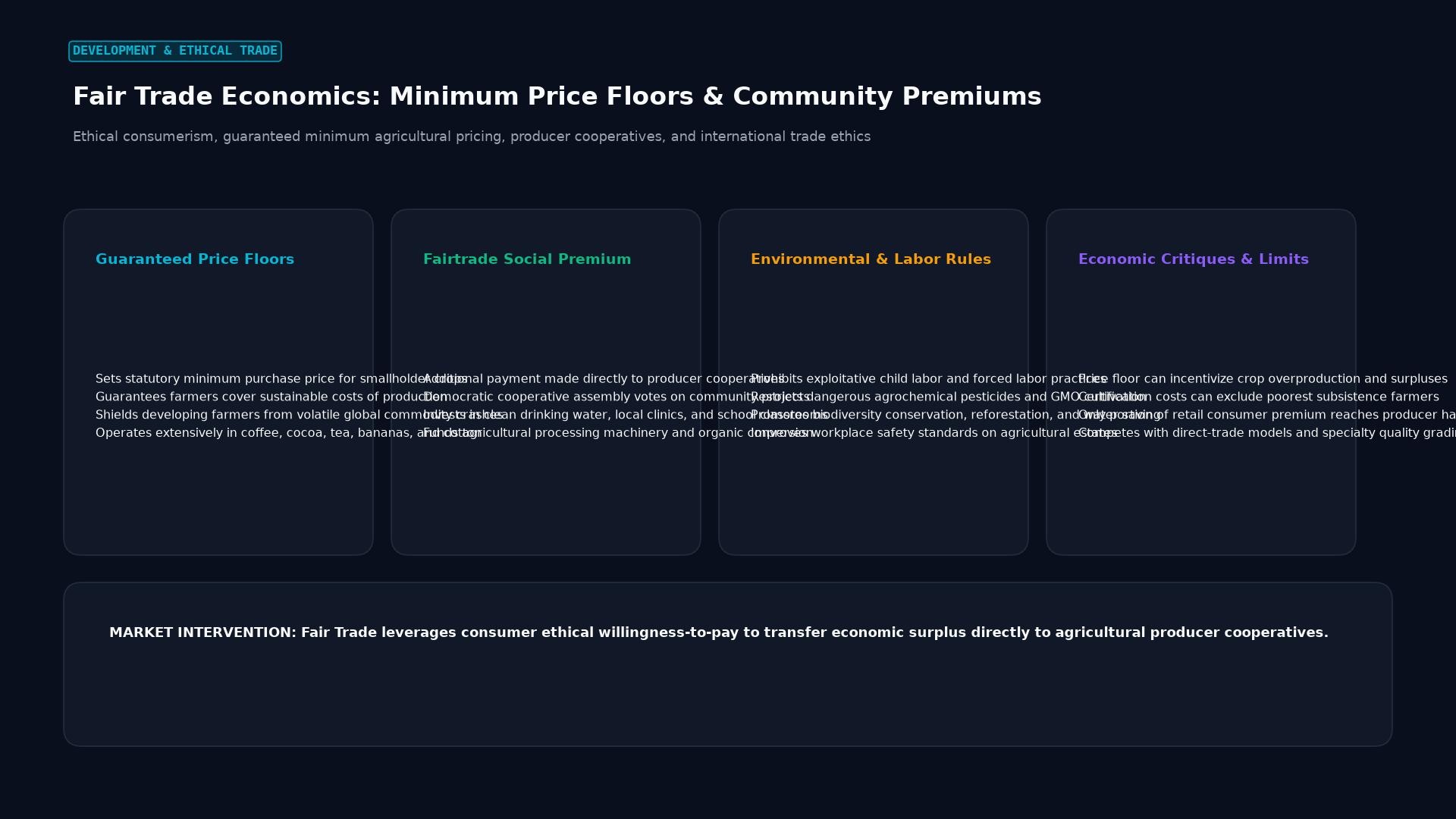 Figure: Ethical consumerism, guaranteed minimum agricultural pricing, producer cooperatives, and international trade ethics
Technical Mechanics & Pricing Formulas
The primary financial mechanism of organizations like Fairtrade International (FLO) and Fair Trade USA is the dual-tier pricing formula:
1. Dual-Tier Producer Payment Formula
$$\text{Total Price Received per Unit} = \max\left(P_{\text{Market}}, P_{\text{Floor}}\right) + \text{Premium}_{\text{Social}}$$
Where:
- $P_{\text{Market}}$ = Current benchmark world commodity exchange price (e.g., ICE Coffee “C” futures price).
- $P_{\text{Floor}}$ = Guaranteed minimum floor price negotiated to cover the cost of sustainable production.
- $\text{Premium}_{\text{Social}}$ = Non-negotiable cash premium earmarked specifically for community infrastructure and cooperative development.
2. Pre-Harvest Financing Facility
To prevent farmers from taking predatory high-interest loans from unregulated loan sharks during lean harvest months, Fair Trade certified buyers are contractually obligated to make up to 60% of the contract value available as pre-harvest trade financing upon request.
Comparative Matrix: Agricultural Sustainability Certifications
| Certification / System | Price Floor Protection | Social Premium Fund | Environmental Audit | Primary Focus |
|---|---|---|---|---|
| Fair Trade (FLO / USA) | Yes (Strict contract floor) | Yes (Fixed democratic premium) | Yes (Strict pesticide / GMO bans) | Producer income security, human rights, labor equity |
| Rainforest Alliance | No (Market price driven) | Voluntary sustainability differential | High (Biodiversity & forest conservation) | Ecosystem preservation & wildlife protection |
| USDA Organic | No (Commands organic market spread) | No | Strict (100% synthetic chemical prohibition) | Soil health & chemical-free food safety |
| Conventional Market | None (Fully exposed to futures drops) | None | Baseline local legal compliance only | Pure cost optimization and arbitrage |
Real-World Case Study: Arabica Coffee Market Crash Protection
During an oversupply crisis in the global coffee market, speculative selling on the ICE exchange drove the world benchmark Arabica “C” price down to $0.92 per pound—far below the average global production cost of $1.40 per pound:
- Conventional Farm Distress: Uncertified farmers in Colombia and Ethiopia were forced to sell coffee cherries at severe financial losses, depleting household savings, falling behind on fertilizer purchases, and facing foreclosure.
- Fair Trade Protection Activated: Fairtrade certified cooperatives in Huila, Colombia delivered parchment coffee under the Fairtrade minimum floor:
- Guaranteed Minimum Floor: $1.80 per pound (plus $0.40 organic differential)
- Social Development Premium: +$0.20 per pound
- Total Realized Price: $2.40 per pound
- The Cooperative Outcome: While neighboring uncertified farms laid off workers and defaulted on loans, the cooperative generated a $450,000 Social Premium surplus, funding a community medical clinic and purchasing centralized drying beds that improved cup quality scores for future harvest seasons.
Frequently Asked Questions (FAQ)
Does Fair Trade distort free-market equilibrium?
Critics argue that by establishing an artificial price floor above market clearing rates, Fair Trade can encourage overproduction of surplus commodities. However, certified cooperatives counter that price floors only absorb extreme financial dumping driven by speculative commodity futures trading, reflecting the true ecological and living wage costs of goods.
Can plantation workers benefit from Fair Trade, or only small family farms?
Both. While commodities like coffee and cocoa prioritize smallholder cooperatives, hired labor setups on tea plantations and flower farms can be certified under Fair Trade Standard for Hired Labour, which mandates democratic worker committees, fair wages, and collective bargaining rights.
How much of the retail price premium reaches the actual farmer?
The direct economic benefit is concentrated in the wholesale import price floor and the social premium. While retail branding markups are determined by supermarkets and roasters, the producer cooperative is legally guaranteed 100% of the designated minimum price and social premium.
Ready to trade forex?
Open a free demo account with a regulated broker. Practice with virtual funds before risking real money.