Fair Value Accounting
Fair value accounting, also known as mark-to-market accounting, is the corporate financial reporting standard under US GAAP (ASC 820) and IFRS 13 that requires entities to measure and record assets and liabilities on balance sheets at their current exit market price in an orderly transaction between independent market participants.
What Is Fair Value Accounting?
In financial reporting, audit compliance, and corporate finance, fair value accounting (frequently termed mark-to-market [MTM] accounting) is the methodology mandated by US GAAP (ASC 820) and IFRS 13 where balance sheet assets and liabilities are reported at their current estimated market value rather than their historical acquisition cost.
Under statutory definition, fair value represents the exit price—the price that would be received to sell an asset or paid to transfer a liability in an orderly transaction between knowledgeable, willing market participants at the measurement date under current market conditions.
Fair value accounting provides investors and regulators with a real-time, transparent picture of an institution’s solvency and exposure to interest rate and liquidity fluctuations. However, during systemic financial panics, strict mark-to-market rules can trigger fire-sale spirals and procyclical capital write-downs.
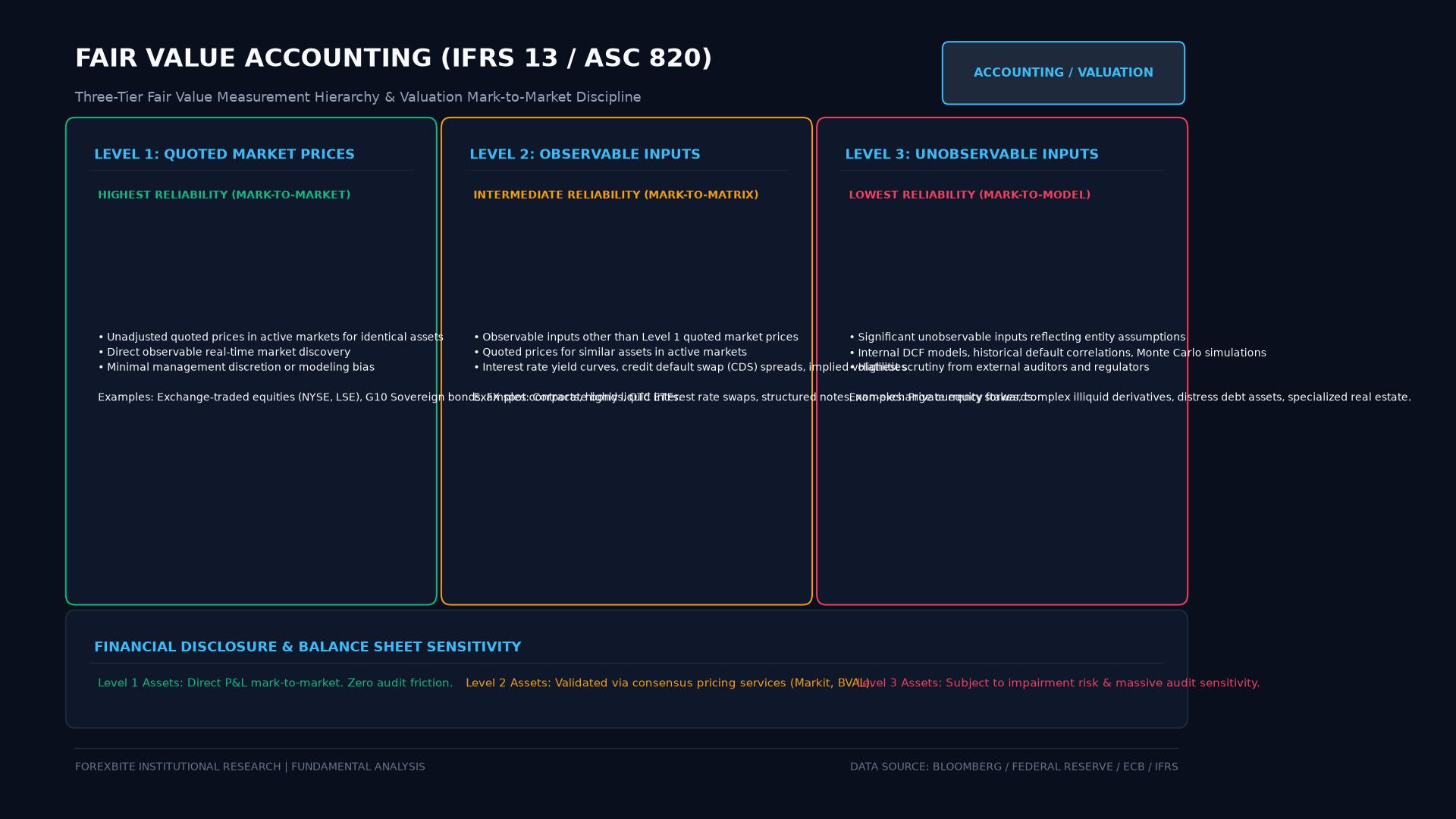 Figure: The three-tier fair value hierarchy under IFRS 13 and ASC 820, contrasting Level 1 quoted active market prices, Level 2 observable market inputs, and Level 3 unobservable internal mark-to-model valuations.
Technical Mechanics & Reporting Classifications
Under ASC 820 / IFRS 13, measuring fair value requires identifying:
- The Principal Market: The market with the greatest volume and level of activity for the asset or liability.
- The Most Advantageous Market: In the absence of a principal market, the market that maximizes the net amount received after transaction and transport costs.
- Highest and Best Use: For non-financial assets (such as real estate), valuation must reflect the use that is physically possible, legally permissible, and financially feasible.
Balance Sheet Accounting Treatment of Marketable Securities
In institutional banking, marketable debt securities are split into three accounting buckets:
| Classification | Valuation Method | Unrealized Gains / Losses Treatment | Impact on Regulatory CET1 Capital |
|---|---|---|---|
| Trading Securities | Fair Value (Mark-to-Market) | Flow through quarterly Net Income (P&L) | Immediate impact on capital |
| Available-for-Sale (AFS) | Fair Value (Mark-to-Market) | Flow through Other Comprehensive Income (AOCI) | Typically filtered out for regional banks |
| Held-to-Maturity (HTM) | Amortized Historical Cost | Ignored on balance sheet (footnote disclosure only) | Zero impact unless sold or impaired |
Comparative Matrix: Fair Value Accounting vs. Historical Cost
| Metric / Dimension | Fair Value Accounting (ASC 820) | Historical Cost Accounting |
|---|---|---|
| Primary Advantage | Real-time transparency of asset quality and economic solvency | High verifiability, objectivity, and earnings stability |
| Primary Disadvantage | Severe balance sheet volatility; procyclical during market crashes | Conceals hidden balance sheet insolvency and underwater loans |
| Audit Verification | Demands complex valuation model audits (Level 2 & 3) | Simple receipt, invoice, and closing escrow verification |
| Asset Revaluation | Continuous revaluation (quarterly / annual reporting) | Never written up; written down only if permanently impaired |
Real-World Case Study: Silicon Valley Bank (SVB) and the AFS/HTM Split
The collapse of Silicon Valley Bank (SVB) in March 2023 demonstrated the high-stakes implications of fair value accounting classifications:
- The Portfolio Mismatch: During 2020–2021, SVB invested billions in long-duration US Treasuries and agency mortgage-backed securities (MBS) yielding ~1.6%. SVB designated $91 billion of these bonds as Held-to-Maturity (HTM), reporting them at amortized historical cost.
- The Federal Reserve Tightening: As the Federal Reserve rapidly hiked interest rates above 5.00%, the economic fair market value of SVB’s fixed-rate bond portfolio plunged by over $17 billion.
- The Fair Value Revelation: Because the bonds were parked in HTM, this $17 billion paper loss was legally hidden from SVB’s headline balance sheet equity.
- The Liquidity Run: When deposit outflows forced SVB to sell $21 billion of Available-for-Sale (AFS) securities at a realized $1.8 billion loss, depositors realized that if SVB had to liquidate its HTM book, the entire bank’s equity would be wiped out under fair value accounting, triggering a fatal $42 billion deposit run in 24 hours.
Frequently Asked Questions (FAQ)
What is the difference between mark-to-market and mark-to-model?
Mark-to-market utilizes observable market transaction prices (Level 1 and Level 2 inputs). Mark-to-model utilizes internal mathematical algorithms, Monte Carlo simulations, or discounted cash flows (Level 3 inputs) when no active secondary trading market exists.
Why is fair value accounting criticized during financial crises?
During panics, liquidity evaporates, causing fire-sale market prices to drop far below intrinsic holding values. When banks are forced to mark balance sheets to distressed liquidation prices, regulatory capital requirements are breached, forcing further asset liquidations in a vicious systemic deflationary loop.
How does fair value accounting apply to crypto assets?
Under recent FASB updates (ASU 2023-08), companies holding crypto assets (such as Bitcoin and Ethereum) are required to measure them at fair value through net income every reporting period, replacing the outdated intangible asset model that only recognized impairments.
Ready to trade forex?
Open a free demo account with a regulated broker. Practice with virtual funds before risking real money.