Fast Market
A fast market is an exceptional market condition marked by rapid, violent price movements, extreme trading volume, and severe liquidity evaporation, resulting in wide bid-ask spreads, quote latency, and heavy execution slippage.
What Is a Fast Market?
A fast market is an anomalous trading environment characterized by extreme volatility, frantic order flow, and hyper-rapid price movement across financial exchanges and electronic communication networks (ECNs). During a fast market, prices change so quickly that trading systems, broker quotation feeds, and human traders struggle to track transactions in real time.
In the global foreign exchange (FX) market, fast market conditions occur during unexpected macroeconomic shock events—such as an emergency interest rate hike by a central bank, an unprecedented geopolitical conflict, or an extreme surprise in a Tier-1 economic release (like U.S. Non-Farm Payrolls or CPI). As prices cascade through technical levels, electronic market makers pull back their limit orders to protect capital, creating sudden liquidity vacuums where price can gap 50 to 100 pips in seconds.
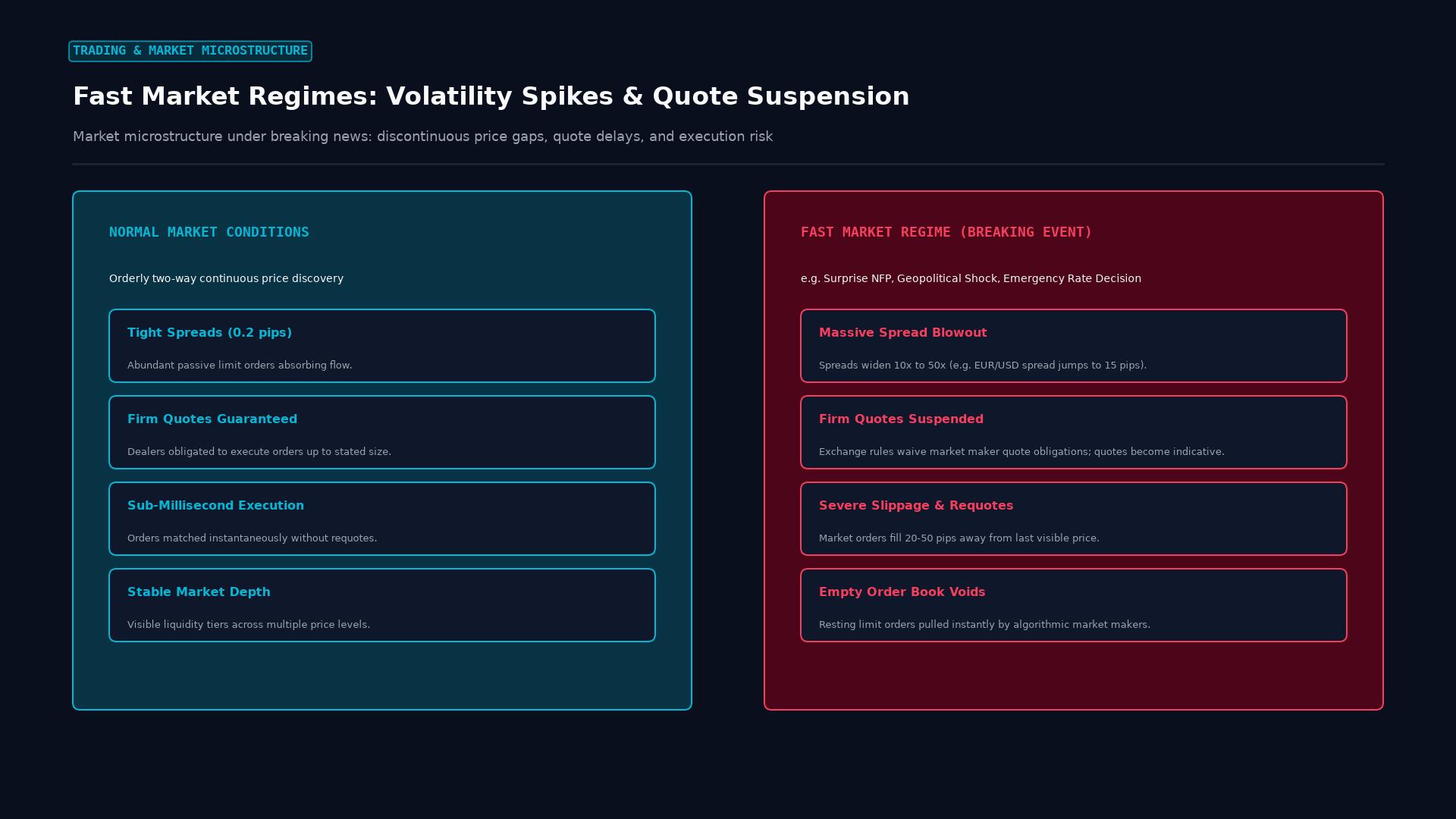 Figure: Microstructure during fast market conditions: extreme order flow spikes, widened spreads, discontinuous gaps, and temporary regulatory suspension of firm quote obligations.
Key Takeaways
- Extreme Volatility & Velocity: Prices move in erratic, jagged leaps rather than continuous tick-by-tick progressions.
- Liquidity Evaporation: Algorithmic market makers immediately cancel resting bid/ask limit orders to avoid adverse selection, leaving order books paper-thin.
- Spread Blowout: Interbank and retail bid-ask spreads expand dramatically (e.g., EUR/USD spreads widening from 0.1 pip to 15–30 pips).
- Exchange Rule Invocation: Regulated exchanges (such as the CME) and retail brokers invoke formal “Fast Market Rules,” waiving standard execution speed guarantees and price-matching obligations.
Normal Market vs. Fast Market Dynamics
| Dimension | Normal Market Conditions | Fast Market Conditions |
|---|---|---|
| Price Action | Smooth, continuous, orderly tick-by-tick | Discontinuous jumps, large price gaps, erratic spikes |
| Order Book Depth | Deep liquidity across multiple price tiers | Extremely shallow; empty tiers (air pockets) |
| Bid-Ask Spread | Tight and predictable (0.1 – 1.0 pip on majors) | Blown out (10 – 50+ pips depending on currency pair) |
| Order Execution | Immediate, near-zero latency, minimal slippage | Delayed fills, heavy negative slippage, requotes |
| Order Type Reliability | Stop-loss orders execute precisely near trigger | Stop-loss orders execute at massive distance (gaps) |
| Broker Operations | Automated Straight-Through Processing (STP) | Dealer manual intervention, circuit breakers, margin spikes |
What Causes a Fast Market?
- Macroeconomic Data Surprises: A statistical release that deviates massively from consensus expectations (e.g., U.S. inflation printing 0.6% above forecasts). Algorithms react within milliseconds, dumping or buying billions of dollars simultaneously.
- Central Bank Interventions: Unscheduled policy announcements or surprise spot market currency interventions (such as the Swiss National Bank abandoning the 1.20 EUR/CHF floor in January 2015, or the Bank of Japan intervening during thin liquidity hours).
- Geopolitical Shocks & Flash Crashes: Outbreak of military hostilities, sovereign defaults, or algorithmic feedback loops where automated stop-loss cascades overwhelm available bids.
The Broker’s “Fast Market Policy”
Under their legal Terms of Business, regulated brokers incorporate specific clauses protecting themselves during fast markets:
- Suspension of Instant Execution: Guarantees of immediate fills at displayed screen prices are automatically nullified. Orders are routed for Market Execution, filling at the next available real-world interbank rate.
- Slippage Disclaimers: Brokers explicitly warn clients that Stop-Loss orders are not guaranteed (unless the trader has paid for a proprietary “Guaranteed Stop-Loss Order” - GSLO).
- Temporary Leverage Reductions: Brokers may proactively increase margin requirements (e.g., reducing leverage from 1:100 to 1:20) ahead of high-risk events like national elections or Brexit-style referendums to prevent retail accounts from going into negative balances.
Tactical Rules for Navigating Fast Markets
- Avoid Market Orders: Submitting a standard “Buy Market” or “Sell Market” order into a fast market is extremely hazardous. An empty order book may sweep prices dozens of pips away from your screen price.
- Use Limit and Stop-Limit Orders: Set a price boundary specifying the worst acceptable fill price. If the market skips past your limit, the order remains unfilled rather than executing at a ruinous loss.
- Cut Position Sizing by 50% to 75%: If you normally trade 2.0 lots with a 20-pip stop, trade 0.5 lots with a wider 80-pip stop to accommodate normal fast-market price swings without violating account risk rules.
- Wait for the “Second Move”: Allow the initial fast-market algorithmic panic to burn out (typically 5 to 15 minutes post-release), and enter trades on confirmed technical pullbacks once liquidity restores normal bid-ask spreads.
Frequently Asked Questions
Why do trading platforms freeze during a fast market?
Platforms freeze primarily due to data feed congestion. Millions of order modifications, price updates, and trade executions flood server gateways simultaneously. Network buffers become overwhelmed, causing a queue backlog that delays price charts and order confirmations on retail terminals.
Can a broker cancel a trade made during a fast market?
Yes. Under institutional exchange rules and retail broker client agreements, firms retain the right to bust or adjust trades executed at erroneous or off-market prices (“manifest error” clauses) caused by liquidity freezes or technical software delays.
Are stop-loss orders safe in a fast market?
Standard stop-loss orders become market orders the moment their trigger price is touched. If the market gaps over your stop-loss price due to an empty order book, your trade will be filled at the next available market price—often resulting in substantial negative slippage.
Ready to trade forex?
Open a free demo account with a regulated broker. Practice with virtual funds before risking real money.