Federal Deposit Insurance Corporation (FDIC)
The Federal Deposit Insurance Corporation (FDIC) is an independent United States government agency established to maintain public confidence and financial stability by insuring commercial bank deposits up to $250,000, supervising member institutions, and managing bank insolvencies.
What Is the Federal Deposit Insurance Corporation (FDIC)?
The Federal Deposit Insurance Corporation (FDIC) is an independent agency of the United States federal government created to maintain stability and public confidence in the nation’s commercial banking system. Founded by President Franklin D. Roosevelt through the landmark Banking Act of 1933 (widely known as the Glass-Steagall Act) in the depths of the Great Depression, the FDIC was established to eliminate destructive bank runs by providing a government guarantee on personal and commercial bank deposits.
The FDIC directly examines and supervises more than 4,000 state-chartered commercial banks and savings institutions for safety, soundness, and consumer protection. Furthermore, when a bank experiences insolvency, the FDIC acts as the statutory receiver, taking control of the failed institution, transferring deposits, and liquidating distressed assets to protect depositors without creating systemic contagion across the global financial system.
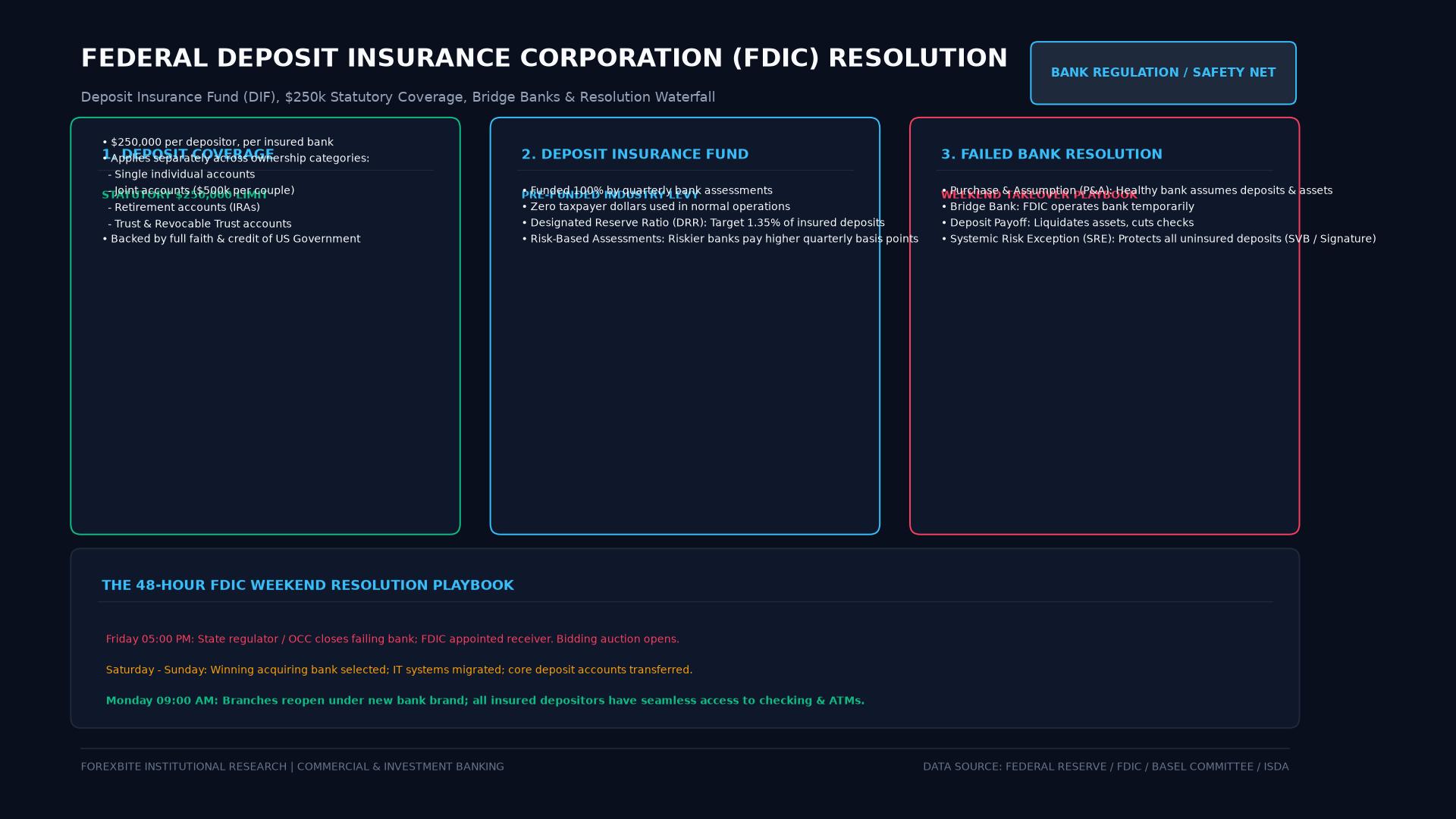 Figure: FDIC deposit protection architecture: $250k ownership category coverage, Deposit Insurance Fund (DIF), and Purchase & Assumption (P&A) bank failure resolution.
Key Takeaways
- The Standard Insurance Limit: The FDIC insures up to $250,000 per depositor, per insured bank, for each legal ownership category (e.g., individual accounts, joint accounts, trust accounts, IRAs).
- Direct Government Backing: FDIC insurance is backed by the full faith and credit of the United States government; since its inception in 1934, no depositor has ever lost a single penny of insured funds.
- Zero Taxpayer Funding: The FDIC receives no federal budget appropriations; its operations and the Deposit Insurance Fund (DIF) are funded entirely through assessment premiums paid by member commercial banks.
- FDIC vs. Brokerage Protection: FDIC covers commercial bank deposits only; it does not insure trading capital held inside retail forex brokerages, stockbroker margin accounts, or cryptocurrency exchanges.
What Does FDIC Insurance Cover?
To optimize capital protection, institutional treasurers and retail depositors must understand which financial products qualify:
| Eligible (Insured up to $250,000) | Ineligible (Zero FDIC Coverage) |
|---|---|
| Checking Accounts | Stocks and Corporate Equities |
| Savings Accounts | Bond and Fixed-Income Mutual Funds |
| Money Market Deposit Accounts (MMDAs) | Foreign Exchange (FX) & Futures Accounts |
| Certificates of Deposit (CDs) | Money Market Mutual Funds (MMFs) |
| Official Bank Checks & Money Orders | Annuities and Municipal Bonds |
Ownership Category Multipliers: A single individual can legally maintain more than $250,000 in fully insured protection at the same bank by utilizing different legal ownership categories—for example, maintaining $250,000 in a personal individual account, $250,000 in an IRA retirement account, and sharing $500,000 in a joint account with a spouse (totaling $1,000,000 in aggregate FDIC insurance coverage).
The Bank Resolution Process: What Happens When a Bank Fails?
When regulatory authorities declare a commercial bank insolvent, the FDIC steps in as receiver, typically executing a resolution over a single weekend to prevent Monday morning banking panics:
- Purchase and Assumption (P&A) Transaction: The preferred resolution method. The FDIC auctions the failed bank’s healthy operations, deposits, and branches to a solvent, healthy bank (e.g., JPMorgan Chase acquiring First Republic Bank in 2023). Depositors automatically become customers of the acquiring bank with zero interruption in ATM, debit card, or check access.
- Bridge Bank: If no immediate private buyer exists, the FDIC charters a temporary national “bridge bank” operated under FDIC control to preserve franchise value until a buyer is found.
- Direct Payoff: In rare situations where no institution will acquire the failed bank, the FDIC directly mails insurance checks to depositors up to the $250,000 limit, while uninsured depositors receive receivership certificates for fractional recovery.
Comparison: FDIC vs. SIPC vs. Segregated Client Accounts
Traders must distinguish between the various investor protection regimes in the United States and internationally:
| Feature | FDIC (Banking) | SIPC (Brokerage Securities) | Forex Segregated Trust Accounts (CFTC/NFA) |
|---|---|---|---|
| Protected Entities | Commercial bank depositors | Equity/options brokerage clients | Retail foreign exchange traders |
| Coverage Limit | $250,000 per depositor | $500,000 (including up to $250,000 cash) | 100% of segregated client margin |
| What It Protects | Bank insolvency/run | Broker bankruptcy or theft of shares | Broker insolvency or unauthorized commingling |
| Market Loss Cover | None | None (protects custody of shares, not market drop) | None (market trading losses are uncompensated) |
The 2023 Systemic Risk Exception
In March 2023, the sudden failure of Silicon Valley Bank (SVB) and Signature Bank exposed a massive vulnerability: over 90% of deposits at these tech-focused institutions exceeded the statutory $250,000 limit.
To halt a contagion bank run across regional banks nationwide, the FDIC, Federal Reserve Board, and U.S. Treasury Department invoked the statutory Systemic Risk Exception. Under this emergency provision, the FDIC guaranteed 100% of all uninsured deposits at both failed institutions, ensuring payrolls were met and stabilizing foreign exchange liquidity.
Frequently Asked Questions
Are funds deposited with a forex broker covered by FDIC insurance?
No. Forex brokerages are not commercial banks; they are registered Retail Foreign Exchange Dealers (RFEDs) regulated by the CFTC and NFA. However, top-tier U.S. brokers deposit client funds into segregated omnibus trust accounts at FDIC-insured banks. While the broker’s underlying bank account has FDIC protection, the individual trader does not have direct FDIC claims.
What is the Deposit Insurance Fund (DIF)?
The DIF is the dedicated insurance reserve fund managed by the FDIC. Maintained by law at a target reserve ratio of at least 1.35% of total estimated insured deposits across all U.S. commercial banks, the DIF is invested exclusively in U.S. Treasury securities.
Does the FDIC insure foreign branches of U.S. banks?
By law, deposits held at foreign overseas branches of U.S. commercial banks (e.g., a Citibank branch in London or Tokyo) are not insured by the FDIC. They fall under the local host jurisdiction’s deposit protection scheme (such as the UK’s FSCS).
Ready to trade forex?
Open a free demo account with a regulated broker. Practice with virtual funds before risking real money.