Federal Reserve Board
The Federal Reserve Board (formally the Board of Governors of the Federal Reserve System) is the governing body of the United States central bank, composed of seven presidentially appointed governors who oversee the 12 regional Reserve Banks and guide national monetary policy.
What Is the Federal Reserve Board?
The Federal Reserve Board—officially designated as the Board of Governors of the Federal Reserve System—is the central governing institution of the United States central banking system. Headquartered in Washington, D.C., the Board is an independent federal agency tasked with formulating national monetary policy, supervising and regulating commercial and holding banks, maintaining payment system stability, and containing systemic financial risk.
The Board consists of seven members nominated directly by the President of the United States and confirmed by the U.S. Senate. To insulate monetary policy from short-term partisan political pressure, governors serve staggered 14-year terms, with one term expiring every two years. The President designates, and the Senate confirms, two governors to serve four-year renewable terms as Chair and Vice Chair.
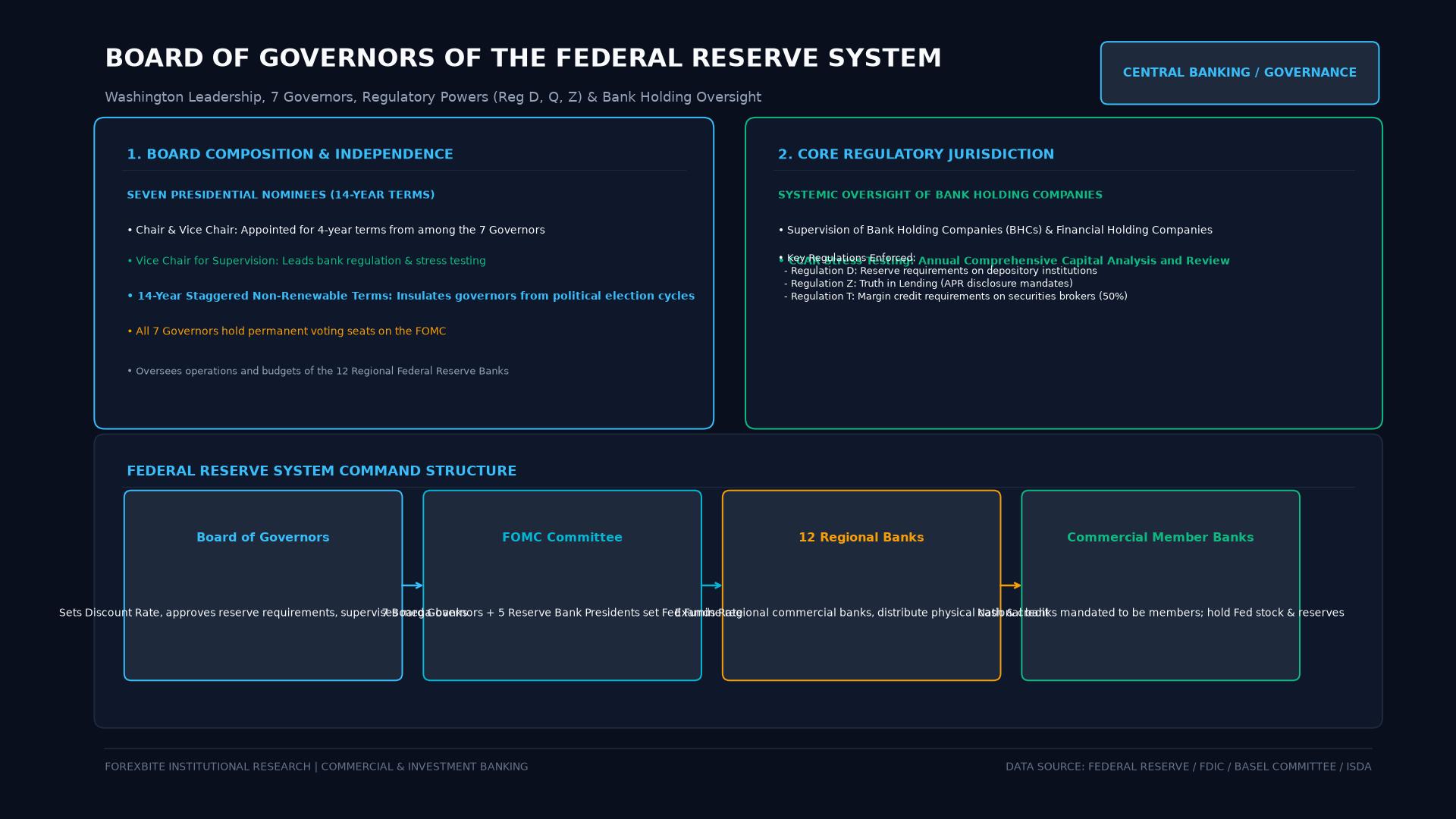 Figure: Institutional hierarchy of the 7-member Board of Governors, statutory regulatory supervision, discount rate approval, and FOMC monetary policy leadership.
Key Takeaways
- The Governing Core: The Federal Reserve Board serves as the regulatory and administrative apex of the U.S. central bank, directly overseeing the 12 regional Federal Reserve Banks.
- Permanent FOMC Majority: All seven members of the Board of Governors hold permanent voting seats on the Federal Open Market Committee (FOMC), giving the Board a decisive voting majority over the five voting regional Fed presidents.
- Dual Mandate Implementation: By congressional statute, the Board guides policy to achieve two core objectives: Maximum Sustainable Employment and Price Stability (anchored at a 2.0% annual inflation target).
- The World’s Most Powerful Central Bank Chair: The Chair of the Federal Reserve Board (who also chairs the FOMC) delivers post-meeting press conferences and congressional testimony that directly dictate global currency valuations and sovereign bond yields.
The Fed Board vs. The FOMC: Understanding the Difference
Currency traders and financial media often use “the Fed” interchangeably, but legal distinctions exist between the Board of Governors and the FOMC:
| Dimension | The Board of Governors (Fed Board) | Federal Open Market Committee (FOMC) |
|---|---|---|
| Composition | 7 Governors exclusively | 12 Voting Members: 7 Governors + NY Fed President + 4 Rotating Regional Presidents |
| Location | Washington, D.C. | Convenes in Washington, D.C. (8 scheduled meetings annually) |
| Primary Authority | Banking regulation, discount window lending rate, emergency facilities (§13(3)) | Target Federal Funds Rate, Quantitative Easing / Tightening, Open Market Operations |
| Congressional Testimony | Humphrey-Hawkins Semi-Annual Monetary Policy Testimony | Minutes and Summary of Economic Projections (SEP / “Dot Plot”) |
Direct Impact on Global Foreign Exchange Markets
Because the United States Dollar (USD) represents the world’s preeminent reserve currency and is involved in nearly 90% of all global foreign exchange transactions, decisions made by the Federal Reserve Board represent the primary driver of international currency trends:
- Policy Rate Trajectory: When the Fed Board signals interest rate hikes to combat inflation, U.S. Treasury yields rise. Global institutional capital flows out of foreign assets and into the U.S., driving broad-based U.S. Dollar appreciation (DXY rally).
- Central Bank Liquidity Swap Lines: During severe global funding crises (such as the 2008 Lehman collapse and the March 2020 pandemic crash), foreign commercial banks face dollar shortages. The Federal Reserve Board exercises statutory emergency power to establish multi-billion-dollar currency swap lines with major foreign central banks (ECB, BOJ, BOE, SNB, BOC) to inject offshore dollar liquidity.
- The “Fed Dot Plot”: Published quarterly by the FOMC, the Summary of Economic Projections includes the famous “dot plot”—an anonymous scatter chart showing where each Board governor and regional president expects policy rates to sit over the next three years, sparking intense volatility across currency pairs.
Frequently Asked Questions
Can the U.S. President fire the Chair of the Federal Reserve Board?
Under Section 10 of the Federal Reserve Act, the President may remove a member of the Board of Governors only “for cause” (such as illegal conduct or severe dereliction of duty). Legal consensus affirms that a President cannot remove a Fed Chair simply over disagreements regarding monetary policy or interest rate decisions.
How is the Federal Reserve funded?
The Federal Reserve Board and the Federal Reserve System receive zero congressional tax appropriations. The Fed funds its operations entirely from the interest earned on its portfolio of U.S. government securities, fees charged to commercial banks for payment clearing services, and interest on discount window loans. Any excess net net earnings are remitted annually to the U.S. Treasury.
What is the Beige Book?
Published eight times per year two weeks before each FOMC meeting, the Beige Book is an anecdotal qualitative report prepared by the 12 regional Reserve Banks summarizing economic, employment, and wage conditions across their respective districts. The Board reviews this report to assess grassroots business activity.
Ready to trade forex?
Open a free demo account with a regulated broker. Practice with virtual funds before risking real money.