Financial Services Authority (FSA)
The Financial Services Authority (FSA) was the quasi-judicial statutory regulator of the financial services industry in the United Kingdom from 2001 until 2013, when it was dismantled and replaced by the Financial Conduct Authority (FCA) and Prudential Regulation Authority (PRA).
What Was the Financial Services Authority (FSA)?
The Financial Services Authority (FSA) was the primary statutory body responsible for regulating the financial services industry in the United Kingdom between 2001 and 2013. Established under the Financial Services and Markets Act 2000 (FSMA), the FSA brought banking, investment business, building societies, insurance, and retail derivatives trading under a single unified regulatory umbrella.
At its peak, the FSA oversaw London’s status as the undisputed global capital of international banking, foreign exchange trading, and wholesale derivatives. However, following the 2007–2008 global financial crisis and the dramatic collapse of UK mortgage giant Northern Rock, the British government determined that a single regulator combining systemic macro-prudential oversight with consumer protection was structurally flawed. On April 1, 2013, the FSA was officially abolished and replaced by a modern “Twin Peaks” regulatory architecture.
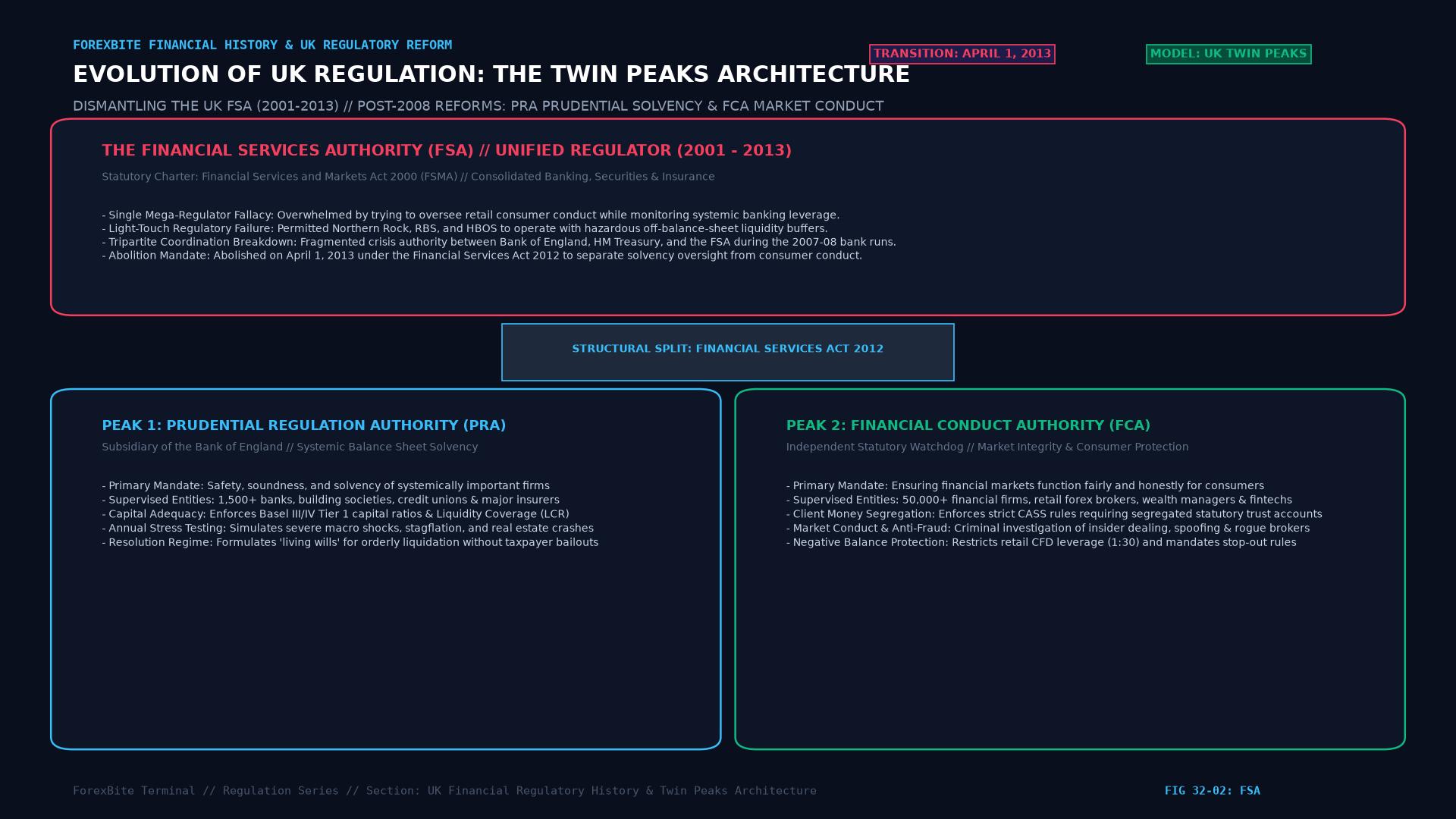 Figure: The evolution of UK financial regulation from the unified Financial Services Authority (FSA) to the post-2008 Twin Peaks model dividing PRA prudential solvency and FCA conduct.
Key Takeaways
- Historical Mandate: The UK FSA operated as an independent, non-governmental body funded entirely by statutory levies charged to the financial services firms it regulated.
- The 2008 Regulatory Failure: The FSA faced severe international criticism during the 2008 credit freeze for “light-touch” regulation, failing to anticipate the liquidity runs on Northern Rock, Royal Bank of Scotland (RBS), and HBOS.
- The 2013 Twin Peaks Split: Regulatory powers were divided into the Financial Conduct Authority (FCA) (market conduct and consumer protection) and the Prudential Regulation Authority (PRA) (bank balance-sheet solvency under the Bank of England).
- International FSAs: Traders must distinguish the historic UK FSA from active overseas regulatory agencies sharing the identical acronym, such as the Financial Services Agency of Japan or the offshore Seychelles FSA.
Why the FSA Was Dismantled: Lessons from the 2008 Crisis
The global financial crisis revealed fundamental vulnerabilities in the FSA’s consolidated regulatory model:
- Light-Touch Philosophy: The FSA prioritized London’s global competitiveness and light regulatory friction, allowing commercial banks to operate with razor-thin capital reserves and dangerous off-balance-sheet leverage.
- The Tripartite System Breakdown: Regulatory supervision was split between the UK Treasury, the Bank of England, and the FSA. When Northern Rock faced a liquidity crisis in September 2007, lack of coordinated emergency lending authorities resulted in the first physical bank run on a British high street in over 140 years.
- Neglect of Consumer Conduct: Because senior FSA leadership was consumed by banking balance-sheet crises, systemic retail misconduct—such as the multi-billion-pound Payment Protection Insurance (PPI) misselling scandal—went unchecked for years.
Global Financial Regulatory Entities Named “FSA”
Because “FSA” remains a prominent acronym, currency traders frequently encounter other active regulatory agencies:
| Regulatory Body | Jurisdiction | Regulatory Tier | Scope & Currency Trading Oversight |
|---|---|---|---|
| UK FSA (Defunct) | United Kingdom | — | Replaced by the FCA and PRA in 2013. |
| Japan FSA (JFSA) | Japan | Tier 1 | Strict domestic oversight of Tokyo financial markets; enforces 1:25 retail FX leverage cap. |
| Seychelles FSA | Seychelles | Offshore (Tier 3) | Regulates offshore international business companies (IBCs); permits 1:500+ retail leverage. |
| St. Vincent FSA (SVG) | SVG | Non-Regulator | Officially ceased issuing forex licenses in 2023; merely registers corporate entity names. |
| Labuan FSA | Malaysia | Mid-Tier (Tier 2) | Oversees offshore financial services and wholesale banking in the Labuan Federal Territory. |
Legacy Impact on Forex Regulation: The FCA’s CASS 7 Rules
Although the FSA was dissolved in 2013, its regulatory directives formed the foundation of the FCA’s rigorous Client Assets Sourcebook (CASS 7) rules governing retail currency brokers:
- Strict Segregation: Brokerages must hold client trading deposits in designated statutory trust accounts at Tier-1 credit institutions, completely isolated from operational corporate funds.
- Daily Reconciliations: Regulated brokers must perform daily internal and external reconciliations to verify that every penny of client equity is accounted for.
- FSCS Coverage: Under the modern successor regime, eligible retail traders holding accounts with FCA-authorized brokers are protected by the Financial Services Compensation Scheme (FSCS) up to £85,000 if the brokerage becomes insolvent.
Frequently Asked Questions
Is any broker still legally licensed by the “UK FSA”?
No. Any online broker claiming to hold a “UK FSA license” is operating fraudulently or displaying obsolete information. The UK FSA ceased to exist on April 1, 2013. All legitimate British forex and CFD brokerages must be authorized and regulated by the Financial Conduct Authority (FCA).
How can a trader verify if an FCA broker is genuine?
Traders should navigate to the official FCA Financial Services Register (register.fca.org.uk) and search the broker’s six-digit Firm Reference Number (FRN). Always verify that the official website domain and corporate address listed on the FCA register match the broker’s website exactly to avoid “clone firm” scams.
What is the primary difference between the FCA and the PRA?
The Prudential Regulation Authority (PRA) focuses on the systemic safety and capital reserves of major deposit-taking institutions (large banks, building societies, systemic insurers). The Financial Conduct Authority (FCA) supervises the operational behavior, consumer fairness, advertising transparency, and retail trade execution of over 50,000 financial firms.
Ready to trade forex?
Open a free demo account with a regulated broker. Practice with virtual funds before risking real money.