Indicative Quote
An indicative quote is a non-binding price estimate provided by a broker, dealer, or data feed for informational purposes only, reflecting general market levels without obligating the dealer to execute a trade at that quoted price.
What Is an Indicative Quote?
In financial market trading and foreign exchange dealing, an indicative quote is an estimated, non-actionable price quotation displayed by a broker, market maker, or financial media provider. Unlike a firm quote—which is a legally binding commitment to execute an order at the displayed rate—an indicative quote is provided purely for informational and reference purposes.
When a participant sees an indicative quote on a public screen or terminal, the market maker is merely saying: “This is approximately where we believe the market is currently trading.” If a trader attempts to execute a trade against an indicative price, the dealer is under zero legal obligation to fill the order at that rate. The dealer may respond with an updated firm price, widen the spread, or reject the order outright.
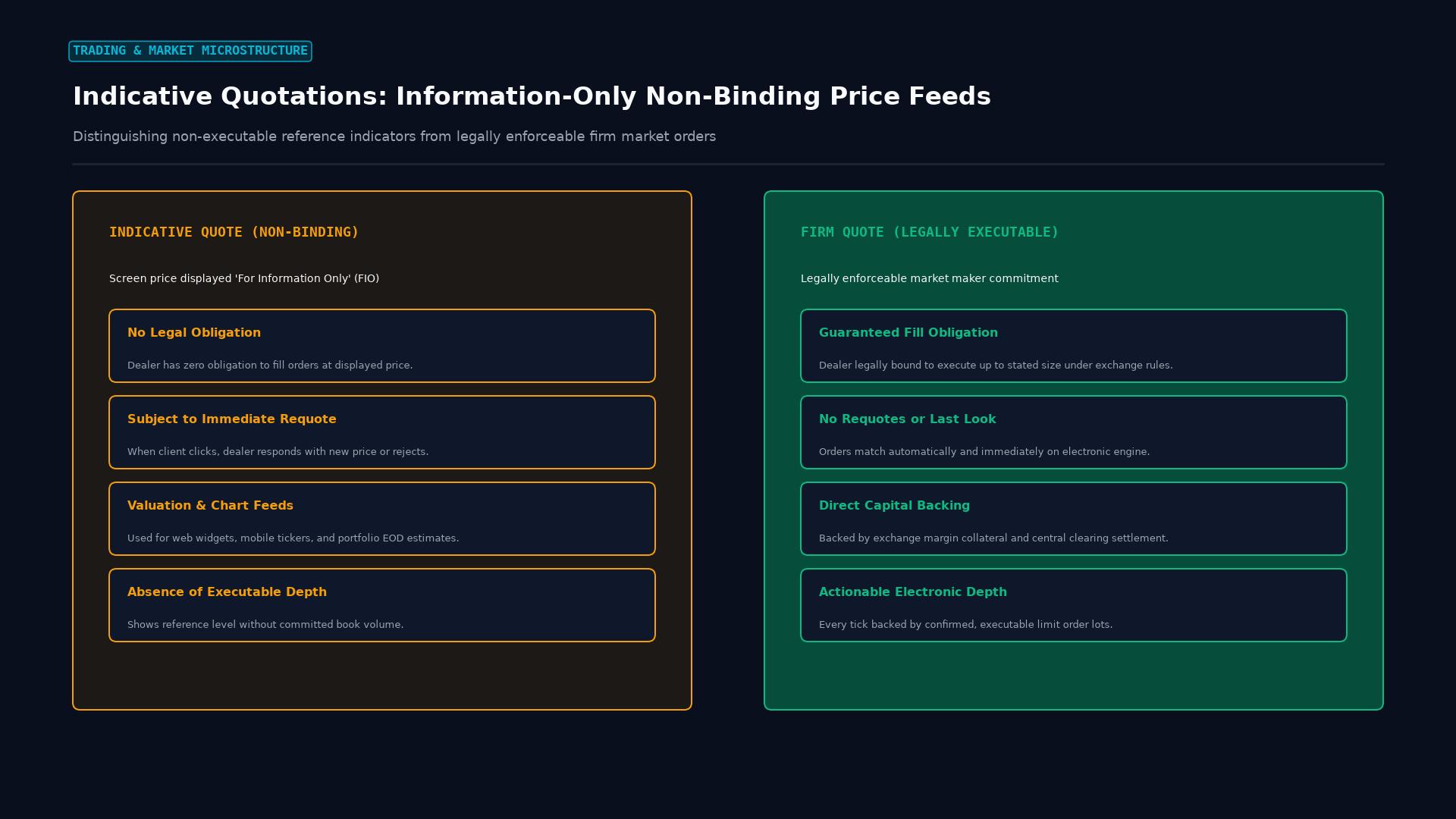 Figure: Distinction between indicative and firm prices: non-binding informational quotes subject to dealer requote versus legally enforceable executable firm quotes.
Key Takeaways
- Non-Binding Status: Indicative quotes do not constitute an actionable offer; dealers cannot be held liable for refusing to execute at indicative rates.
- Informational Utility: Used to gauge general market trends, track historical exchange rate ranges, and monitor prices across illiquid assets where continuous firm trading is impractical.
- Prevalence Outside Trading Hours: Public currency converter websites and weekend financial data feeds show indicative quotes, as interbank order books are closed.
- Danger for Algorithmic Models: Algorithmic trading systems must never be calibrated to execute against indicative feeds, as attempting to trade non-firm liquidity results in high order rejection rates and severe slippage.
Indicative Quote vs. Firm Quote Comparison
| Dimension | Indicative Quote (Informational) | Firm Quote (Executable) |
|---|---|---|
| Legal Status | Non-binding estimate | Legally binding contract upon acceptance |
| Execution Guarantee | None; dealer can reject or re-quote | Guaranteed fill at quoted price for specified size |
| Data Feed Cost | Inexpensive or free (public web feeds) | Expensive (high-bandwidth direct exchange lines) |
| Where Encountered | Financial news tickers (CNBC/Bloomberg TV), currency converters | Central Limit Order Books (CLOBs), ECNs, MT5 terminals |
| Spread Accuracy | Often displays artificial or delayed spreads | Displays live, actionable market bid-ask spread |
Where Are Indicative Quotes Encountered in Forex?
1. Free Public Web Portals and Financial TV
Websites offering free currency conversion widgets or financial news channels display indicative quotes. These feeds are typically delayed by 10 to 15 minutes and aggregate prices from disparate sources rather than streaming live interbank order books, which require costly exchange licensing fees.
2. Weekend and Off-Hour Screen Displays
The foreign exchange market officially closes at 5:00 PM EST on Friday and reopens at 5:00 PM EST on Sunday. Any prices displayed on retail platforms during the weekend are indicative estimates derived from illiquid Middle Eastern or regional bank desks; retail traders cannot execute live trades against them until the market officially opens.
3. Illiquid Exotic Currency Pairs and Structured Swaps
For rarely traded emerging market currencies (such as the Nigerian Naira or Zimbabwean Dollar) or complex 10-year cross-currency swaps, dealers do not stream continuous firm prices. Instead, they provide indicative runs. When a corporate client wishes to trade, they submit a formal Request for Quote (RFQ) to convert the indicative price into an actionable firm quote.
The Danger of Indicative Feeds in High-Frequency Trading
In quantitative finance, relying on indicative feeds creates severe operational risks:
- Phantom Liquidity: Indicative quotes often display tight spreads that do not exist in reality. An algorithm attempting to arbitrage an indicative quote against a firm market will find that the liquidity cannot be captured.
- Stale Tick Latency: Indicative feeds update irregularly, often masking sharp market moves that have already taken place on institutional matching engines.
Frequently Asked Questions
What happens if I click to trade on an indicative quote?
In modern retail trading platforms, clicking on an indicative quote triggers an immediate check with the broker’s liquidity providers. If the live market price has changed, the platform will present a re-quote pop-up showing the new, live firm price, asking whether you wish to accept or decline the trade.
Why do banks provide indicative quotes if they aren’t binding?
Banks provide indicative quotes to showcase their market-making capabilities to institutional clients and asset managers. It gives clients an accurate estimation of where large-block currency swaps or options can be structured before entering formal negotiations.
What does “Subject to Confirmation” mean?
When a dealer quotes a price with the disclaimer “subject to confirmation,” it means the quote is purely indicative. The dealer reserves the right to check the market price before confirming whether the trade is accepted.
Ready to trade forex?
Open a free demo account with a regulated broker. Practice with virtual funds before risking real money.