Fisher Effect
The Fisher Effect is an economic theory formulated by Irving Fisher stating that the nominal interest rate equals the real interest rate plus expected inflation, while the International Fisher Effect (IFE) posits that exchange rate changes reflect nominal interest rate differentials.
What Is the Fisher Effect?
The Fisher Effect is a cornerstone macroeconomic concept introduced by American economist Irving Fisher in his seminal 1930 work, The Theory of Interest. The hypothesis explains the fundamental relationship between inflation, real borrowing costs, and nominal interest rates across an economy.
Fisher asserted that the real interest rate—the true purchasing power earned by a lender or paid by a borrower—is independent of monetary variables over the long run, being determined instead by structural factors such as capital productivity, technological innovation, and time preference for consumption. Consequently, when lenders anticipate an increase in the rate of inflation, they demand a proportionally higher nominal interest rate to protect the real purchasing power of their capital upon repayment.
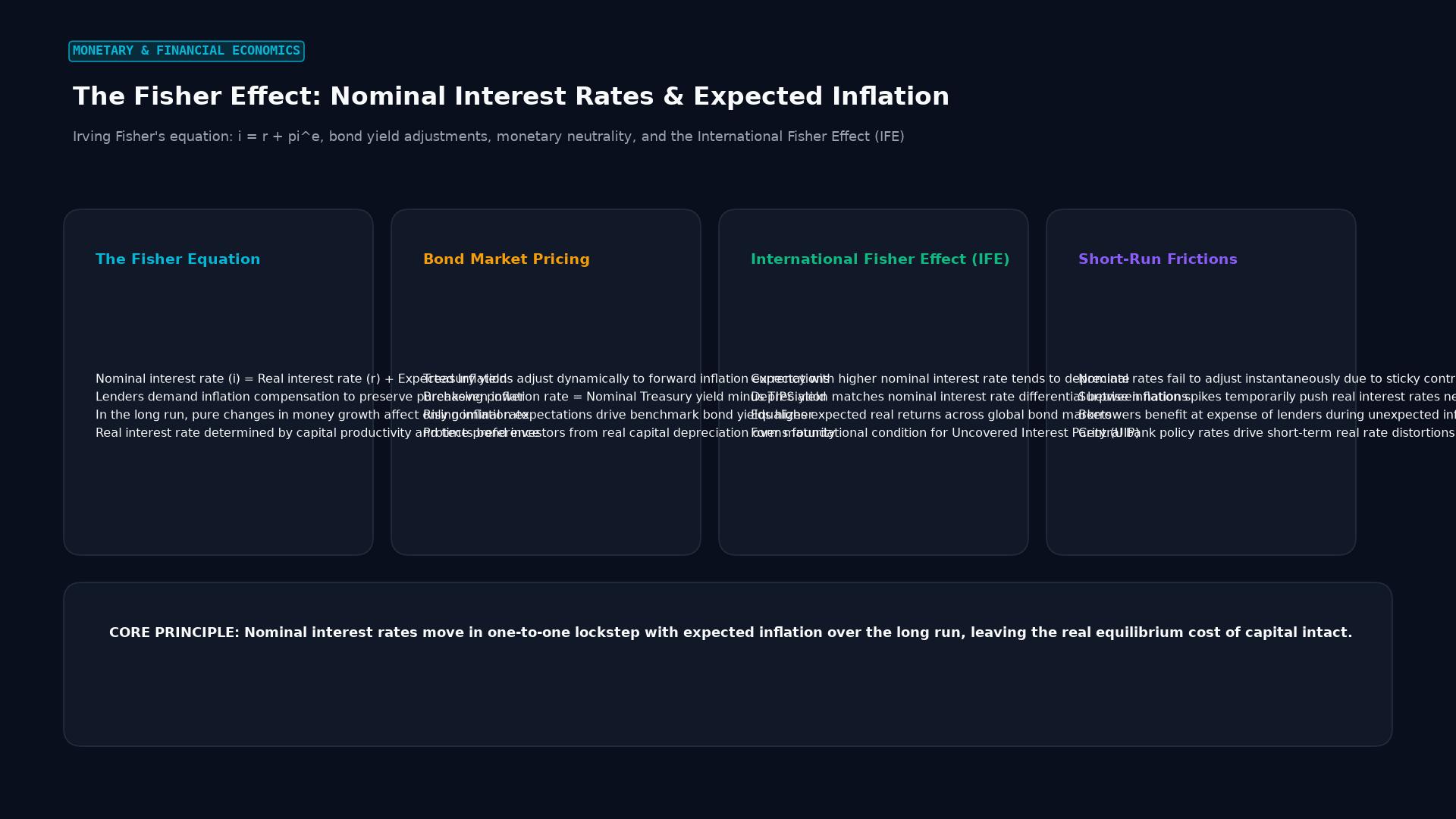 Figure: Irving Fisher’s equation: i = r + pi^e, bond yield adjustments, monetary neutrality, and the International Fisher Effect (IFE)
The Mathematical Formulation
The relationship is formally expressed through the Fisher Equation:
$$1 + i = (1 + r)(1 + \pi^e)$$
Expanding the equation gives:
$$1 + i = 1 + r + \pi^e + (r \times \pi^e)$$
In low-inflation economies, the cross-product term $(r \times \pi^e)$ is small enough to ignore, yielding the familiar linear approximation:
$$i \approx r + \pi^e$$
Where:
- $i$ = Nominal interest rate (the stated market yield on a Treasury bill or bank deposit)
- $r$ = Real interest rate (yield adjusted for inflation)
- $\pi^e$ = Expected rate of price inflation over the investment horizon
If an investor buys a 1-year US government bond yielding 5.0% nominal interest while expecting annual inflation to average 3.0%, the investor’s anticipated real return is:
$$r \approx 5.0% - 3.0% = \mathbf{2.0%}$$
If inflation unexpectedly surges to 6.0%, the investor’s real return turns negative ($-1.0%$), eroding the real purchasing power of their capital despite earning nominal interest.
The International Fisher Effect (IFE)
In international finance and foreign exchange, Fisher’s domestic equation extends into the International Fisher Effect (IFE). The IFE hypothesis combines the domestic Fisher Effect with Purchasing Power Parity (PPP) to project how exchange rates between two countries should evolve over time.
According to the IFE, because real interest rates tend to equalize across open global capital markets through international arbitrage, any difference in nominal interest rates between two nations must reflect differences in their expected inflation rates. Because higher inflation erodes a currency’s purchasing power, the currency with the higher nominal interest rate is mathematically expected to depreciate against the currency with the lower nominal interest rate by an amount equal to the interest rate differential.
The mathematical formula for the expected change in spot exchange rates is:
$$\frac{E(S_1) - S_0}{S_0} \approx i_d - i_f$$
Where:
- $E(S_1)$ = Expected future spot exchange rate
- $S_0$ = Current spot exchange rate
- $i_d$ = Nominal interest rate in the domestic quote currency
- $i_f$ = Nominal interest rate in the foreign base currency
Numerical IFE Example
Assume the following annualized 1-year parameters for the British Pound and the Japanese Yen:
- UK Nominal Yield ($i_d$): 5.25% (reflecting ~3.25% expected inflation + 2.0% real rate)
- Japan Nominal Yield ($i_f$): 0.25% (reflecting ~0.0% expected inflation + 0.25% real rate)
- Current GBP/JPY Spot ($S_0$): 200.00
Under the International Fisher Effect:
$$\frac{E(S_1) - 200.00}{200.00} \approx 0.0525 - 0.0025 = +0.050 \text{ (or } +5.0%)$$
Because UK inflation is substantially higher, the theoretical model predicts that the British Pound will depreciate by approximately 5% against the Japanese Yen over the coming year, causing GBP/JPY to fall toward 190.00, wiping out the UK yield advantage.
Why the International Fisher Effect Fails in the Short Term: The Carry Trade
While the International Fisher Effect exhibits reasonable explanatory power over 5-to-10-year macroeconomic horizons, it consistently fails in the short-to-medium term (1 to 24 months). This failure is widely documented in empirical finance as the “forward premium puzzle.”
Instead of depreciating as the IFE predicts, currencies with high nominal interest rates frequently appreciate over medium-term horizons. This occurs because global hedge funds and institutional macro desks execute carry trades: borrowing in low-yielding currencies (like the Japanese Yen or Swiss Franc) to purchase assets in high-yielding currencies (such as the US Dollar, Mexican Peso, or British Pound).
Macro Theory (IFE) vs. Real-World Currency Market
------------------------------------------------------------------------
IFE Theoretical Expectation:   High Rate Currency DEPRECIATES (Compensates Inflation)
Real Market Behavior (Carry):  High Rate Currency APPRECIATES (Attracts Capital Inflows)
Result:                        Sudden violent crashes occur when carry trades unwind
This structural inflow creates persistent upward spot pressure on the high-yielding currency, defying the IFE until an economic shock or sudden central bank shift forces a violent carry trade unwinding.
Key Takeaways
- The Fisher Effect demonstrates that the nominal interest rate is the sum of the real interest rate and expected inflation.
- Real interest rates reflect actual growth in purchasing power, whereas nominal rates include an inflation risk premium.
- The International Fisher Effect (IFE) posits that currency exchange rates fluctuate to offset nominal interest rate differentials between countries.
- In theory, high-interest currencies should depreciate over time to eliminate cross-border arbitrage opportunities.
- In reality, the IFE fails in the short term due to the foreign exchange carry trade, where speculative capital floods into high-yielding currencies for extended periods.
Frequently Asked Questions
What happens to a currency if the central bank raises nominal rates but inflation rises faster?
If nominal interest rates increase by 100 basis points while inflation expectations surge by 200 basis points, the country’s real interest rate actually declines. Despite the nominal rate hike, the currency frequently weakens because global capital seeks positive real yields.
What is the difference between the Fisher Effect and the International Fisher Effect?
The domestic Fisher Effect explains the relationship between nominal interest, real interest, and inflation within a single national economy. The International Fisher Effect extends this concept across borders, using interest rate disparities between two sovereign nations to project future currency exchange rate movements.
Why do TIPS (Treasury Inflation-Protected Securities) rely on the Fisher Effect?
TIPS are government bonds indexed directly to the Consumer Price Index. The difference between a standard nominal Treasury bond yield and a TIPS yield of the same maturity represents the “breakeven inflation rate”—the market’s direct application of the Fisher Effect to price expected inflation.
Ready to trade forex?
Open a free demo account with a regulated broker. Practice with virtual funds before risking real money.