Fixing
A currency fixing is a standardized daily reference exchange rate established at a precise time by central banks, price reporting agencies, or electronic consortia to benchmark institutional portfolio valuations, settle corporate contracts, and rebalance global index funds.
What Is a Currency Fixing?
In international finance and foreign exchange, a currency fixing (or FX fix) is a standardized daily exchange rate calculated and published at a specific time of day. Unlike continuous spot foreign exchange trading, where bid and ask prices fluctuate second-by-second across 24 hours, a fixing establishes an official, universally recognized single reference price for each currency pair on that calendar date.
Fixings serve as the accounting bedrock for institutional capital allocation. Sovereign wealth funds, international pension trustees, mutual fund managers, and multinational corporations use fixings to rebalance global multi-currency portfolios, calculate net asset values (NAV) for benchmark indices (such as the MSCI World Index), and settle commercial international supply contracts without haggling over intraday market spreads.
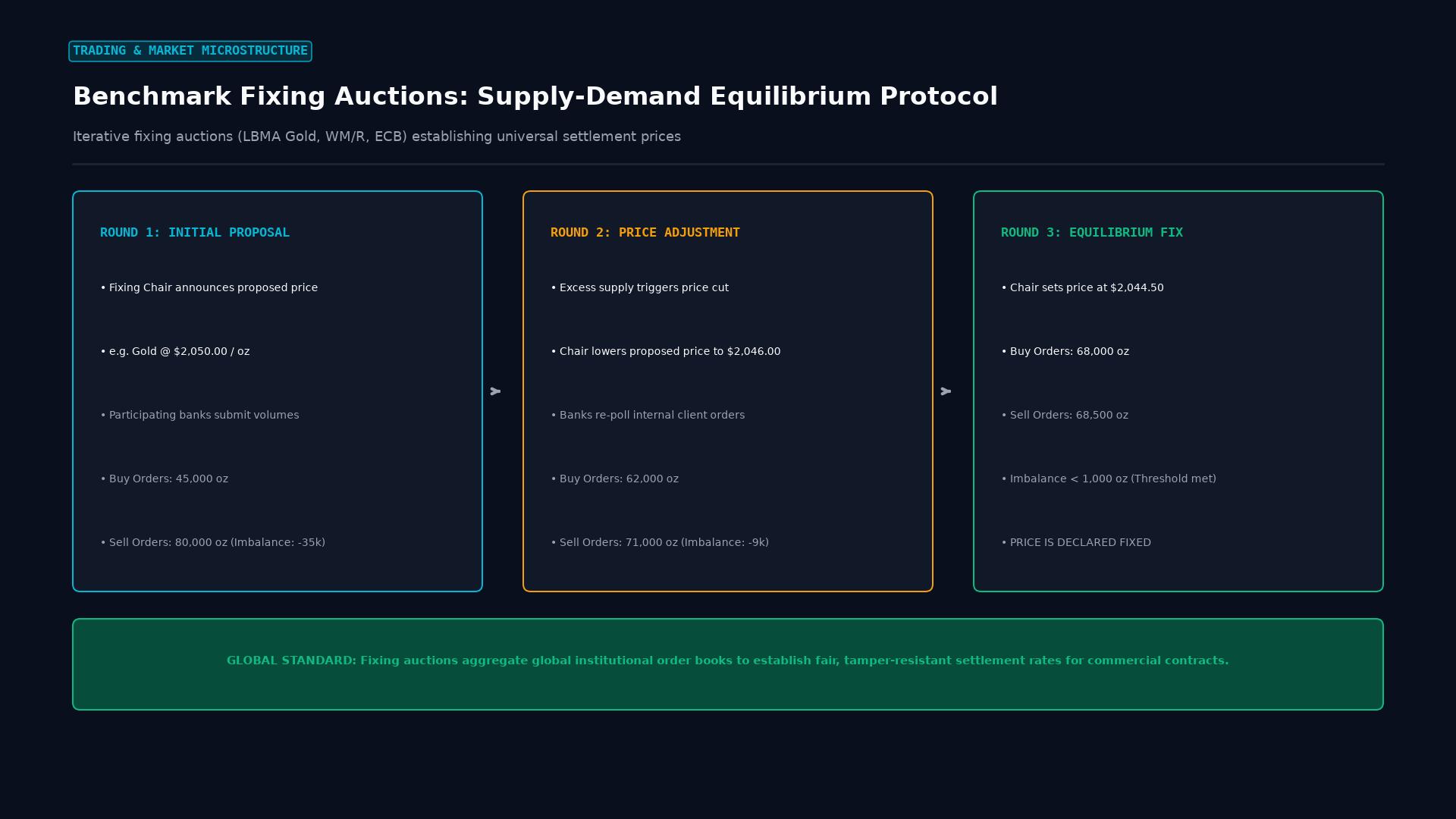 Figure: Fixing auction methodology: multi-round iterative price adjustments balancing global institutional supply and demand to establish transparent settlement benchmarks.
Key Takeaways
- The Global Anchor: The WM/Refinitiv (WMR) 4:00 PM London Fix is the undisputed world benchmark, determining the pricing for hundreds of billions in daily cross-border asset rebalancing.
- “At the Fix” Execution: Institutional fund managers instruct dealer banks to execute trades “at the fix,” guaranteeing that their execution price perfectly matches the official benchmark rate, eliminating portfolio tracking error.
- The 2013 Market Manipulation Scandal: The historic FX fixing scandal revealed that interbank traders colluded via private chat rooms (“The Cartel”) to front-run massive client fixing orders, leading to over $10 billion in global regulatory fines.
- 5-Minute Calculation Reform: In response to the scandal, global regulators widened the benchmark sampling window from 1 minute to 5 minutes (from 2.5 minutes before the hour to 2.5 minutes after), severely reducing the ability of rogue dealers to artificially manipulate fix rates.
Major Global Currency Fixings
Financial markets rely on several primary regional fixings corresponding to local business centers:
| Fixing Benchmark | Local Time | Administering Entity | Primary Market Application |
|---|---|---|---|
| WMR London 4:00 PM Fix | 16:00 London (GMT/BST) | LSEG Benchmark Administration | The undisputed global benchmark for equity index NAV, pensions, and FX forwards |
| Tokyo TTM Fix | 09:55 AM JST | Bank of Tokyo-Mitsubishi / Major Japanese Banks | Commercial corporate import/export settlements; “Gotobi” dates (every 5th/10th of month) |
| ECB Reference Rates | 14:15 CET | European Central Bank (Frankfurt) | Official non-commercial reference rate; statutory corporate accounting across the EU |
| PBoC Daily Yuan Fixing | 09:15 AM CST | People’s Bank of China | Official daily central parity rate around which onshore USD/CNY is permitted to trade $\pm 2%$ |
How “At the Fix” Orders Work
To understand why fixings dominate institutional order flow, consider an American pension fund that owns $10 billion of European equities tracked against an MSCI Index:
- At the end of each month, the fund must convert €500 million of dividend returns into U.S. Dollars.
- If the fund manager trades via discretionary spot orders throughout the day, their execution price will differ from the closing index benchmark, resulting in tracking error.
- Instead, the manager submits an “At the Fix” order to an investment bank. The bank legally guarantees to fill the entire €500 million at the official 4:00 PM WMR fix rate.
- The bank assumes the market risk of acquiring the currency across the fixing window, profiting if it can execute the underlying currency slightly better than the published benchmark.
The 2013 FX Fixing Manipulation Scandal
Prior to 2014, the WMR London Fix was calculated using a narrow 60-second window (30 seconds before and after 4:00 PM). A consortium of senior foreign exchange traders at major investment banks (including Barclays, Citigroup, JPMorgan, UBS, and RBS) formed illicit online chat rooms nicknamed “The Cartel” and “The Mafia”:
The Front-Running Fixing Scheme:
1. Traders shared non-public confidential client order volumes ahead of the fix.
2. Knowing the syndicate held a massive net BUY fix order for EUR/USD, traders
   bought spot EUR/USD minutes BEFORE the fix using bank proprietary capital ("front-running").
3. During the 60-second fix window, traders flooded the market with buy orders ("banging the close"),
   ramping the 4:00 PM fix price to an artificial high.
4. The banks billed their clients at the inflated fix rate, while dumping their cheap
   front-run currency back into the market for millions in personal bonuses.
The resulting investigations by the UK FCA, U.S. CFTC, and Swiss FINMA resulted in criminal convictions, massive algorithmic overhaul, and the adoption of the FX Global Code.
Frequently Asked Questions
Can retail traders trade “At the Fix”?
Direct “At the Fix” order routing is typically reserved for institutional accounts, corporate treasuries, and large hedge funds via FIX API connections. However, retail traders routinely trade the volatility and momentum surrounding the 4:00 PM London Fix, as massive institutional order flows create predictable trend continuations or mean-reverting pin action between 15:45 and 16:15 London time.
What is the “Tokyo Gotobi Fix”?
In Japan, commercial businesses traditionally settle corporate invoices on days ending in 5 and 10 (known as Gotobi days: 5th, 10th, 15th, 20th, 25th, and 30th of the month). On Gotobi mornings leading up to the 9:55 AM JST Tokyo fixing, Japanese commercial importers execute immense buy orders for U.S. Dollars, creating a well-known historical bullish intraday bias for USD/JPY.
Does the European Central Bank profit from its daily fix?
No. The European Central Bank explicitly states that its daily reference rates (published at 14:15 CET) are purely informational and derived from averaging across European central banks. The ECB does not execute commercial client transactions against its reference fix.
Ready to trade forex?
Open a free demo account with a regulated broker. Practice with virtual funds before risking real money.