Flat/Square
Being flat or square is a market condition wherein an investor or trading desk holds zero active open positions, maintains zero directional currency exposure, or has fully balanced offsetting contracts, eliminating market price risk.
What Does It Mean to Be Flat or Square?
In financial market trading and foreign exchange dealing, being flat (or square) describes a state in which an investor, hedge fund, or interbank trading desk holds zero net market exposure. A trader is flat when all previously initiated buy and sell orders have been completely closed, offset, or settled, leaving account capital sitting 100% in uncommitted cash.
While retail traders commonly use the term “flat” (e.g., “I closed my positions and went flat ahead of the weekend”), institutional market makers and interbank dealers historically refer to this state as being “square” (e.g., “squaring the book”). At the conclusion of a trading session, an institutional dealing desk will execute closing trades to square its open inventory, ensuring that unexpected overnight price gaps or foreign interest rate movements cannot inflict losses on the bank’s balance sheet.
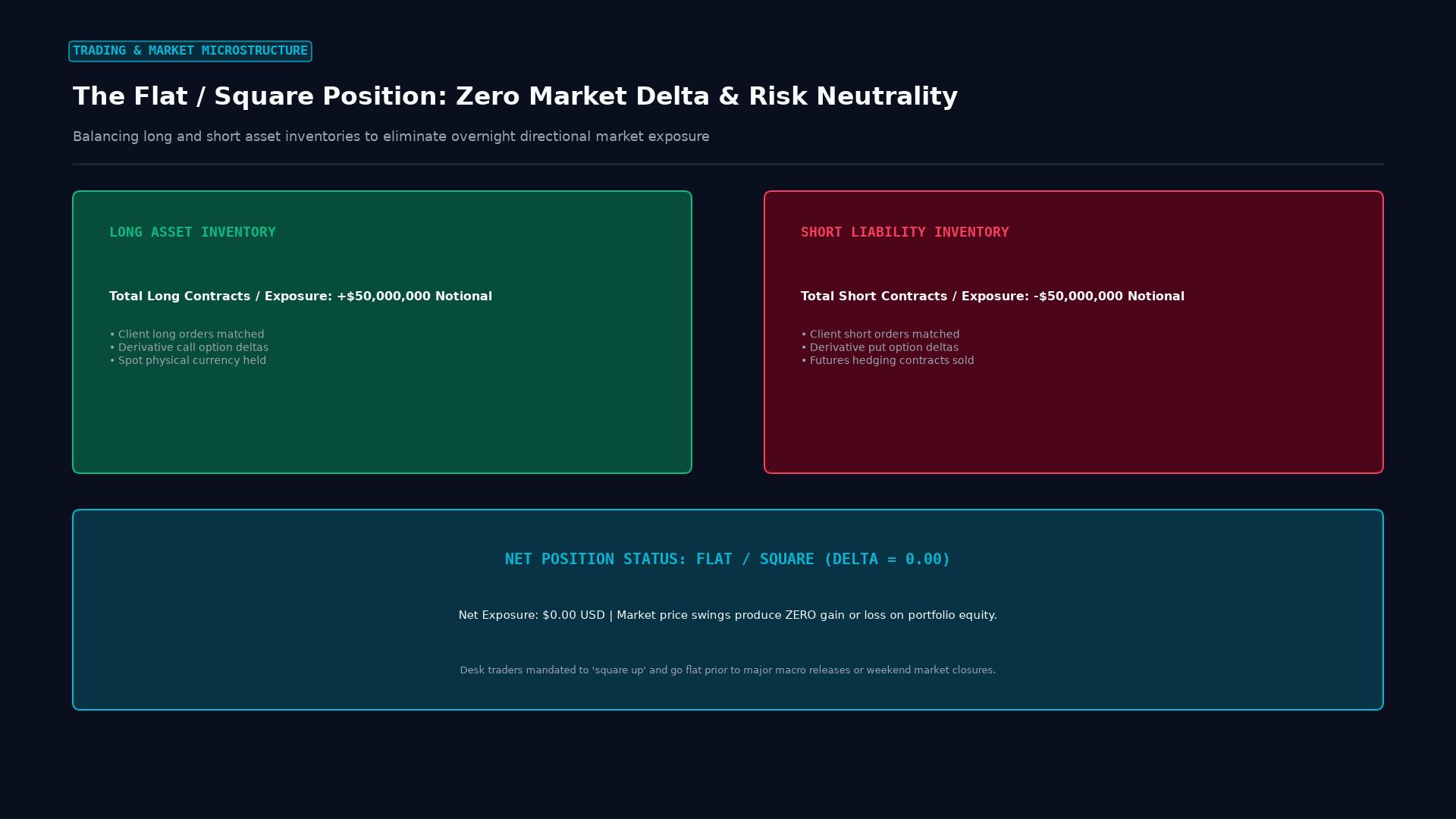 Figure: Balancing long and short asset inventories to establish exact net zero market delta ($0.00 exposure), completely immunizing portfolio equity from overnight market risk.
Key Takeaways
- Zero Directional Risk: A flat trader is completely indifferent to whether exchange rates surge higher or collapse lower; account equity remains unaffected by market volatility.
- “Squaring Up”: The process of liquidating long or covering short positions to bring net exposure precisely back to zero.
- Overnight Swap Elimination: When an account is flat at the 5:00 PM EST market cut-off, the trader incurs zero overnight rollover financing charges (swap debits).
- Cash Is an Active Position: Professional traders view sitting flat in cash as a deliberate, high-conviction strategic choice—not a passive absence of trading.
Position States Compared
| Dimension | Long Position | Short Position | Flat / Square Position |
|---|---|---|---|
| Market Outlook | Bullish (anticipates rising prices) | Bearish (anticipates falling prices) | Neutral / Ambiguous / Defensive |
| Net Market Delta | Positive ($+\Delta$) | Negative ($-\Delta$) | Zero ($\Delta = 0$) |
| Capital Commitment | Capital locked as Used Margin | Capital locked as Used Margin | 100% Free / Excess Margin |
| Overnight Risk | Subject to swap debits/credits & gap risk | Subject to swap debits/credits & gap risk | Zero gap risk; Zero swap cost |
| Execution Action | Buy to Open $\rightarrow$ Sell to Close | Sell to Open $\rightarrow$ Buy to Close | All trades closed; waiting for edge |
Strategic Reasons to Go Flat
Professional currency managers deliberately square their books under several key operational scenarios:
1. High-Impact Event Risk (Macroeconomic Binary Catalysts)
Ahead of unpredictable, binary risk events—such as U.S. Presidential Elections, emergency central bank rate summits, or major geopolitical referendums (like Brexit)—institutional desks square their books. Because spreads widen dramatically and liquidity vanishes during such events, staying in open positions transforms trading into unhedged gambling.
2. Weekend Gap Protection
The 24-hour foreign exchange market closes on Friday at 5:00 PM EST and reopens Sunday at 5:00 PM EST. News arriving over the weekend (such as military conflicts, bank failures, or unscheduled political resignations) can cause Monday market open prices to gap hundreds of pips away from Friday’s close, bypassing stop-loss orders. Going flat on Friday afternoon eliminates weekend gap risk entirely.
3. Psychological Reset During Drawdown
When an active trader suffers consecutive trading losses, emotional tilt and revenge trading frequently set in. Top proprietary trading firms mandate that struggling traders go completely flat for 24 to 48 hours. Stepping back into 100% cash clears mental anxiety, restores objective analytical discipline, and prevents catastrophic capital destruction.
Delta-Neutral vs. Pure Flat
In quantitative derivatives trading, a portfolio can be synthetically “square” without literally closing all contracts:
- A trader who is long 100,000 spot EUR/USD and simultaneously short 100,000 forward EUR/USD holds a delta-neutral (synthetically square) book.
- Although individual contracts remain open, the net portfolio exposure is zero. The position will neither gain nor lose money if the spot exchange rate moves.
Frequently Asked Questions
Is it a waste of time to sit flat in cash?
No. In professional financial trading, capital preservation is the first rule of survival. Forcing low-probability trades during choppy, directionless market consolidations is the primary cause of retail capital depletion. Patience—waiting flat until a clear, high-reward technical or fundamental edge appears—is a hallmark of elite trading performance.
What is the difference between “closing a trade” and “going flat”?
Closing a trade refers to exiting an individual position. If you hold three open trades and close one, you have closed a trade, but your portfolio is still active. You only “go flat” when all open positions are terminated, reducing total account open risk to zero.
What does “flat” mean when referring to a price chart?
When traders describe an exchange rate as “trading flat,” they mean the price action is moving sideways in a tight, horizontal consolidation range with virtually zero upward or downward trend momentum.
Ready to trade forex?
Open a free demo account with a regulated broker. Practice with virtual funds before risking real money.