Force Majeure
Force majeure is a contractual and statutory legal clause that temporarily suspends or permanently discharges a party from fulfilling its contractual obligations due to extraordinary, unforeseeable, and unavoidable events beyond its reasonable control.
What Is Force Majeure in Financial Markets?
In contract law, financial trading, and international commerce, force majeure (French for “superior force”) is a contractual provision that relieves one or both transacting parties from liability or performance obligations when an extraordinary, catastrophic event occurs that could not have been anticipated or prevented through reasonable foresight.
In the global foreign exchange (FX) and derivatives markets, force majeure clauses govern relationships between interbank dealers, prime brokers, clearing houses, and institutional clients. When black-swan events—such as armed international conflict, sovereign capital controls, the complete shutdown of global telecommunications or payment rails (like SWIFT or CLS), or statutory government prohibitions on foreign currency conversions—paralyze financial infrastructure, force majeure prevents parties from being sued for contractual default while establishing orderly protocols for trade termination.
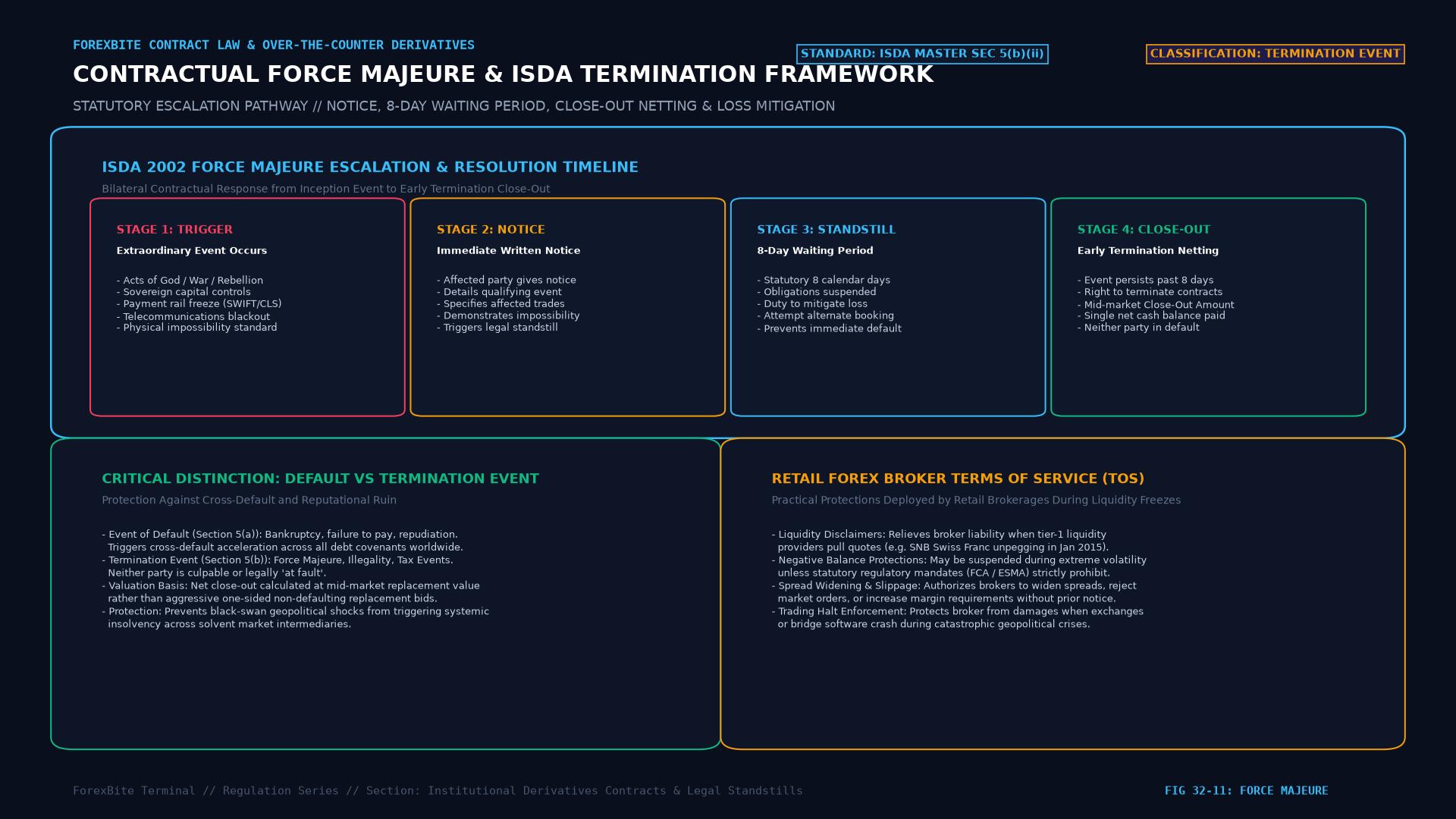 Figure: The ISDA contractual force majeure escalation timeline from catastrophic trigger event through the statutory 8-day waiting period to mid-market early termination netting.
Key Takeaways
- Relief from Default: Invoking a valid force majeure clause shields a market participant from breach of contract damages, penalty fees, and cross-default triggers.
- Strict Legal Thresholds: A party cannot claim force majeure simply because a trade became unprofitable; the event must render physical or electronic performance legally or physically impossible.
- ISDA Master Agreement Standard: The 2002 ISDA Master Agreement codifies “Force Majeure” under Section 5(b)(ii) as an official Termination Event, distinct from an Event of Default.
- Forex Broker Terms of Service: Retail broker client agreements explicitly cite force majeure to disclaim liability for extreme liquidity freezes, internet gateway failures, and sudden sovereign currency unpeggings.
Qualifying Events in Foreign Exchange Contracts
Under institutional ISDA Master Agreements and exchange rules, qualifying force majeure events typically include:
| Event Category | Real-World Financial Example | Contractual Impact |
|---|---|---|
| Acts of War & Geopolitics | Outbreak of military hostilities, terrorist strikes on data hubs | Disables regional trading desks; suspends physical asset delivery |
| Sovereign Capital Controls | A government bans foreign currency outflows or freezes banking rails | Physical currency delivery becomes legally impossible (Transfer Risk) |
| Infrastructure Collapse | Complete subsea fiber optic cable severance, nationwide power grid failure | Electronic trade matching and SWIFT settlement messages paralyzed |
| Natural & Health Disasters | Catastrophic earthquakes or tsunamis flooding exchange data centers | Physical and electronic operations temporarily closed |
| Currency Confiscation | Sudden sovereign demonetization of banknotes or compulsory conversion | Contracts redenominated or settled at official administrative fixes |
Force Majeure in ISDA Master Agreements (The 2002 Framework)
Under the widely used 2002 ISDA Master Agreement, Force Majeure is classified as an Illegality / Force Majeure Termination Event:
- Waiting Period (Section 5(b)(ii)): When a force majeure event arises, an initial waiting period of eight business days applies. During these eight days, both parties must make reasonable commercial efforts to route payments through alternative offices or settlement channels.
- Termination Notice: If performance remains impossible after the waiting period, either party may declare an Early Termination Date on affected derivative transactions.
- Calculation of the Close-Out Amount: Unlike an Event of Default where the defaulting party is penalized, under Force Majeure both parties are deemed blameless. The non-affected party (or both parties jointly) calculates the fair-market Close-Out Amount for all open contracts, netting positions down to a single cash balance.
Recent Real-World Case Studies in Foreign Exchange
1. Russian Ruble (RUB) Sanctions (2022)
Following the imposition of international sanctions against the Central Bank of Russia and major Russian banks in February 2022, western banks were legally blocked from converting Russian Rubles or transferring funds via SWIFT. Major clearing houses (such as CME and ICE) and OTC derivatives desks declared force majeure, settling open RUB currency futures and forwards using cash benchmarks or freezing contracts.
2. The Swiss Franc De-pegging (January 2015)
When the Swiss National Bank unexpectedly abandoned the 1.20 EUR/CHF floor, multiple retail brokerages suffered liquidity blackouts where no interbank bank was willing to provide price quotes for over 30 minutes. Several brokerages invoked the force majeure clauses in their customer agreements to cancel erroneous trades executed at wildly distorted non-market rates.
Frequently Asked Questions
Can a trader invoke force majeure to cancel a massive trading loss?
No. Market volatility, sudden price crashes, and severe financial losses are inherent trading risks and do not constitute force majeure. Courts and regulatory arbitrations consistently rule that economic unprofitability or bad market timing is not an impossibility of performance.
What is the difference between “Force Majeure” and “Act of God”?
An “Act of God” refers exclusively to natural phenomena caused without human intervention (such as hurricanes, earthquakes, and floods). Force majeure is a much broader legal category that includes Acts of God alongside human-created extraordinary events, such as wars, armed insurgencies, government sanctions, and nationwide labor strikes.
What is the duty of mitigation?
Under international commercial law, the party invoking force majeure has an active legal duty to take all reasonable steps to minimize and mitigate the impact of the event. A bank or broker cannot passively sit idle; it must attempt to route trades through backup servers, alternative clearing entities, or secondary liquidity channels.
Ready to trade forex?
Open a free demo account with a regulated broker. Practice with virtual funds before risking real money.