Foreign Currency Effect
The foreign currency effect is the measurable financial impact that fluctuating foreign exchange rates exert upon the net returns of cross-border investments, multinational corporate earnings, and international portfolio valuations when translated into a domestic home currency.
What Is the Foreign Currency Effect?
The foreign currency effect (also referred to as the currency translation effect or FX drag/tailwind) describes the mathematical variance in an investor’s total return or a corporation’s reported earnings caused purely by fluctuations in foreign exchange rates. Whenever an individual, institutional fund, or corporation holds assets, conducts business, or earns revenues denominated in a foreign currency, the final financial performance in their domestic “home” currency is a composite of two distinct variables:
- The Underlying Asset Performance: The capital appreciation or dividend yield of the foreign asset in its local currency (e.g., the local stock price gain of a Japanese company in Yen).
- The Currency Translation Component: The percentage appreciation or depreciation of that foreign currency against the investor’s domestic reporting currency (e.g., the movement of JPY against USD).
In global asset management, the foreign currency effect can dramatically amplify international profits or completely erase substantial equity gains, transforming an otherwise successful foreign investment into a net financial loss.
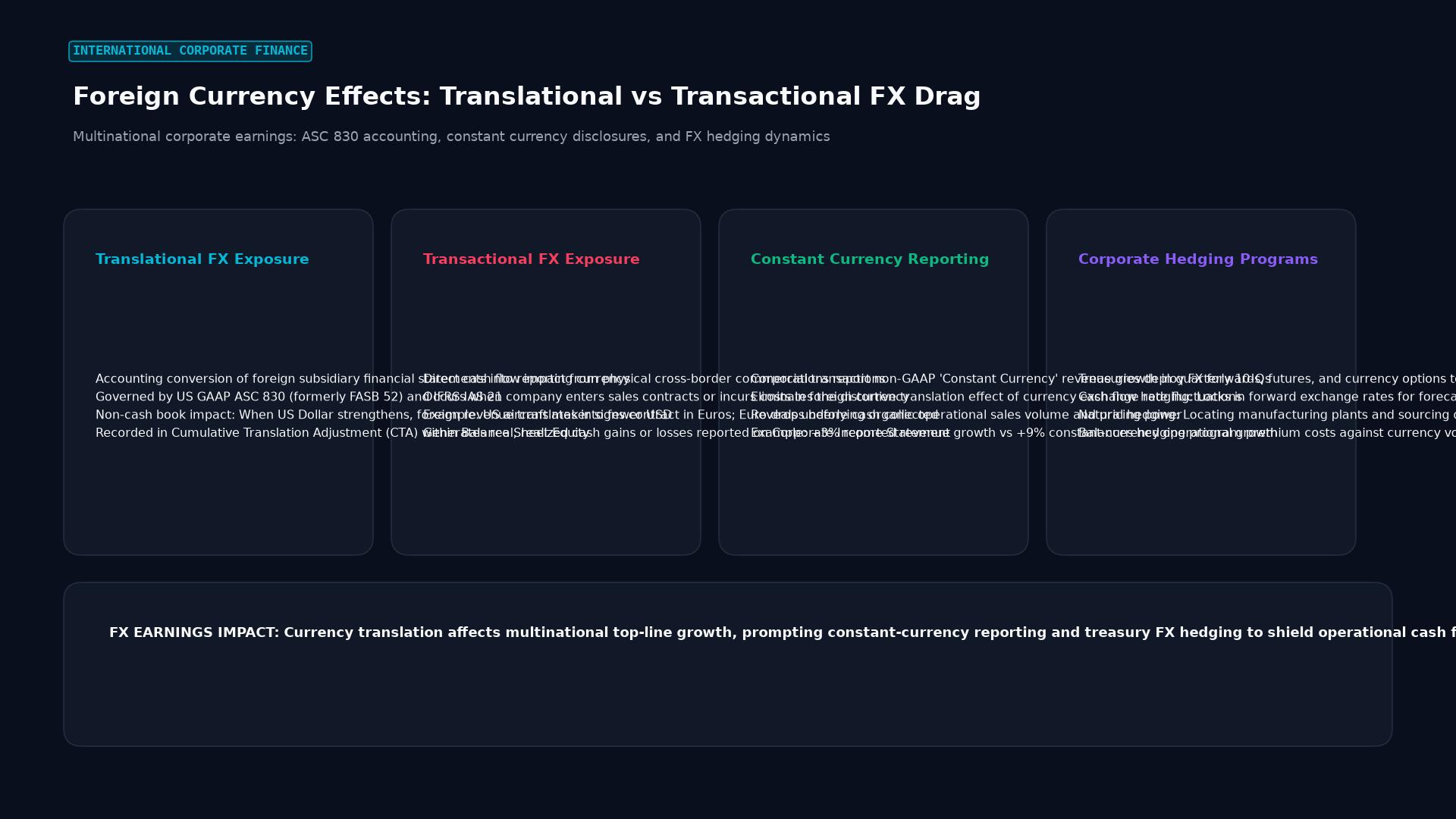 Figure: Multinational corporate earnings: ASC 830 accounting, constant currency disclosures, and FX hedging dynamics
Key Takeaways
- The Compounding Return Formula: Total return on an unhedged foreign asset is: $R_{\text{Total}} = (1 + R_{\text{Asset}}) \times (1 + R_{\text{FX}}) - 1$.
- The “Nikkei Dilemma” Example: If the Japanese Nikkei 225 stock index surges by +15%, but the Japanese Yen simultaneously depreciates by -20% against the U.S. Dollar, an American unhedged investor experiences a net loss of -8.0%.
- Corporate Earnings Translation: A strengthening domestic currency acts as a severe headwind for multinational corporations (such as Apple or Microsoft), shrinking foreign revenue when converted back into domestic balance sheets.
- Hedged vs. Unhedged ETFs: Global investors mitigate the currency effect by investing in currency-hedged Exchange-Traded Funds (ETFs), which utilize forward contracts to neutralize foreign exchange volatility.
Mathematical Formulation and Scenarios
The exact domestic-currency return ($R_{\text{Total}}$) derived from an unhedged international investment is computed as follows:
$$R_{\text{Total}} = (1 + R_{\text{Asset}}) \times (1 + R_{\text{FX}}) - 1 = R_{\text{Asset}} + R_{\text{FX}} + (R_{\text{Asset}} \times R_{\text{FX}})$$
Where:
- $R_{\text{Asset}}$ is the percentage return of the asset in its local foreign currency.
- $R_{\text{FX}}$ is the percentage change of the foreign currency relative to the investor’s domestic currency.
Scenario Matrix: S&P 500 Investor Holding European Assets
| Local European Stock Return ($R_{\text{Asset}}$) | EUR/USD Currency Move ($R_{\text{FX}}$) | Net Total USD Return ($R_{\text{Total}}$) | Nature of Currency Impact |
|---|---|---|---|
| +10.0% (Gain) | +10.0% (EUR Appreciates) | +21.0% Gain | Massive Tailwind: Returns compound positively |
| +10.0% (Gain) | 0.0% (Stable Currency) | +10.0% Gain | Neutral: Pure asset performance captured |
| +10.0% (Gain) | -10.0% (EUR Depreciates) | -1.0% Loss | Currency Drag: Wipes out all equity profits |
| -10.0% (Loss) | +15.0% (EUR Appreciates) | +3.5% Gain | Protective Cushion: Currency gain salvages loss |
| -10.0% (Loss) | -10.0% (EUR Depreciates) | -19.0% Loss | Compounded Catastrophe: Severe dual drawdown |
Corporate Impact: Multinational Translation Headwinds
For large corporations listed on the S&P 500 or FTSE 100 that generate 40% to 60% of their top-line revenues overseas, the foreign currency effect is a primary focal point during quarterly earnings calls:
- The Strong Dollar Drag: When the U.S. Dollar Index (DXY) surges, foreign customers paying in Euros, Pounds, or Yen generate fewer U.S. Dollars upon accounting consolidation. U.S. multinationals often report a “3% to 5% FX revenue headwind,” lowering earnings per share (EPS).
- Export Price Competitiveness: Conversely, a depreciating domestic currency makes domestic manufactured exports cheaper for overseas buyers, boosting sales volumes while generating foreign exchange translation bonuses.
Currency-Hedged vs. Unhedged Investment Vehicles
To manage this risk, institutional and retail asset managers choose between two investment architectures:
Unhedged Strategy vs. Currency-Hedged Strategy:
┌────────────────────────────────────────────────────────┐
│                 INTERNATIONAL PORTFOLIO                │
└──────────────────────────┬─────────────────────────────┘
                           │
       ┌───────────────────┴───────────────────┐
       ▼                                       ▼
┌──────────────────────────────┐ ┌──────────────────────────────┐
│     UNHEDGED INVESTMENT      │ │    CURRENCY-HEDGED ETF       │
│ • Full exposure to foreign   │ │ • Purchases rolling 1-month  │
│   equity + currency moves    │ │   FX Forward contracts       │
│ • Higher volatility          │ │ • Neutralizes FX volatility  │
│ • Superior if foreign        │ │ • Captures PURE local stock  │
│   currency is appreciating   │ │   performance minus swap fee │
└──────────────────────────────┘ └──────────────────────────────┘
Frequently Asked Questions
Is the foreign currency effect always negative?
No. The foreign currency effect is a double-edged sword. If you invest in foreign assets and that foreign currency appreciates against your home currency, your returns will be substantially higher than the local market gain.
How do currency-hedged ETFs eliminate the foreign currency effect?
Currency-hedged ETFs (such as hedged Japanese or European equity funds) enter into rolling forward foreign exchange contracts (FX Forwards). By selling the foreign currency forward against the domestic currency, any decline in the foreign currency’s spot value is offset by an equal cash gain on the derivative forward contract.
What is the difference between translation effect and transaction effect?
The transaction effect occurs when actual physical cash is exchanged to settle an active invoice or contract at an adverse rate. The translation effect is an accounting consolidation procedure where foreign subsidiary paper balances are converted into the parent company’s reporting currency without an actual cash conversion occurring.
Ready to trade forex?
Open a free demo account with a regulated broker. Practice with virtual funds before risking real money.