Free Reserves
Free reserves are the net surplus funds held by commercial depository institutions at the central bank, calculated as excess reserves (balances exceeding statutory minimum requirements) minus borrowed reserves drawn from the central bank discount window.
What Are Free Reserves?
In central banking and monetary economics, free reserves represent the net liquid reserve buffer available within the commercial banking system. Commercial banks maintain reserve deposits at their national central bank (such as the Federal Reserve or the European Central Bank) to satisfy statutory reserve requirements and settle interbank transactions.
Free reserves measure whether the banking system as a whole holds an autonomous surplus of liquid funds or is relying on emergency emergency borrowing from the central bank. Mathematically, free reserves equal excess reserves (total reserves minus legally required reserves) minus borrowed reserves (funds borrowed directly from the central bank’s discount window):
$$\text{Free Reserves} = \text{Excess Reserves} - \text{Borrowed Reserves}$$
When free reserves are positive, commercial banks possess excess uncommitted liquidity to expand business loans and buy securities. When free reserves turn negative—a state known as net borrowed reserves—the banking system is credit-strained, forcing institutions to borrow emergency funds directly from the central bank.
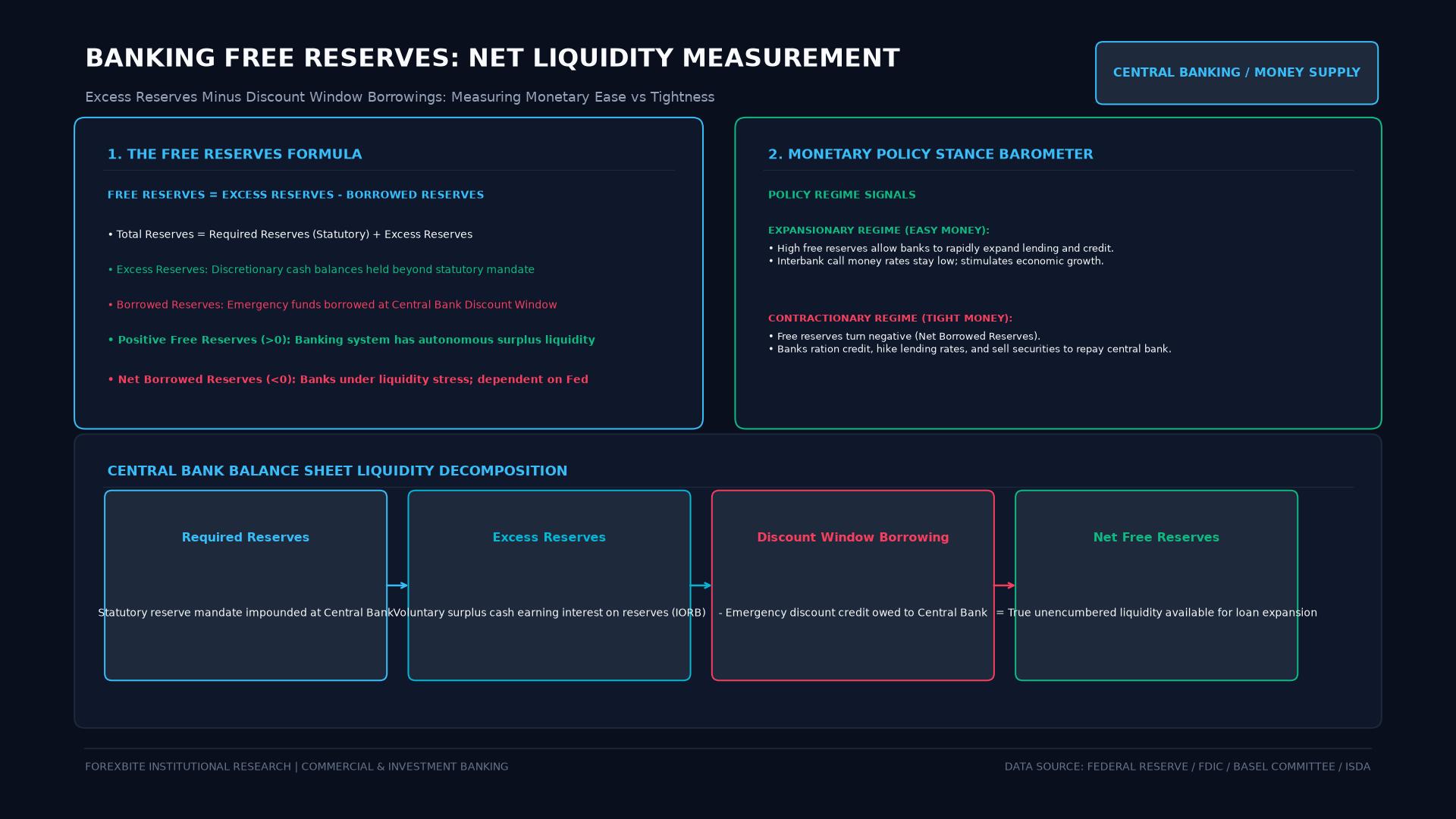 Figure: Commercial banking liquidity gauge: excess central bank reserves minus discount window borrowings, delineating net free vs net borrowed reserve regimes.
Key Takeaways
- Macroeconomic Barometer: Historically, free reserves served as one of the Federal Reserve’s primary operational barometers for gauging monetary ease or tightness across the banking system.
- Positive Free Reserves (Monetary Ease): Indicates that commercial banks are flush with surplus liquidity, incentivizing banks to lower lending rates and expand private credit.
- Net Borrowed Reserves (Monetary Tightness): Indicates credit contraction; commercial banks are short on liquidity and must borrow from the central bank at penalty discount rates to meet clearing obligations.
- Evolution Under Abundant Reserves: Following the 2008 financial crisis and the Federal Reserve’s massive Quantitative Easing (QE) programs, the banking system transitioned to an “Abundant Reserves Framework,” pushing excess reserves into the trillions of dollars and rendering traditional reserve requirements obsolete.
The Four Categories of Central Bank Reserves
To understand bank balance sheets, analysts categorize central bank balances into four distinct tiers:
| Reserve Tier | Definition & Regulatory Status | Primary Economic Function |
|---|---|---|
| Required Reserves | The statutory minimum percentage of transaction deposits a bank must hold by law. | Historically enforced to control the money multiplier (reduced to 0% by Fed in 2020). |
| Excess Reserves | Total reserve deposits held at the central bank that exceed the required reserve threshold. | Provides an operational cushion for daily interbank clearing and payment spikes. |
| Borrowed Reserves | Reserve funds borrowed directly by commercial banks through central bank credit lines (Discount Window). | Measures institutional liquidity stress; carries administrative stigma. |
| Free Reserves | Excess Reserves minus Borrowed Reserves. | Reflects the banking sector’s net organic lending power without central bank debt. |
Free Reserves as an Indicator of Credit Conditions
Prior to the global financial crisis of 2008, the Federal Reserve managed monetary policy through a corridor system by adjusting the supply of non-borrowed reserves:
- Tightening Phase (Negative Free Reserves): When the Fed wished to cool inflation, it conducted open market bond sales, draining reserves from the system. As banks ran short of reserves, they were forced to borrow from the Fed’s discount window. Free reserves dropped into negative territory (Net Borrowed Reserves), pushing the interbank Federal Funds Rate higher.
- Easing Phase (Surging Free Reserves): When the Fed sought to stimulate the economy, it bought Treasury bills, injecting fresh reserves into bank accounts. Free reserves expanded rapidly, driving interbank money market borrowing costs down.
The Paradigm Shift: From Scarcity to the Abundant Reserves Regime
Following the 2008 financial crisis and the 2020 pandemic intervention, the Federal Reserve implemented Quantitative Easing (QE), purchasing trillions of dollars in government bonds from commercial banks:
- Trillions in Excess Reserves: Bank reserves skyrocketed from under $50 billion in 2007 to over $3.5 trillion by 2021.
- The Elimination of Reserve Requirements: In March 2020, the Federal Reserve Board officially reduced statutory reserve requirements to 0.00% for all depository institutions.
- IORB Administration: Today, the Fed controls short-term rates not by micro-managing free reserve scarcity, but by paying an administrative rate called Interest on Reserve Balances (IORB) directly on all bank deposits held at the central bank.
Frequently Asked Questions
Why do banks avoid borrowing reserves from the Discount Window?
Borrowing from the central bank discount window historically carried a severe industry stigma. Market participants and regulators viewed discount window borrowing as a confession of severe liquidity distress or counterparty insolvency, prompting healthy banks to borrow at higher rates in the private interbank repo market rather than tap the Fed.
How do free reserves affect the foreign exchange value of the U.S. Dollar?
In classical monetary economics, an abundance of free reserves signals loose domestic money supply and falling interbank lending rates, which historically exerts downward pressure on the currency (depreciation). Conversely, tight free reserves indicate constrained dollar liquidity, driving short-term dollar borrowing rates up and strengthening the U.S. Dollar.
Can an individual bank have negative free reserves while the aggregate banking system has positive free reserves?
Yes. An individual commercial bank that is mismanaging its daily liquidity may exhaust its excess reserves and borrow heavily from the discount window, giving it negative free reserves, even while the broader banking sector as a whole holds an aggregate surplus of free reserves.
Ready to trade forex?
Open a free demo account with a regulated broker. Practice with virtual funds before risking real money.