Fundamental Trader
A fundamental trader is an investor or market participant who determines trading entries, exits, and portfolio positioning based on macroeconomic indicators, central bank monetary policy, sovereign interest rate differentials, and geopolitical trends.
What Is a Fundamental Trader?
A fundamental trader is a market participant whose investment thesis and trade execution are driven by macroeconomic, financial, and geopolitical analysis rather than the geometric chart patterns or mathematical oscillators favored by technical analysts. In the foreign exchange (FX) market, a fundamental trader views currency exchange rates as reflective of relative national economic strength, productivity, inflation dynamics, and sovereign interest rate paths.
Rather than asking “What chart pattern is forming on the 4-hour timeframe?”, a fundamental trader asks: “Is the Federal Reserve likely to cut interest rates faster than the European Central Bank?” or “How will an unexpected surge in domestic wage inflation impact real sovereign bond yields?” Fundamental traders analyze the economic “engine” driving capital flows across international borders.
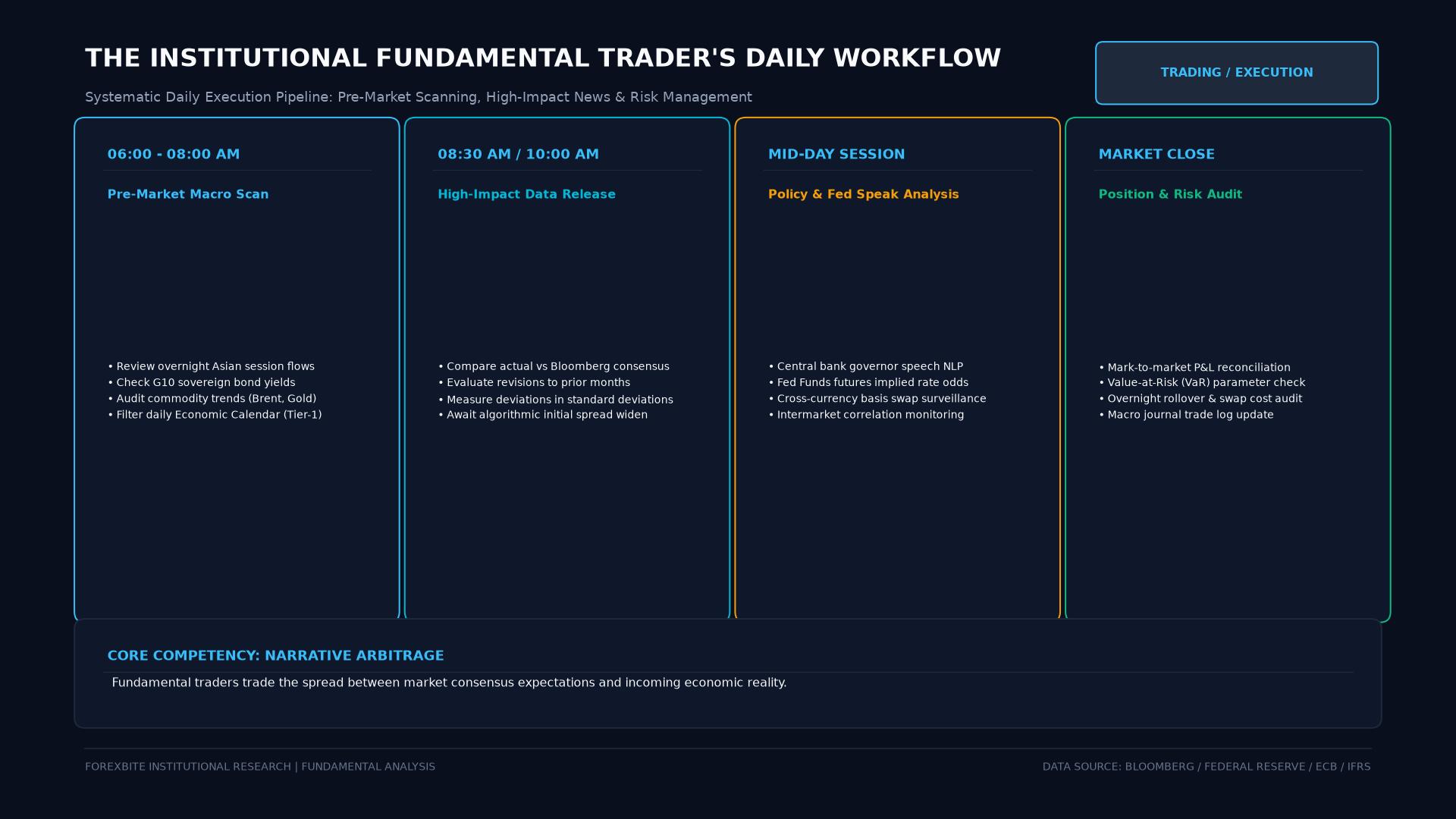 Figure: Systematic daily trading workflow of an institutional fundamental FX trader: pre-market macro scanning, high-impact data surprise evaluation, central bank communication parsing, and multi-asset risk management.
Key Takeaways
- Macro Driver Focus: Fundamental traders focus on the underlying economic catalysts that cause exchange rates to move: interest rate differentials, economic health data, trade balances, and central bank mandates.
- Intrinsic Fair Value: Fundamentalists operate under the belief that market exchange rates periodically diverge from economic reality, but will inevitably mean-revert toward long-term macroeconomic equilibrium.
- Catalyst-Driven Volatility: Fundamental traders monitor economic calendars, capitalizing on the divergence between actual data and institutional consensus expectations.
- The Modern Techno-Fundamentalist: While pure fundamentalists focus solely on macro data, the most successful modern FX traders synthesize fundamental analysis for directional bias with technical analysis for precise entry timing.
Primary Analysis Domains for Fundamental Currency Traders
1. Central Bank Monetary Policy & Interest Rate Differentials
The single most powerful fundamental driver in foreign exchange is the real interest rate differential between two countries:
- Central banks (such as the Fed, ECB, Bank of Japan, and Bank of England) raise rates to suppress inflation and lower rates to combat recession.
- Fundamental traders track 2-year sovereign bond yield spreads, forward rate expectations (OIS curves), and Fed “dot plots” to position ahead of multi-month currency trends.
2. Tier-1 Macroeconomic Reports
Traders track regular statistical indicators to gauge economic momentum:
- Employment Reports: Non-Farm Payrolls (NFP), wage growth, and jobless claims indicate labor market tightness.
- Inflation Metrics: Consumer Price Index (CPI), Producer Price Index (PPI), and Core Personal Consumption Expenditures (PCE).
- Economic Growth & Activity: Gross Domestic Product (GDP), Retail Sales, and Purchasing Managers’ Indices (PMIs).
3. Balance of Payments & Terms of Trade
Fundamentalists examine a country’s Current Account and Trade Deficit. Export-reliant economies that experience a surge in commodity prices (e.g., Australia exporting iron ore or Canada exporting crude oil) benefit from favorable “terms of trade,” driving fundamental demand for the domestic currency.
Fundamental Trader vs. Technical Chartist vs. Quantitative Trader
| Dimension | Fundamental Trader | Technical Chartist | Quantitative Trader (Quant) |
|---|---|---|---|
| Core Question | Why is the market moving? | Where is price likely to go based on history? | What mathematical/statistical edge exists in the data? |
| Primary Data Source | Economic indicators, central bank speeches, yield curves | Historical price charts, candlestick patterns, RSI, Fibonacci | Tick-level order flow, volatility surfaces, econometric regressions |
| Holding Horizon | Weeks to Months (Macro Position Trading) | Minutes to Days (Intraday / Swing) | Microseconds to Hours (Algorithmic / HFT) |
| Weakness | Can be fundamentally right, but suffer severe timing drawdowns | Vulnerable to sudden macro news breaks and liquidity vacuums | Prone to curve-fitting and model breakdown during black swans |
Three Styles of Fundamental Trading
- Event-Driven News Trading: Rapidly trading the immediate knee-jerk deviation between consensus forecasts and actual data prints (e.g., entering within 60 seconds of a CPI release).
- Monetary Policy Swing Trading: Holding positions across several weeks as market participants reprice expectations ahead of an upcoming central bank interest rate decision.
- Global Macro Thematic Trading: Multi-month institutional positioning based on structural global shifts—such as energy transitions, emerging market debt crises, or multi-year currency carry trades.
Frequently Asked Questions
Can a beginner succeed as a pure fundamental trader?
Trading purely on fundamentals is challenging for retail beginners because macroeconomic variables are slow to materialize, and foreign exchange prices can remain detached from fundamentals for extended periods due to speculative sentiment. Beginners generally find greater success combining fundamental direction with clear technical entry points.
Where do fundamental traders source their news?
Institutional fundamentalists utilize professional financial terminals such as Bloomberg Terminal or LSEG Refinitiv Workspace for instantaneous, machine-readable data feeds. Retail fundamental traders rely on real-time economic calendars (such as Forex Factory, DailyFX, or Investing.com) and live financial newswires.
What is “hawkish” vs “dovish”?
In fundamental currency analysis, a central bank official who favors higher interest rates to combat inflation is described as hawkish (bullish for the currency). An official who favors lower interest rates and monetary easing to stimulate growth and employment is described as dovish (bearish for the currency).
Ready to trade forex?
Open a free demo account with a regulated broker. Practice with virtual funds before risking real money.