Group of Eight (G8)
The Group of Eight (G8) was an intergovernmental political and macroeconomic forum comprising eight major industrialized nations—the United States, Japan, Germany, the United Kingdom, France, Italy, Canada, and Russia—that met annually between 1997 and 2014 to coordinate global economic and monetary policy.
What Was the Group of Eight (G8)?
The Group of Eight (G8) was an annual intergovernmental summit forum that brought together the political leaders and finance ministers of eight of the world’s most advanced industrialized economies: the United States, Japan, Germany, the United Kingdom, France, Italy, Canada, and Russia, along with representatives from the European Union. Between 1997 and 2014, the G8 represented approximately 50% of global Gross Domestic Product (GDP) and the overwhelming majority of global foreign exchange market liquidity.
In international finance, meetings of the G8 finance ministers and central bank governors were high-impact catalysts for foreign exchange markets. Joint communiqués issued at the conclusion of G8 summits set international benchmarks for sovereign debt management, fiscal policies, and coordinated central bank interventions to halt destabilizing currency volatility and combat beggar-thy-neighbor competitive currency devaluations.
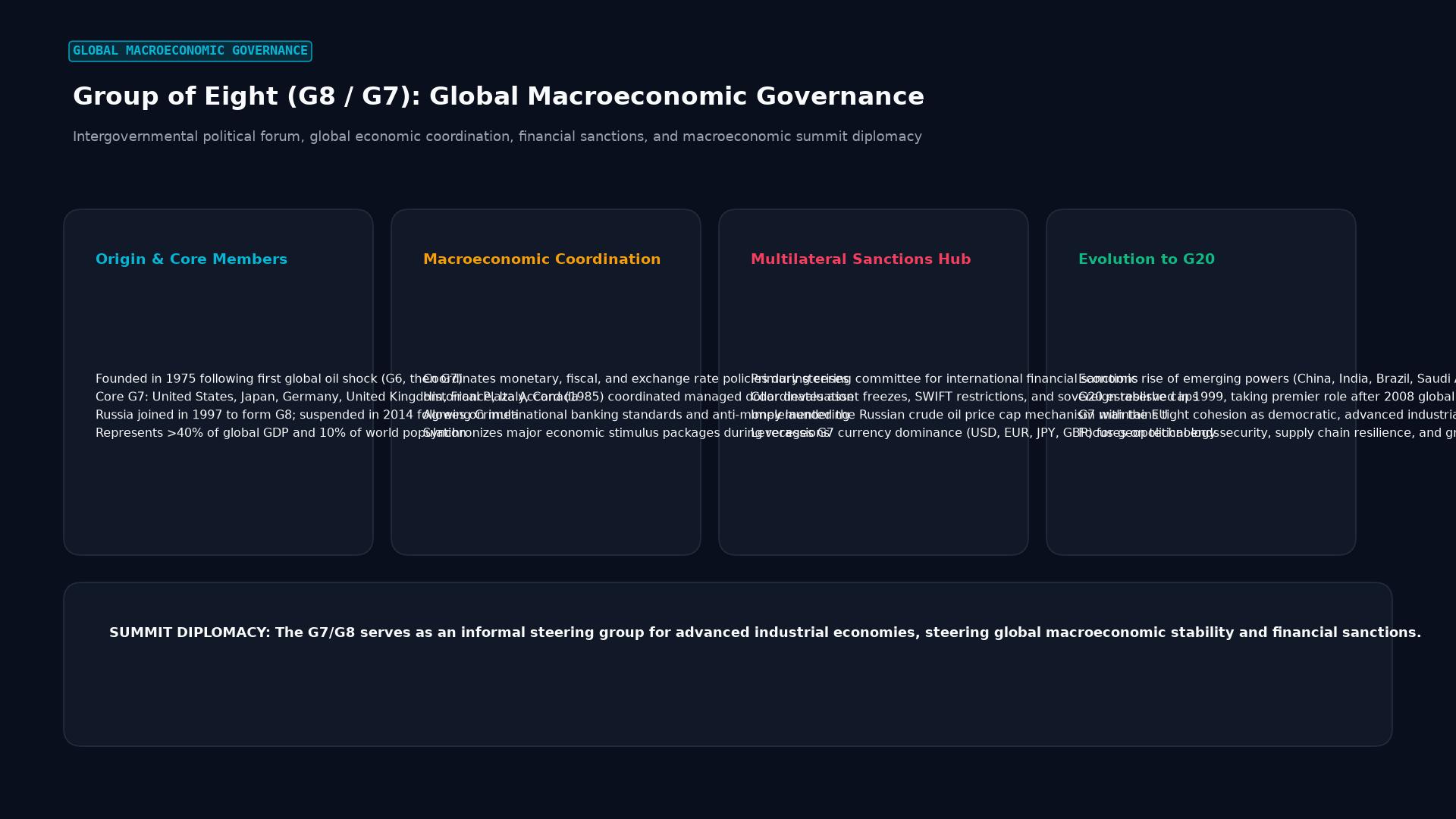 Figure: Intergovernmental political forum, global economic coordination, financial sanctions, and macroeconomic summit diplomacy
Key Takeaways
- Historical Duration: The G8 existed from 1997, when the Russian Federation was formally incorporated into the preexisting G7, until March 2014, when Russia was indefinitely suspended following the annexation of Crimea.
- The Modern G7: Following Russia’s suspension, the forum reverted to the Group of Seven (G7), which continues to meet annually to address international finance, trade, and geopolitical crises.
- Currency Coordination Power: The G7/G8 framework established the institutional mechanism for coordinated central bank foreign exchange interventions, most famously demonstrated by the Plaza Accord (1985) and the joint G7 Yen intervention after the Fukushima earthquake (2011).
- The Rise of the G20: Due to the rapid economic expansion of emerging market giants like China, India, and Brazil, the broader Group of Twenty (G20) has largely superseded the G7/G8 as the premier forum for global systemic financial regulation.
Landmark International Currency Accords
Historically, summit agreements between G7/G8 members have produced the most dramatic, sustained multi-year trend reversals in foreign exchange history:
1. The Plaza Accord (September 1985)
Convening at the Plaza Hotel in New York City, finance ministers and central bank governors of the G5 (U.S., Japan, West Germany, France, UK) agreed that the U.S. Dollar had become dangerously overvalued, generating unsustainable trade deficits. The nations agreed to conduct massive, coordinated open-market sales of dollars. Over the following two years, the U.S. Dollar depreciated by over 40% against the Japanese Yen and German Deutsche Mark.
2. The Louvre Accord (February 1987)
With the U.S. Dollar falling too rapidly, the G6 met at the Louvre Palace in Paris to halt the dollar’s decline. The member nations established informal currency target zones (fluctuation bands of $\pm 5%$) to stabilize international exchange rates.
3. The 2011 Coordinated G7 Yen Intervention
Following the catastrophic Tōhoku earthquake and tsunami in March 2011, Japanese repatriation flows caused USD/JPY to plunge to a historic record low of 76.25. On March 18, 2011, G7 central banks (including the Fed, ECB, and BOE) conducted joint coordinated market purchases of U.S. Dollars against the Yen, immediately reversing the speculative spike and stabilizing the Japanese financial system.
Comparing Global Economic Forums: G7 vs. G8 vs. G10 vs. G20
Traders must distinguish between overlapping international multilateral groups:
| Forum | Member Count | Core Nations | Primary Focus in Foreign Exchange |
|---|---|---|---|
| G7 | 7 | USA, UK, Germany, France, Italy, Japan, Canada (+ EU) | Democratic economic policy, sanctions, exchange rate stability declarations |
| G8 (Defunct) | 8 | G7 members + Russia (1997–2014) | Historic post-Cold War geopolitical and energy integration |
| G10 (Currencies) | 11 | G7 + Netherlands, Belgium, Sweden, Switzerland | The G10 Currencies: The most liquid, freely floating global reserve currencies |
| G20 | 20+ | G7 + China, India, Brazil, Saudi Arabia, S. Africa, etc. | Macroeconomic stability, global banking capital regulations (Basel III), IMF funding |
How G7/G8 Communiqués Move Forex Markets
At the conclusion of each summit, finance ministers release an official joint statement. Foreign exchange trading algorithms scan these communiqués for specific linguistic code words:
- “Excess volatility and disorderly movements in exchange rates are undesirable”: This standardized phrase signals that member central banks are dissatisfied with recent speculative runs and may conduct coordinated spot market currency interventions.
- “Reaffirming commitments to market-determined exchange rates”: Signals that central banks will not intervene in spot markets and will allow currencies to float freely based on macroeconomic fundamentals.
Frequently Asked Questions
Why was Russia expelled from the G8?
In March 2014, following the military annexation of the Crimean Peninsula from Ukraine, the other seven member nations (USA, UK, Germany, France, Italy, Japan, and Canada) condemned the violation of national sovereignty, cancelled the scheduled 2014 G8 summit in Sochi, and officially suspended Russia, permanently returning the forum to the G7.
Does the G7/G8 have a permanent headquarters or staff?
No. The G7 does not possess a permanent secretariat, charter, or headquarters like the United Nations or IMF. The presidency of the group rotates annually among the member nations, with the host country setting the summit agenda and organizing ministerial meetings.
What is the difference between the G7 and the G10 in forex trading?
The G7 is a political and economic forum of heads of state. In currency trading, G10 currencies refers to the eleven most liquid, heavily traded sovereign currencies governed by the Bank for International Settlements (BIS), which includes all G7 nations plus Switzerland, Sweden, the Netherlands, and Belgium.
Ready to trade forex?
Open a free demo account with a regulated broker. Practice with virtual funds before risking real money.