Gamma
Gamma is an option Greek that measures the rate of change in an option contract's Delta for every one-unit price movement in the underlying asset, quantifying the curvature and acceleration of directional exposure.
What Is Gamma in Options Trading?
Gamma ($\Gamma$) is one of the primary “Option Greeks” derived from the Black-Scholes-Merton options pricing model. While Delta measures how much an option’s premium changes when the underlying asset moves by one point (the “speed” of price change), Gamma measures how fast Delta itself changes—acting as the “acceleration” of an option position.
For institutional options traders, hedge funds, and market makers, Gamma is the premier metric for evaluating curvature and non-linear risk. A position with high Gamma means that a minor move in the spot currency pair can rapidly transform a neutral position into an aggressively directional long or short exposure.
+-------------------------------------------------------------------------+
|                         THE GREEKS ANALOGY                              |
|                                                                         |
|      Option Price  ====>  Distance Traveled                             |
|      Delta         ====>  Velocity (Speed of Price Change)             |
|      Gamma         ====>  Acceleration (Rate of Velocity Change)       |
+-------------------------------------------------------------------------+
The Mathematical Formulation
Mathematically, Gamma is the first derivative of Delta with respect to the underlying asset’s price ($S$), and the second derivative of the theoretical option price ($V$) with respect to $S$:
$$\Gamma = \frac{\partial \Delta}{\partial S} = \frac{\partial^2 V}{\partial S^2}$$
In standard Black-Scholes formulations for European currency options (the Garman-Kohlhagen model), Gamma is identical for both call options and put options sharing the same strike price, maturity, and underlying volatility:
$$\Gamma_{\text{call}} = \Gamma_{\text{put}} = \frac{N’(d_1) \cdot e^{-r_f \cdot T}}{S \cdot \sigma \cdot \sqrt{T}}$$
Where:
- $N’(d_1)$ = Standard normal probability density function evaluated at $d_1$
- $S$ = Spot exchange rate
- $\sigma$ = Implied volatility of the currency pair
- $T$ = Time to expiration (in years)
- $r_f$ = Foreign currency interest rate
Gamma Behavior Across Moneyness and Expiration
Gamma is not constant across an option’s lifespan. Its magnitude varies dramatically based on two critical parameters:
1. Moneyness (Strike vs. Spot Price)
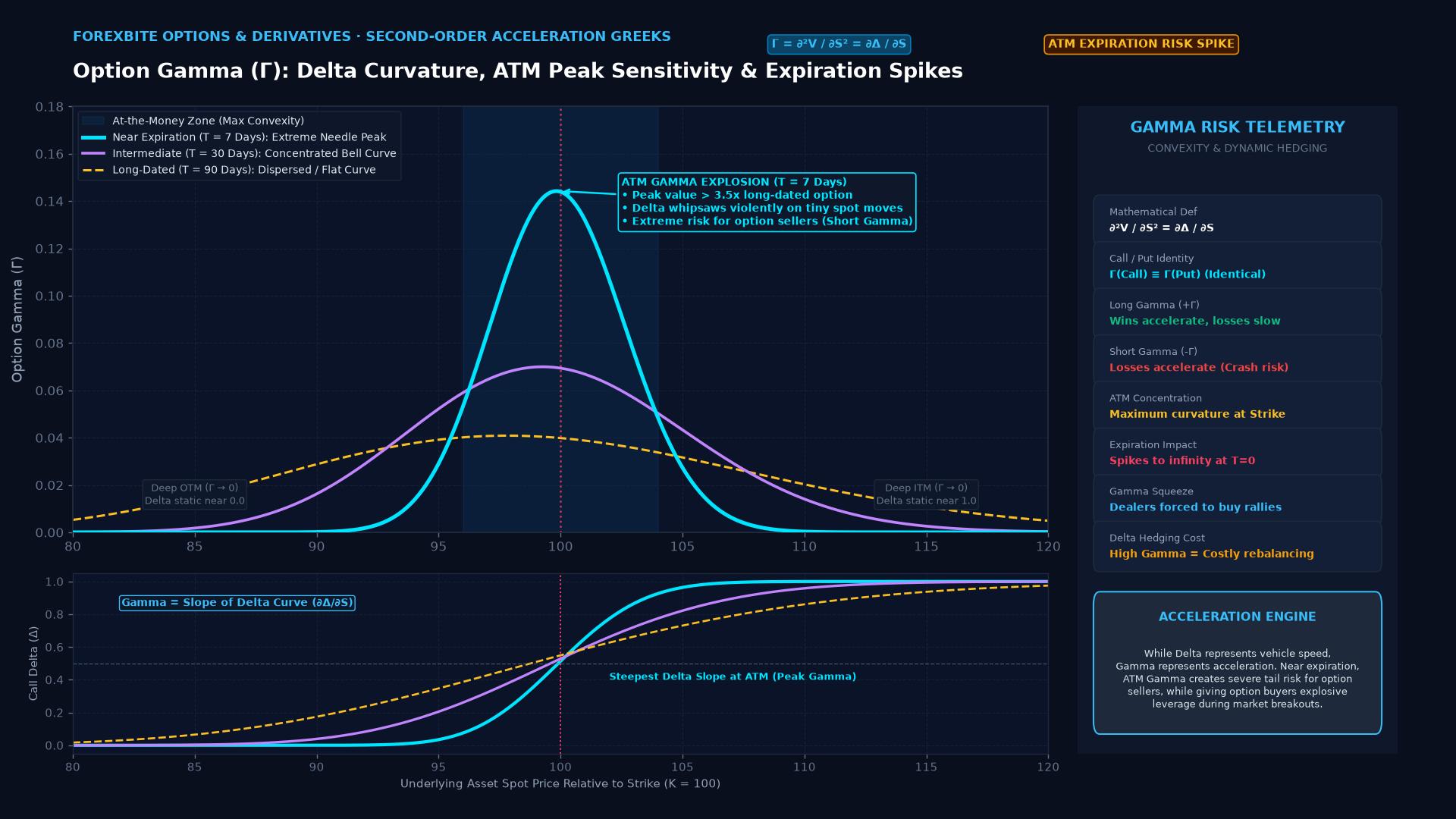
- At-the-Money (ATM): Gamma reaches its absolute maximum when an option is exactly at-the-money. Because the probability of expiring in-the-money hovers near 50%, small movements in spot price produce the sharpest swings in Delta.
- Deep In-the-Money (ITM) / Deep Out-of-the-Money (OTM): Gamma approaches zero. For deep ITM options, Delta is locked near 1.00; for deep OTM options, Delta is glued near 0.00. Small spot fluctuations do not meaningfully alter these extreme probabilities.
2. Time Decay (Expiration Proximity)
As expiration approaches, the Gamma of an at-the-money option explodes higher. On expiration day (0 DTE), an ATM option’s Delta can violently oscillate between 0.00 and 1.00 with every single pip move in the spot market, creating intense “Gamma risk” for option sellers.
Practical Calculation: How Gamma Alters Delta
Suppose a trader purchases a 30-day EUR/USD call option:
- Current Spot EUR/USD: 1.0800
- Call Option Strike: 1.0800 (At-the-Money)
- Initial Delta: +0.50
- Current Gamma: +0.05 per 100 pips (or 0.0005 per pip)
If EUR/USD advances by 100 pips to 1.0900:
$$\text{New Delta} = \text{Old Delta} + (\text{Gamma} \times \text{Spot Change})$$
$$\text{New Delta} = 0.50 + 0.05 = \mathbf{0.55}$$
Because the trader is “Long Gamma,” the position becomes increasingly bullish as the market rallies. Conversely, if EUR/USD falls 100 pips to 1.0700, Delta drops to 0.45, reducing the trader’s directional exposure and cushioning further downside losses.
Long Gamma vs. Short Gamma Profiles
| Characteristic | Long Gamma (Option Buyer) | Short Gamma (Option Seller) |
|---|---|---|
| Market Position | Long Calls or Long Puts | Short Calls or Short Puts |
| Delta Movement | Moves in your favor (wins accelerate, losses decelerate) | Moves against you (losses accelerate, gains decelerate) |
| Volatility Exposure | Benefits from large, sudden price explosions | Benefits from calm, range-bound price stagnation |
| Time Decay (Theta) | Pays theta decay daily | Collects theta decay daily |
| Hedging Requirement | Buy low, sell high (positive feedback) | Buy high, sell low (forced whipsaw hedging) |
The Mechanics of a “Gamma Squeeze”
A Gamma Squeeze occurs when institutional market makers who hold massive short Gamma positions are forced into aggressive, feedback-loop delta hedging.
When retail or speculative funds buy enormous volumes of short-dated out-of-the-money call options, market makers take the opposing short call side. To remain market-neutral, dealers must buy the underlying asset as price rises because their negative Gamma increases their short Delta exposure.
As spot prices rally toward the strike, dealers must buy more and more underlying contracts at market prices. This institutional buying pressure forces spot prices even higher, pulling additional strikes into the money and triggering an explosive, self-fulfilling price surge.
Key Takeaways
- Gamma measures the rate of change in Delta for every one-unit move in the underlying asset.
- Gamma represents the acceleration of an option position’s profit and loss profile.
- At-the-money (ATM) options have the highest Gamma, which increases exponentially as expiration draws near.
- Long Gamma positions expand directional exposure in profitable directions and reduce exposure during losses.
- Short Gamma poses severe tail risk for option sellers, requiring constant dynamic hedging that can trigger market-wide Gamma squeezes.
Frequently Asked Questions
Can Gamma ever be negative?
For individual options contracts, Gamma is always positive for long positions (buyers of calls or puts) and always negative for short positions (sellers/writers of calls or puts).
Why do institutional market makers fear expiration-day Gamma?
On expiration day, ATM options experience extreme Gamma spikes. A few ticks in the spot market can instantly swing an option from worthless (Delta 0) to fully exercised (Delta 1), forcing dealers to buy or sell massive volumes of spot currency in seconds to maintain delta neutrality.
How does implied volatility affect Gamma?
When implied volatility is low, Gamma is tightly concentrated in a sharp, narrow peak directly around the ATM strike. When implied volatility is high, Gamma flattens and spreads out across a much wider range of out-of-the-money and in-the-money strikes.
Ready to trade forex?
Open a free demo account with a regulated broker. Practice with virtual funds before risking real money.