At-the-Money
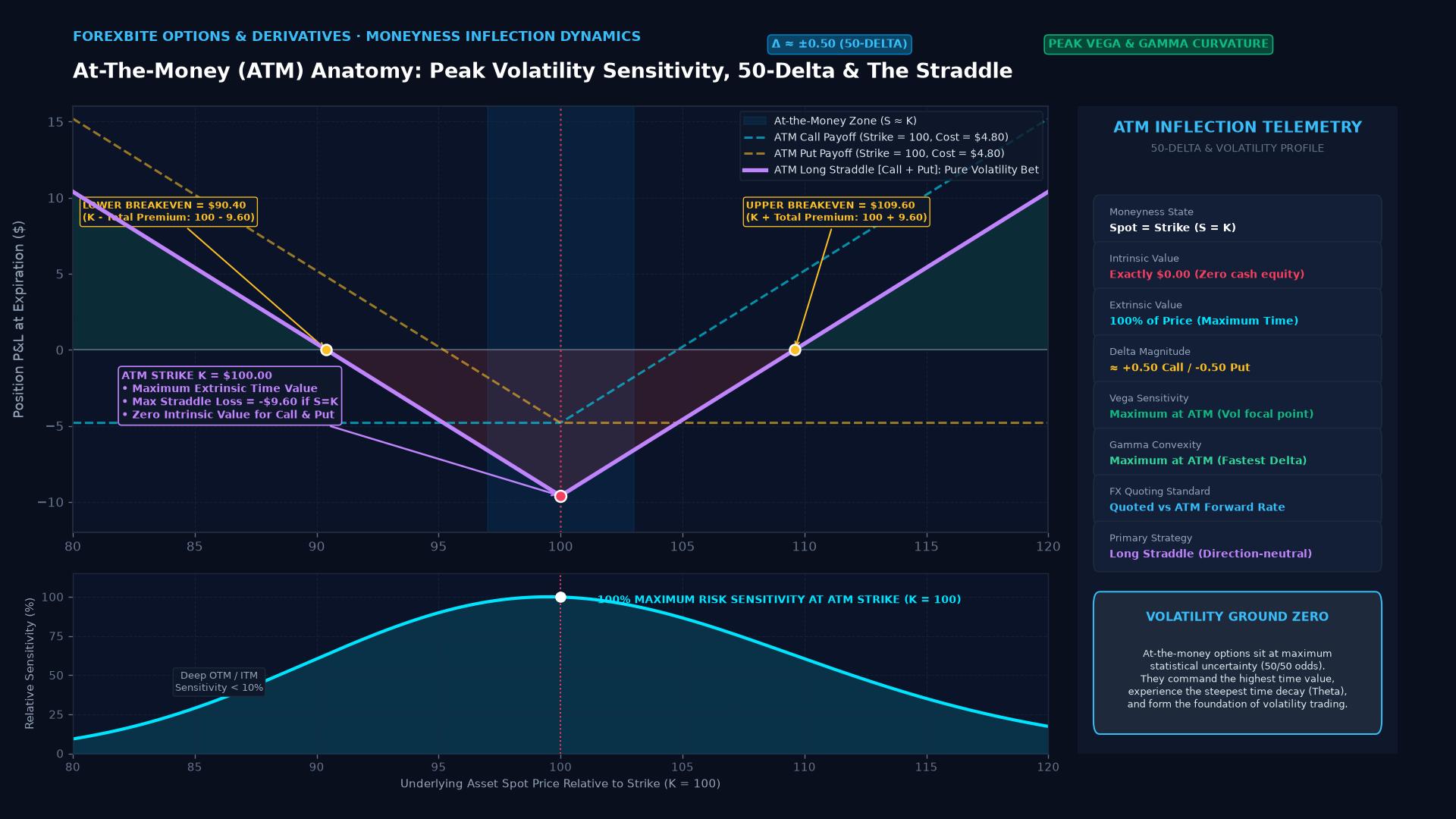
At-the-money (ATM) describes an option contract whose strike price is identical or virtually equal to the current spot or forward market price of the underlying asset. An ATM option carries zero intrinsic value and consists entirely of extrinsic or time value.
What Does At-the-Money Mean?
In financial derivatives and currency options, the concept of “moneyness” describes the relationship between an option contract’s strike price (the agreed price at which the contract can be exercised) and the prevailing market price of the underlying asset. Moneyness falls into three distinct classifications: In-the-Money (ITM), Out-of-the-Money (OTM), and At-the-Money (ATM).
An option is designated at-the-money when its strike price matches the current market price of the underlying instrument. For example, if EUR/USD is trading at 1.0850, a call option with a strike price of 1.0850 is at-the-money. A put option with the exact same 1.0850 strike price is also at-the-money.
Because exercising an ATM option at the current moment would yield zero immediate financial gain, the option possesses zero intrinsic value. However, it is far from worthless. An ATM option commands substantial premium in the marketplace because it carries maximum extrinsic value (also called time value)—the mathematical probability that price fluctuations before expiration will drive the contract into profitable territory.
Spot ATM vs. Forward ATM in Foreign Exchange
In equity and stock options, at-the-money almost always references the immediate spot price of the underlying share. In institutional foreign exchange options, a crucial technical distinction exists between Spot ATM and Forward ATM:
- Spot ATM: The strike price equals the current cash spot exchange rate.
- Forward ATM (ATM Forward): The strike price equals the forward exchange rate for the specific maturity date of the option.
Because national interest rates differ across currency pairs, Covered Interest Parity dictates that forward exchange rates trade at either a premium or discount to spot prices. In institutional interbank trading (over-the-counter FX options), vanilla options are almost universally quoted and traded relative to the ATM Forward strike. If US dollar interest rates are higher than Eurozone rates, EUR/USD forward rates trade lower than spot rates. A 3-month ATM Forward option will therefore have a strike price set slightly below the current spot market rate.
The Greeks at the Money
Traders monitor the mathematical risk sensitivities known as “the Greeks” to manage option portfolios. At-the-money options display distinctive Greek profiles that make them the focal point of volatility trading:
Delta ($\Delta \approx 0.50$)
Delta measures how much an option’s premium changes for every one-unit move in the underlying currency. An ATM call option typically has a delta close to +0.50 (often quoted as a “50-delta call”), while an ATM put option has a delta of roughly -0.50. This indicates a roughly 50% risk-neutral probability of the option expiring in-the-money.
Gamma ($\Gamma$ at Maximum)
Gamma measures the rate of change in Delta as the underlying price moves. Gamma peaks sharply for at-the-money options, particularly as expiration approaches. A small move in the spot currency pair causes an ATM option’s delta to swing dramatically toward 0 or 1.0, creating substantial acceleration in position risk.
Vega ($\nu$ at Maximum)
Vega measures an option’s sensitivity to changes in implied volatility. Because ATM options sit at the exact inflection point between profit and loss, they are the most responsive to shifts in market volatility expectations. Institutional desks trade “ATM volatility” as an asset class in itself, buying and selling ATM straddles to express views on market turbulence rather than market direction.
Theta ($\Theta$ Accelerated Decay)
Theta represents the rate of daily time value decay. ATM options experience the steepest absolute dollar decline in value as expiration approaches. For option sellers, writing ATM options yields the highest premium capture, but also carries the greatest gamma risk if the underlying currency breaks out violently.
Classic Trading Strategies Using ATM Contracts
Because ATM options offer maximum liquidity and symmetric price sensitivity, they form the cornerstone of popular options structures:
The Long Straddle
A trader simultaneously purchases an ATM call and an ATM put with the identical strike price and expiration date. This trade profits from a massive breakout in either direction. For instance, heading into a contentious central bank rate decision, a trader might buy an ATM EUR/USD straddle. If the exchange rate moves further than the total premium paid across both contracts, the position produces a net profit regardless of whether EUR/USD surges or collapses.
The Short Straddle
An options seller writes both an ATM call and an ATM put, collecting the combined premium. The trader wagers that the currency pair will remain tightly range-bound inside a narrow corridor through expiration. If the pair consolidates around the strike price, both options expire worthless, allowing the seller to retain 100% of the collected premium. However, this strategy carries theoretically unlimited risk if a sudden macroeconomic crisis sparks a violent trend.
Practical Trading Example
Suppose USD/JPY is trading at spot rate 155.00. A currency trader expects substantial volatility from an upcoming Bank of Japan monetary policy announcement scheduled in two weeks.
- The trader purchases a 14-day 155.00 ATM Call for 1.20 JPY per dollar.
- The trader purchases a 14-day 155.00 ATM Put for 1.20 JPY per dollar.
- Total premium invested: $1.20 + 1.20 = 2.40\text{ JPY}$ per USD.
The trade establishes two breakeven thresholds at expiration:
- Upper Breakeven: $155.00 + 2.40 = 157.40$
- Lower Breakeven: $155.00 - 2.40 = 152.60$
If the Bank of Japan delivers an unexpected rate hike and USD/JPY plunges to 150.00:
- The 155.00 call expires worthless (value = 0).
- The 155.00 put is deep in-the-money, with an intrinsic value of: $$ 155.00 - 150.00 = 5.00\text{ JPY} $$
- Deducting the initial 2.40 JPY cost yields a net profit of 2.60 JPY per dollar of notional contract size, illustrating how ATM options capture non-directional volatility.
Key Takeaways
- An at-the-money option has an exercise strike price that equals the current market price of the underlying currency pair.
- ATM options have zero intrinsic value and derive their entire market price from extrinsic time value and volatility expectations.
- In institutional forex, options are typically priced against the ATM Forward rate to account for cross-currency interest rate differentials.
- ATM contracts exhibit maximum Vega (volatility sensitivity), maximum Gamma (rate of delta change), and a Delta near 0.50.
- ATM options form the foundation for volatility trading strategies such as long and short straddles.
FAQ
Why do ATM options have the highest time value? Time value reflects uncertainty. When an option is deep in-the-money or deep out-of-the-money, its final outcome at expiration is relatively predictable. For an at-the-money option, the probability of finishing in-the-money or out-of-the-money sits near 50/50, maximizing the premium buyers are willing to pay for future price movement.
What happens to an ATM option at expiration? At the exact moment of expiration, if the underlying price remains identical to the strike price, the option expires worthless because it cannot be exercised for a net gain. To yield a return, the underlying price must move beyond the strike price by an amount greater than the original premium paid.
What is the difference between ATM and ITM? An In-the-Money (ITM) option already possesses tangible intrinsic value—a call strike is below market price, or a put strike is above market price. An At-the-Money (ATM) option has a strike equal to market price, carrying only potential value based on remaining time and expected market volatility.
Ready to trade forex?
Open a free demo account with a regulated broker. Practice with virtual funds before risking real money.