Gold Contract
A gold contract is a standardized financial futures or Over-the-Counter derivative agreement obligating the buyer to purchase and the seller to deliver a specified quantity and purity of gold bullion at an agreed price on a future delivery date.
What Is a Gold Contract?
A gold contract is a legally binding, standardized derivative agreement to buy or sell a specified quantity of refined physical gold bullion at an agreed price on a future settlement date. Gold contracts trade primarily in two institutional formats:
- Exchange-Traded Futures Contracts: Standardized contracts listed on regulated commodity exchanges, most notably the COMEX (a division of the Chicago Mercantile Exchange - CME Group) and the Shanghai Gold Exchange (SGE).
- Over-the-Counter (OTC) Spot Gold: Traded on interbank currency networks under the ISO 4217 currency code XAU/USD (or against other fiat currencies such as XAU/EUR and XAU/GBP).
In the global foreign exchange market, gold occupies a unique status as a “stateless sovereign currency.” While classified physically as a commodity, gold functions as a primary safe-haven monetary reserve asset held by sovereign central banks to hedge against fiat currency debasement, runaway inflation, and geopolitical turmoil.
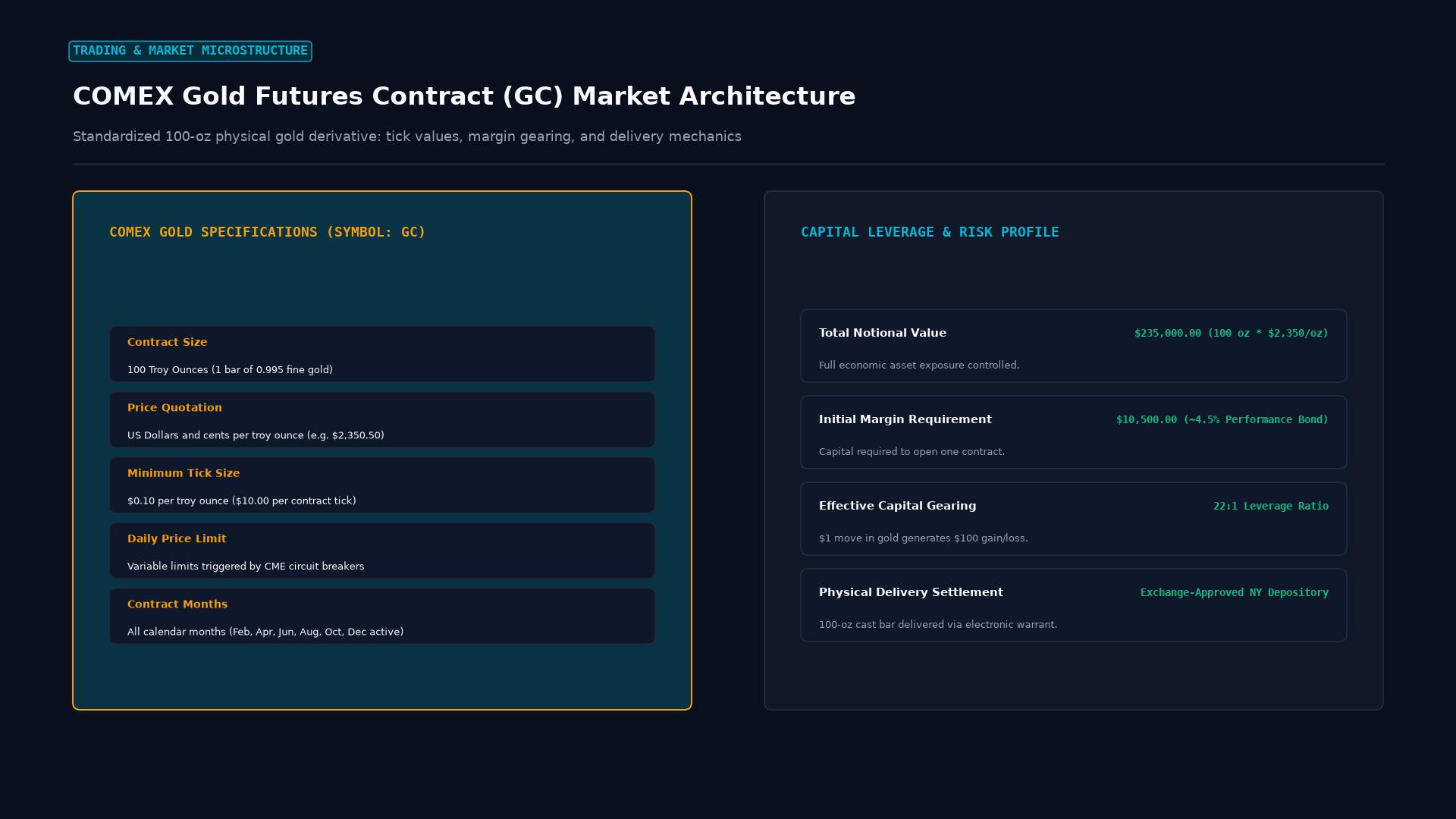 Figure: Standardized 100-troy-ounce gold futures contract: tick value economics ($10/tick), capital margin gearing (22:1 leverage), and physical vault delivery warrants.
Key Takeaways
- Standard Contract Sizes: The institutional benchmark futures contract (COMEX GC) represents 100 troy ounces of fine gold of at least 0.995 fineness. For smaller retail accounts, exchanges offer Micro Gold (MGC) representing 10 troy ounces.
- Spot Gold as a Currency (XAU): In retail forex platforms, spot gold is quoted as XAU/USD; buying 1.0 standard lot controls 100 ounces of physical gold priced in U.S. Dollars.
- Inverse Correlation with Real Yields: Gold generates zero dividend or coupon yield. Consequently, its price is heavily driven by U.S. 10-Year Real Interest Rates (Treasury yield minus expected inflation)—when real yields rise, gold faces selling pressure; when real yields fall, gold rallies.
- Physical vs. Cash Settlement: While institutional bullion dealers use futures for physical vault delivery (warrants), over 98% of all speculative gold contracts are liquidated or rolled over prior to First Notice Day to settle in cash.
Contract Specifications Across Major Venues
| Parameter | COMEX Standard Gold (GC) | COMEX Micro Gold (MGC) | Retail Spot Gold (XAU/USD) |
|---|---|---|---|
| Contract Size | 100 Troy Ounces (~3.11 kg) | 10 Troy Ounces (~311 g) | 100 Troy Ounces (per 1.0 Lot) |
| Price Quotation | U.S. Dollars & Cents per oz | U.S. Dollars & Cents per oz | U.S. Dollars & Cents per oz |
| Minimum Tick Size | $0.10 per ounce ($10.00/contract) | $0.10 per ounce ($1.00/contract) | $0.01 per ounce ($1.00/pip on 1 lot) |
| Trading Hours | CME Globex: 23 hrs/day (Sun–Fri) | CME Globex: 23 hrs/day (Sun–Fri) | 24 hrs/day (Sun 5 PM – Fri 5 PM EST) |
| Settlement Method | Physical Delivery of vault warrants | Financial / Cash settled to GC | Rolling OTC cash contract (Daily swap) |
| Purity Standard | Minimum 0.995 fine gold bar | Based on COMEX benchmark | Refined 0.999 gold equivalence |
Macroeconomic Drivers: Why Gold Trades with Foreign Exchange
Foreign exchange traders monitor gold contracts around the clock because gold serves as a vital cross-market sentiment barometer:
- U.S. Dollar Inverse Correlation: Because gold is priced internationally in U.S. Dollars, a weakening dollar makes gold cheaper for foreign international buyers holding Euros, Yen, or Yuan, stimulating physical bullion demand and driving dollar-denominated gold prices higher.
- Central Bank De-Dollarization: Following the 2022 freezing of Russian foreign reserves, emerging market central banks (notably China, India, and Turkey) accelerated physical gold purchases, reducing their reliance on U.S. Treasury reserves and driving structural multi-year bull markets in gold contracts.
- Geopolitical Flight to Quality: During outbreaks of war or global banking instability (such as the March 2023 regional bank failures in the U.S.), capital rapidly flees risk assets and seeks refuge in gold contracts.
Physical Delivery: First Notice Day and Warrants
For exchange-traded futures, market participants must manage contract expiration carefully:
- First Notice Day (FND): The earliest date on which a long futures contract holder can be assigned physical delivery of gold by the exchange clearinghouse.
- Delivery Mechanism: Physical delivery does not involve armored trucks delivering gold bars to a trader’s home. Instead, the buyer receives an electronic warehouse receipt (warrant) representing ownership of serialized 100-ounce or 1-kilo gold bars stored in approved, high-security depository vaults in New York.
- Speculative traders who do not wish to take delivery must close or roll their contracts before First Notice Day.
Frequently Asked Questions
What is the pip value on a standard lot of XAU/USD?
In retail spot forex trading, 1.0 standard lot of XAU/USD equals 100 troy ounces. The smallest standard price movement is typically $0.01 (1 cent per ounce). Therefore, a 1-dollar price move in gold (e.g., from $2,400.00 to $2,401.00) equals $100.00 in profit or loss per standard lot.
What is the London Bullion Market Association (LBMA)?
The LBMA is the premier international trade association that oversees the wholesale London Over-the-Counter physical gold and silver market. The LBMA sets the “Good Delivery” quality standards for gold bars and administers the twice-daily LBMA Gold Price electronic benchmark (fixing).
What is an “Exchange for Physical” (EFP) transaction?
An EFP is an off-exchange transaction where an institutional participant simultaneously trades a physical gold bullion position against an offsetting exchange-traded gold futures contract, allowing bullion banks to convert OTC gold inventory into exchange exposure.
Ready to trade forex?
Open a free demo account with a regulated broker. Practice with virtual funds before risking real money.