Goldilocks Economy
A Goldilocks economy is an ideal macroeconomic environment characterized by moderate, sustainable economic growth, low unemployment, and stable inflation—an expansion that is neither too hot to ignite inflation nor too cold to cause a recession.
What Is a Goldilocks Economy?
A Goldilocks economy describes an optimal macroeconomic condition in which an economy expands at a balanced, sustainable pace. Borrowed from the classic children’s fairy tale Goldilocks and the Three Bears—in which the protagonist seeks porridge that is neither too hot nor too cold, but “just right”—the term was coined in 1992 by Wall Street economist David Shulman and later popularized during the mid-to-late 1990s economic boom under Federal Reserve Chairman Alan Greenspan.
In a Goldilocks regime, gross domestic product (GDP) grows robustly enough to generate ample employment opportunities and support corporate earnings, but not so fast that production capacity overheats and stokes runaway inflation. Concurrently, growth is strong enough to keep the economy insulated from contractionary recessionary forces.
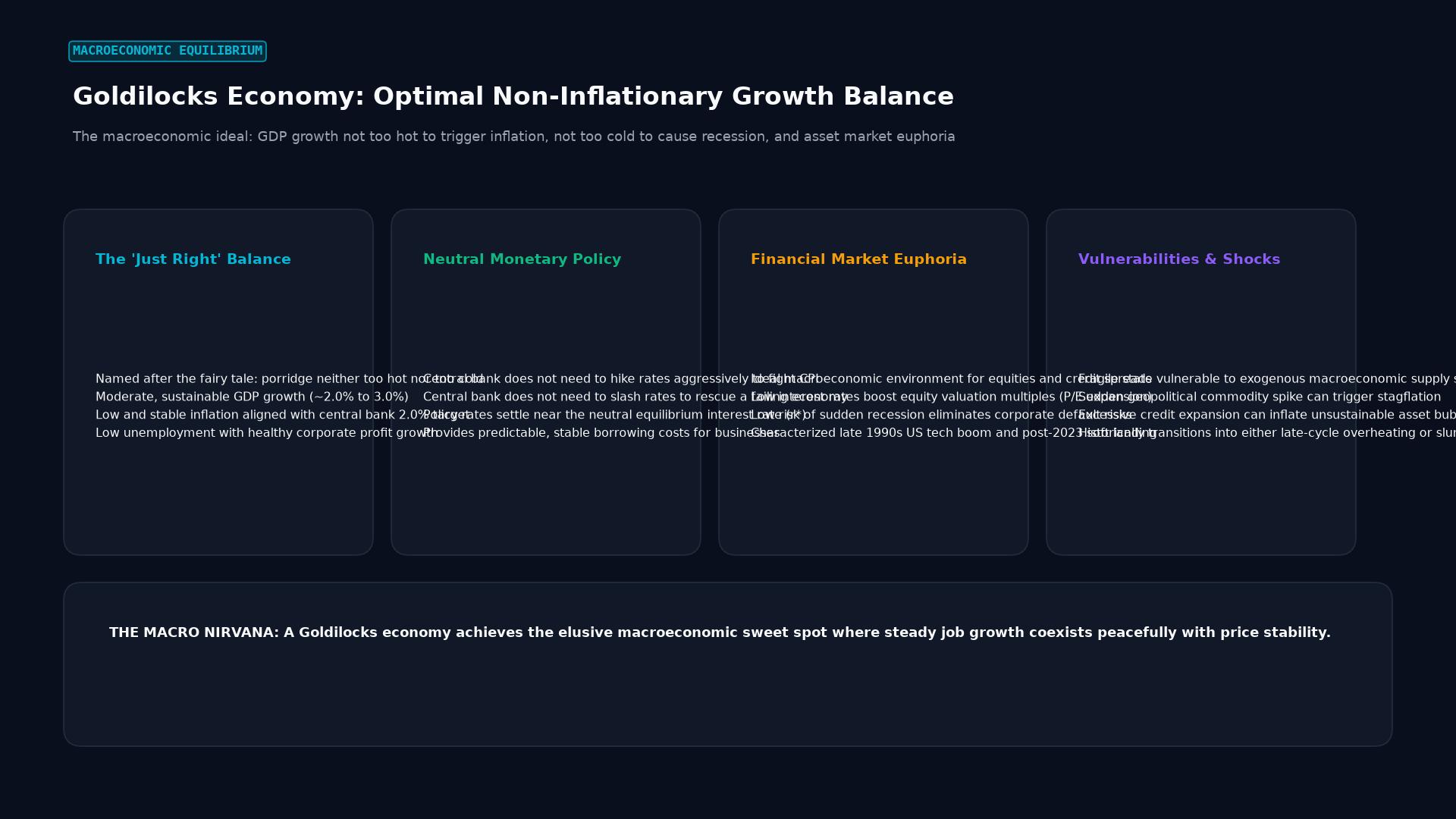 Figure: The macroeconomic ideal: GDP growth not too hot to trigger inflation, not too cold to cause recession, and asset market euphoria
The Three Fundamental Pillars of a Goldilocks Regime
A genuine Goldilocks economy rests upon three interconnected macroeconomic pillars:
1. Moderate, Sustainable GDP Expansion
Real GDP growth typically tracks between 2.0% and 3.0% per annum. Growth at this pace matches an economy’s long-term potential growth rate, expanding national wealth without straining industrial supply chains or exhausting natural resource reserves.
2. Contained, Anchored Price Inflation
Consumer price inflation (CPI) remains predictable and closely anchored to central bank targets—conventionally around 2.0%. Businesses can plan multi-year capital expenditures without fearing volatile raw material spikes, and consumer purchasing power expands in tandem with real wages.
3. Balanced Labor Markets and Productivity Growth
Unemployment remains low, but wage growth is supported by structural labor productivity gains rather than labor shortages. Because workers produce more output per hour worked, corporations can pay higher real wages without passing increased labor costs onto consumers, neutralizing the threat of a wage-price spiral.
Central Bank Behavior in a Goldilocks Environment
For central banks like the Federal Reserve, the European Central Bank, and the Bank of England, a Goldilocks economy represents the realization of their dual mandate: maximum sustainable employment and price stability.
During a Goldilocks phase, monetary policy operates near the neutral interest rate ($r^*$)—the theoretical interest rate that neither stimulates nor restricts economic activity:
- No Emergency Tightening: Because inflation is benign, central bankers have no need to enact aggressive, growth-choking rate hikes.
- No Emergency Easing: Because the economy is expanding steadily on its own, policymakers do not need to inject distortive Quantitative Easing (QE) or slash rates toward zero.
- Predictable Forward Guidance: Financial markets benefit from clear forward guidance and minimal interest rate uncertainty, depressing market volatility.
Foreign Exchange and Financial Market Implications
Financial asset classes and currency markets thrive during prolonged Goldilocks environments:
| Asset Class | Market Behavior During Goldilocks Conditions | Underlying Driver |
|---|---|---|
| Equities | Sustained multi-year bull rallies | Corporate profits expand while borrowing costs remain moderate. |
| Corporate Bonds | Credit spreads compress to historic lows | Low default rates and stable corporate cash flows. |
| Forex Majors | Compressed volatility across major pairs | Synchronized central bank pauses; lack of extreme monetary divergence. |
| Carry Trades | Massive institutional capital inflows | Stable global conditions encourage borrowing low-yielding currencies to buy high yield. |
| Emerging Currencies | Strong performance and capital inflows | High global risk appetite drives capital into developing markets. |
The Carry Trade Renaissance
Because global macroeconomic risk is subdued during a Goldilocks phase, institutional hedge funds aggressively deploy the FX carry trade. Investors borrow in low-rate funding currencies (such as the Japanese Yen or Swiss Franc) and park that capital in higher-yielding sovereign debt (such as the US Dollar, Mexican Peso, or Australian Dollar). The absence of violent exchange rate shocks allows traders to harvest interest rate differentials with minimal risk of currency depreciation wiping out returns.
How a Goldilocks Economy Ends
A Goldilocks regime is inherently delicate and cannot persist indefinitely. It typically terminates through one of two macroeconomic transitions:
- Overheating and Inflation Spike: Sustained demand eventually absorbs all surplus labor and industrial capacity. Supply bottlenecks emerge, commodity prices surge, and inflation breaches policy targets, forcing the central bank to slam on the monetary brakes with aggressive rate hikes.
- Exogenous Economic Shock or Recession: An unexpected external catalyst—such as an energy price shock, banking crisis, or geopolitical escalation—chills consumer confidence, tipping corporate earnings into contraction and ending the expansion.
Key Takeaways
- A Goldilocks economy is an optimal economic state with moderate growth and low, stable inflation.
- Real GDP typically expands at 2% to 3% annually, matching long-term productivity capacity.
- Central banks operate at neutral policy rates with minimal interest rate volatility.
- Equity markets and high-yield credit thrive, while foreign exchange volatility compresses.
- The low-volatility environment provides ideal conditions for institutional FX carry trade strategies.
Frequently Asked Questions
Why is low inflation essential for a Goldilocks economy?
If growth is strong but inflation rises to 6% or 8%, the economy is no longer “just right”—it is overheating. High inflation erodes consumer purchasing power and forces central banks to hike interest rates aggressively, which inevitably precipitates an economic downturn.
When was the last major US Goldilocks economy?
The classic modern Goldilocks era occurred during the mid-to-late 1990s in the United States, when technological advances in computing and the internet boosted productivity, allowing 3% to 4% GDP growth while inflation hovered peacefully near 2%. Portions of 2017–2019 and 2023–2024 also exhibited distinct Goldilocks characteristics following post-pandemic normalization.
How does a Goldilocks economy affect safe-haven currencies like the Swiss Franc and Japanese Yen?
During a Goldilocks economy, safe-haven currencies typically underperform or weaken. Because global market sentiment is optimistic (“risk-on”), investors sell low-yielding safe havens to allocate capital into higher-yielding global equities, emerging markets, and cyclical commodity currencies.
Ready to trade forex?
Open a free demo account with a regulated broker. Practice with virtual funds before risking real money.