Good-till-Cancelled Order (GTC)
A Good-till-Cancelled (GTC) order is a pending trade instruction to buy or sell an asset at a specified price that remains active indefinitely until it is filled by the market, manually cancelled by the trader, or purged under broker expiration limits.
What Is a Good-till-Cancelled (GTC) Order?
A Good-till-Cancelled (GTC) order is an order duration parameter applied to pending limit and stop orders. When a trader places a GTC order, the instruction instructs the broker to keep the order working in the market order book until one of three conditions occurs:
- The market reaches the trigger price and the order is completely filled.
- The trader manually cancels or modifies the order.
- The broker’s administrative retention window (typically 30, 60, or 90 days) or underlying contract expiration is reached.
Unlike standard Day Orders, which automatically expire at the daily market close (5:00 PM Eastern Time in foreign exchange), a GTC order persists overnight, across weekend market closures, and through multiple trading sessions without requiring daily re-entry.
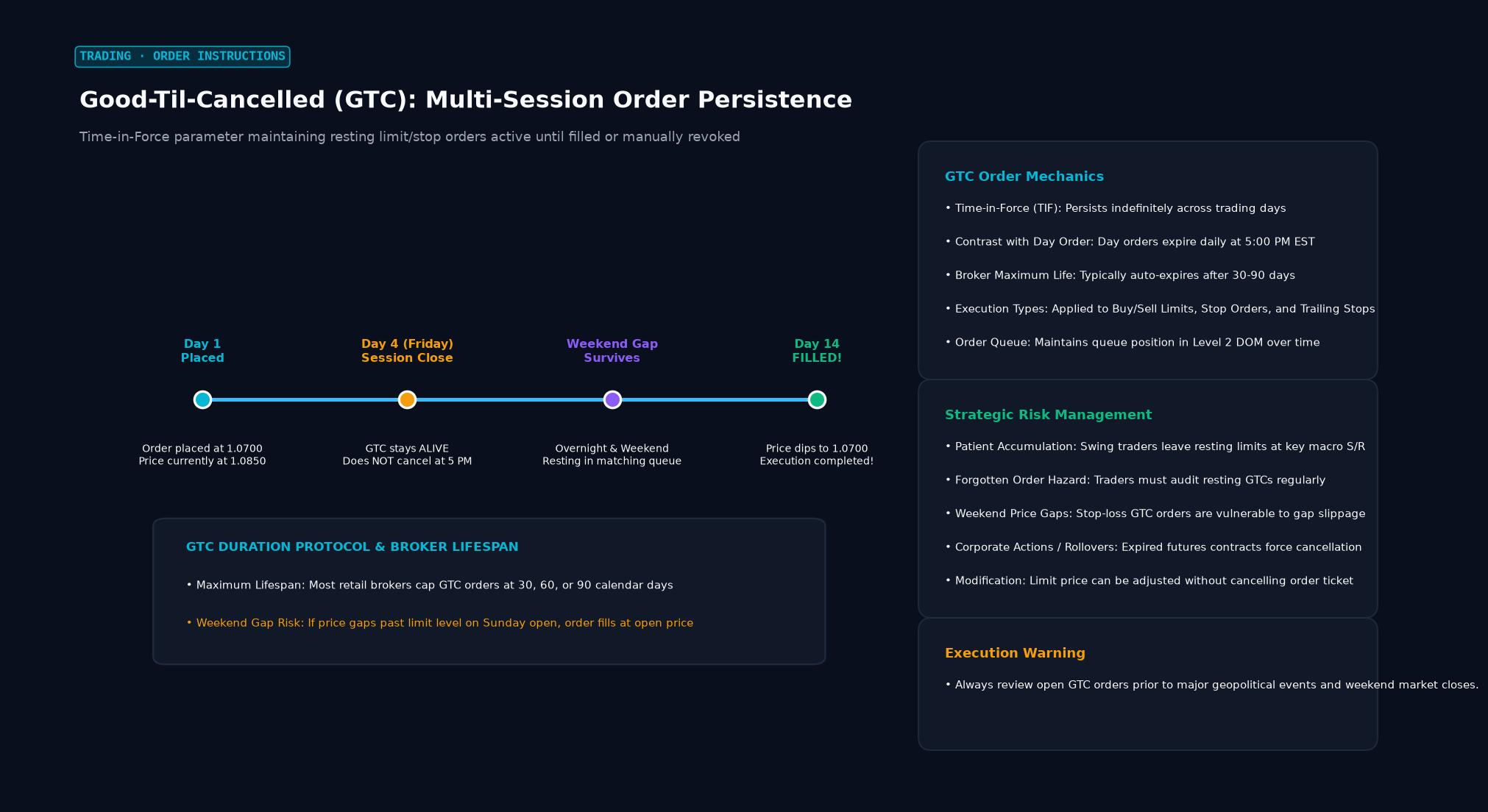 Figure: Time-in-Force parameter maintaining resting limit/stop orders active until filled or manually revoked
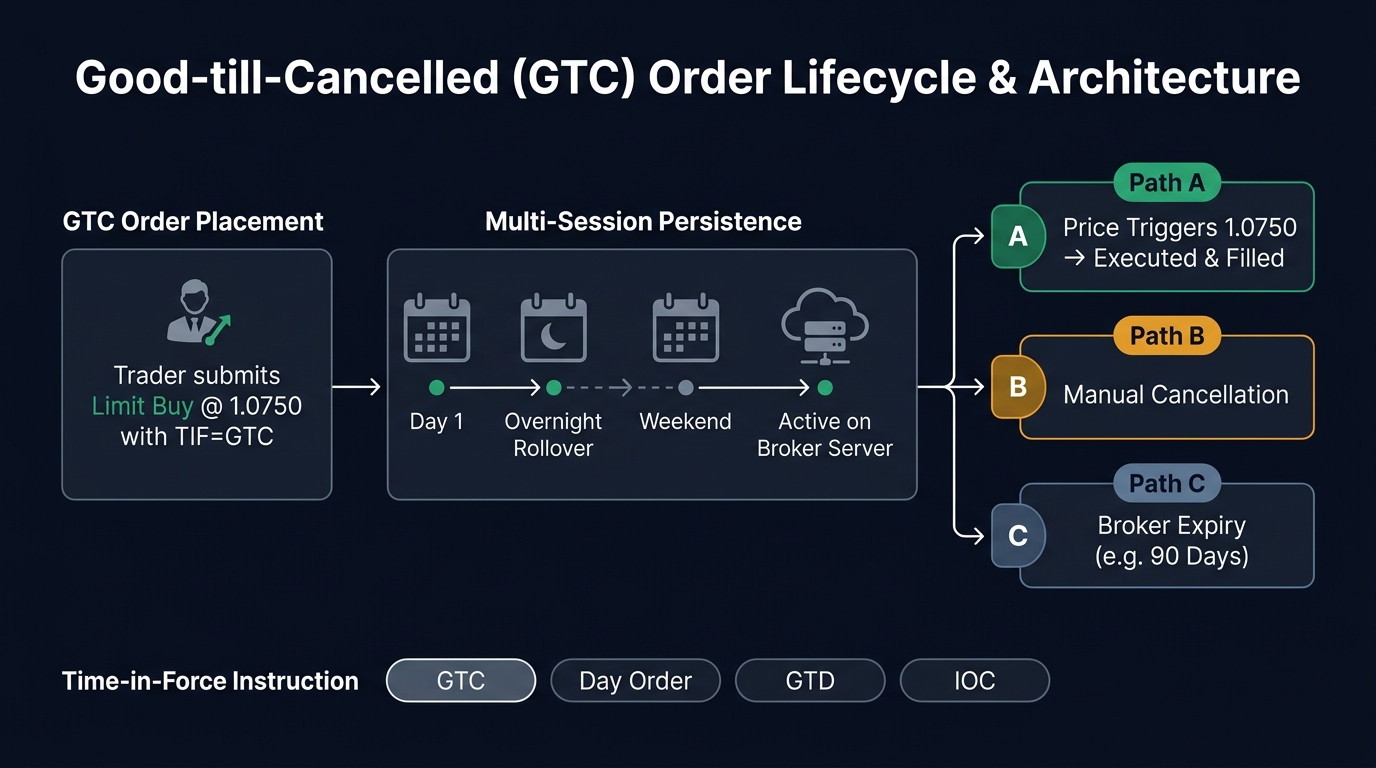
GTC vs. Alternative Time-in-Force Instructions
In modern electronic trading platforms, order duration is designated through “Time-in-Force” (TIF) settings. Understanding the operational differences prevents unintended market exposure:
| Time-in-Force | Execution Rule | Typical Use Case |
|---|---|---|
| GTC (Good-till-Cancelled) | Remains active indefinitely until executed or cancelled. | Swing trading key support/resistance levels. |
| Day Order | Automatically cancels if unfilled by the daily market close. | Intraday scalping and day trading. |
| GTD (Good-till-Date) | Remains active until a precise user-defined date and time. | Trading around scheduled high-impact economic releases. |
| IOC (Immediate-or-Cancel) | Fills immediately (partially or fully); cancels any unfilled portion. | Institutional liquidity sweeps in thin markets. |
| FOK (Fill-or-Kill) | Must be filled immediately in its entirety, or cancelled completely. | Large block orders where partial fills are unacceptable. |
Server-Side vs. Client-Side Execution
A critical technical advantage of a GTC order is that it resides on the broker’s trading server (or directly in the exchange matching engine for futures), rather than on the trader’s personal computer or mobile app.
- Computer Off: A trader can enter a GTC limit order, shut down their trading terminal, disconnect from the internet, or travel abroad. The order remains active on the broker’s liquidity bridge.
- Execution Speed: When the interbank bid or ask price crosses the GTC order threshold, the server executes the fill instantly without waiting for transmission from the client’s device, minimizing network latency.
Managing the Hidden Risks of GTC Orders
While GTC orders provide convenience for busy traders, leaving unfilled orders active for extended periods introduces distinct operational hazards:
1. Weekend Gap Risk
Forex trading ceases for retail traders between Friday 5:00 PM ET and Sunday 5:00 PM ET. However, global geopolitical events or emergency weekend central bank announcements can cause the Sunday opening price to gap substantially beyond a GTC pending order price.
Weekend Gap Scenario:
- Trader places GTC Buy Limit on EUR/USD at 1.0800 on Thursday.
- Friday Market Close: EUR/USD is trading at 1.0840 (Order unfilled).
- Sunday Market Open: Major geopolitical shock gaps price down to 1.0720.
- Execution Reality: The GTC Buy Limit executes at the opening price of 1.0720,
  or triggers severe slippage depending on whether it was a limit or stop order.
2. “Stale Order” Vulnerability
Market fundamentals evolve continuously. A technical support level that looked attractive three weeks ago may become hazardous following an unexpected interest rate hike or worsening trade balance. Traders who fail to audit their pending order ledger frequently find themselves filled on “forgotten” orders right in the path of an aggressive momentum breakdown.
Practical Trading Application: Swing Trading with GTC Orders
Swing traders and position traders rely heavily on GTC orders to manage multi-week campaigns:
- Strategic Entry Staging: Rather than monitoring screens for hours, a trader identifies major multi-month horizontal demand zones (e.g., 1.2500 on GBP/USD) and submits a GTC Buy Limit order accompanied by predetermined Take-Profit and Stop-Loss brackets (OCO: One-Cancels-the-Other).
- Profit Taking Without Emotion: Attaching a GTC Take-Profit order ensures that sudden, transient liquidity spikes—such as a flash spike during the Asian session—fill the order and lock in gains even while the trader is asleep.
Key Takeaways
- A Good-till-Cancelled (GTC) order remains open on the broker’s server until executed, cancelled, or closed by broker policy.
- Unlike Day Orders, GTC orders survive overnight roll-overs and weekend market closures.
- GTC orders execute server-side, eliminating the need to keep the trading software running.
- The primary danger of GTC orders is “stale order risk,” where market conditions change while an forgotten order remains live.
- Most retail brokers impose an administrative expiration on GTC orders (often 60 to 90 days) to clear inactive server memory.
Frequently Asked Questions
Do GTC orders expire automatically on forex brokers?
While theoretically permanent, most retail forex brokers enforce an administrative cutoff—typically 30, 60, or 90 days—after which unfilled GTC orders are purged from the system. Traders should review their broker’s specific execution policy.
What is the difference between a GTC order and a Day order?
A Day order cancels automatically at the end of the trading day (5:00 PM ET) if the market fails to hit the specified price. A GTC order rolls over into the next trading day and remains active indefinitely until filled or cancelled.
What happens to an attached GTC Stop Loss when the main trade is closed manually?
On modern MetaTrader 5 and cTrader platforms, closing a position manually automatically cancels the associated stop-loss and take-profit orders. However, on certain older platforms or API connections, closing the trade may leave an orphaned GTC pending order active, which could inadvertently open a new opposing position if touched later.
Ready to trade forex?
Open a free demo account with a regulated broker. Practice with virtual funds before risking real money.