Take-Profit Order (TP)
A take-profit order is a pending order to automatically close a trade at a specified price level when a target profit has been reached. It executes as a limit order — buy positions close with a sell at the target price; sell positions close with a buy. Take-profit orders eliminate the need to monitor a position continuously and prevent the psychological tendency to hold winning trades too long.
The Problem Take-Profit Orders Solve
Profitable trades create a specific psychological trap: the longer they stay open, the more you want to extract from them. A 50-pip winner tempts you to hold for 80. At 80 pips, you want 120. Meanwhile, price reverses, and what was a strong winner becomes a mediocre gain — or a loss if you held through a full reversal without a stop in place.
This behavior — greed destroying actual profits — is one of the most well-documented trading mistakes. Take-profit orders eliminate the decision. The trade closes automatically at your target. You don’t have to be at the screen. You don’t have to fight the temptation to hold longer. The execution happens mechanically, consistently.
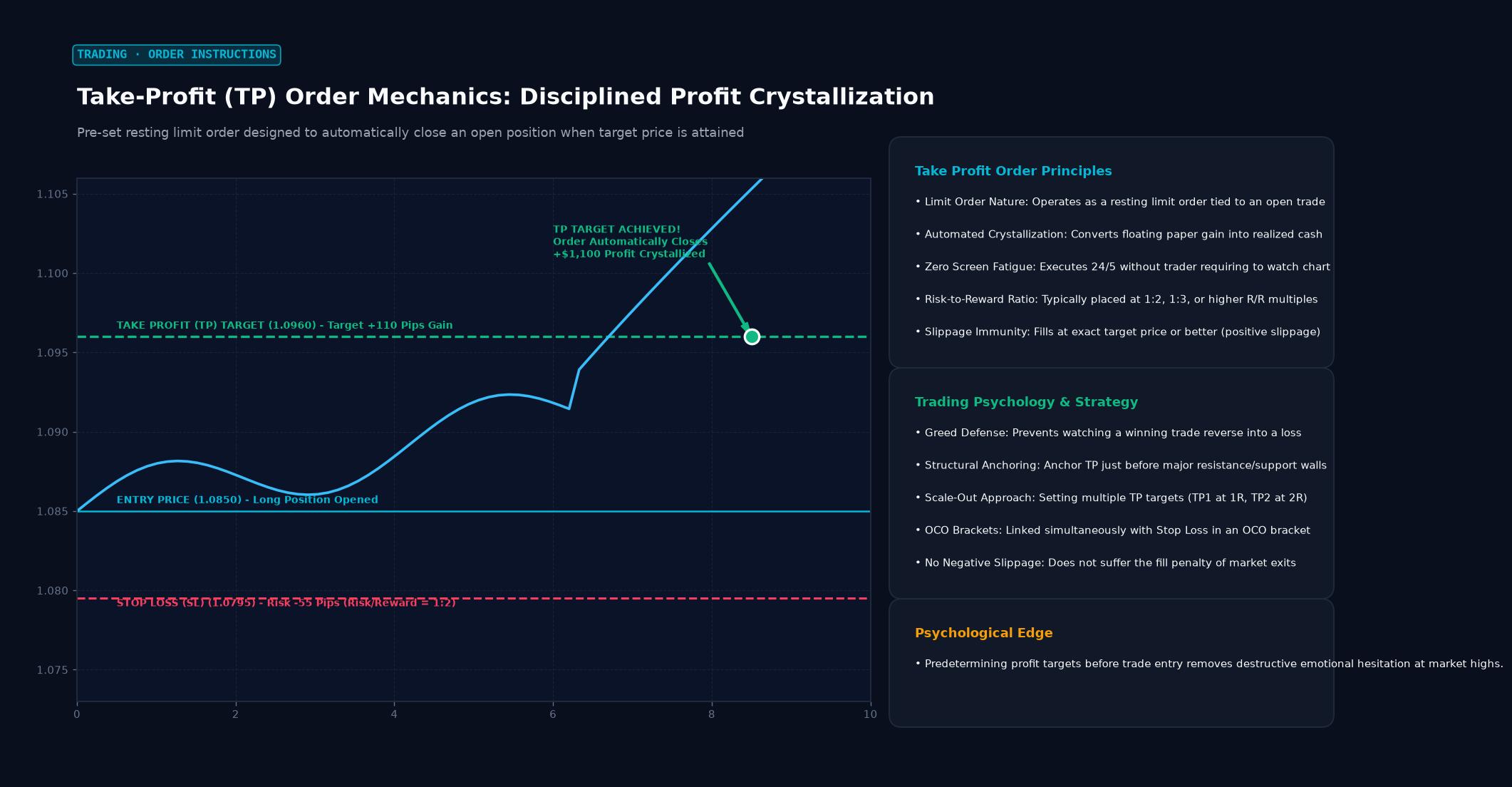 Figure: Pre-set resting limit order designed to automatically close an open position when target price is attained
How Take-Profit Orders Execute
A take-profit is set at a price level above the entry for long positions (you want price to go up and close the trade profitably) and below the entry for short positions (you want price to go down).
Example — Long EUR/USD:
- Entry: 1.0850
- Stop-loss: 1.0820 (30-pip risk)
- Take-profit: 1.0940 (90-pip target)
- Risk-reward ratio: 1:3
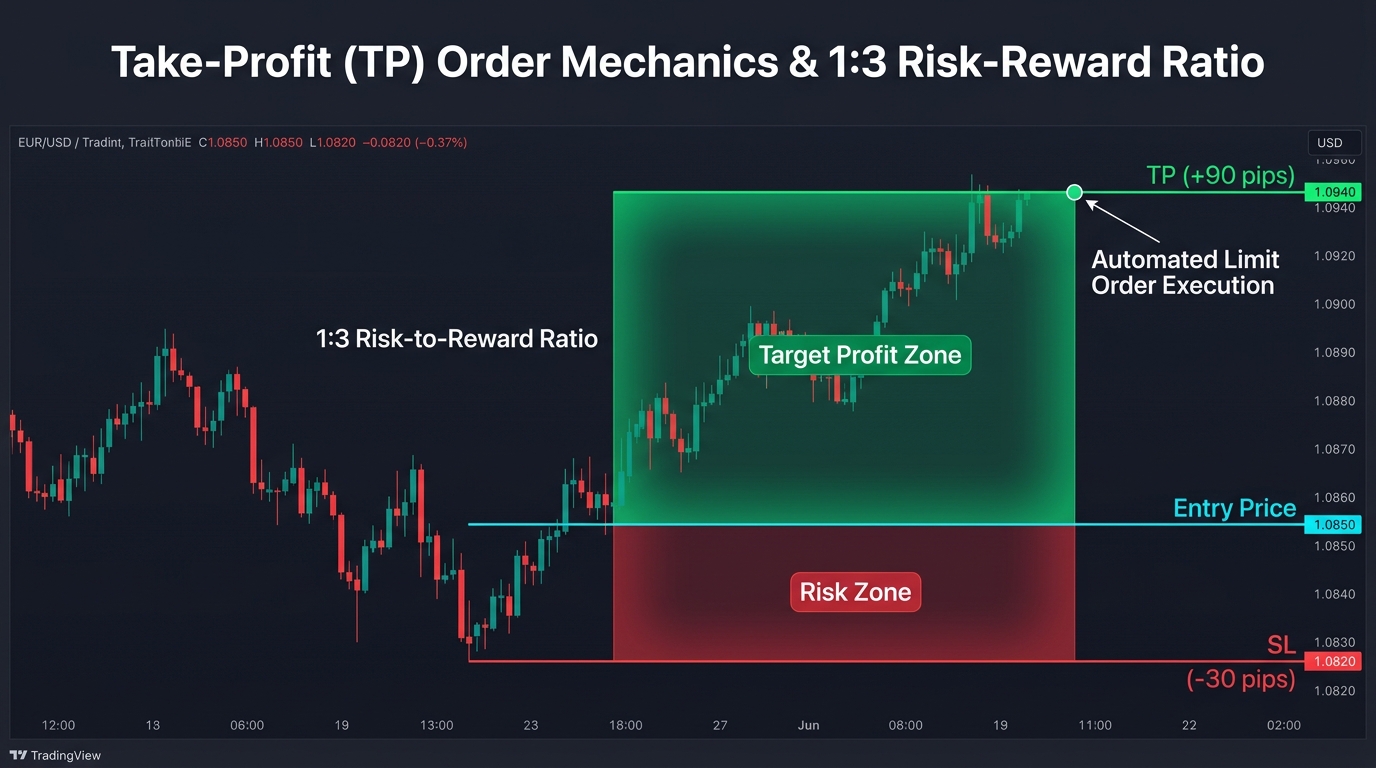
When price rises to 1.0940, the trade automatically closes. If price falls to 1.0820 first, the stop-loss closes it. Either way, the trade exits without manual intervention.
Take-profit orders execute as limit orders — meaning they guarantee the price if reached (or better if the market gaps through the level). Unlike stop-losses, take-profit orders cannot experience adverse slippage.
Setting the Right Take-Profit Level
The take-profit level should be set at a logical price target, not an arbitrary round number chosen to give “acceptable” profit. Common methods:
Risk-reward ratio: Set the target at a multiple of your risk. At 1:2, a 30-pip stop implies a 60-pip take-profit. At 1:3, the target is 90 pips. Most trading systems require at minimum a 1:2 ratio to be profitable over time with a sub-50% win rate.
Next support/resistance level: The most structurally sound method. Set the target just before the next significant resistance level (for longs) or support level (for shorts). The logic: buyers who were waiting at that level will start selling when price reaches it, creating supply that limits upside. Target the level where that supply concentrates.
Fibonacci extension: Project where the next leg of the trend might reach using Fibonacci extension levels (127.2%, 161.8%). These levels serve as natural profit target zones.
Measured move: Many chart patterns (double bottom, head and shoulders, flag breakout) produce a specific “measured move” projection — the height of the pattern applied to the breakout. Setting the take-profit at the measured move target aligns the exit with the pattern’s implied objective.
Take-Profit vs. Manual Exit
Setting a take-profit in advance doesn’t mean you’re locked in. You can modify or cancel it at any time while the trade is open. Some traders use the take-profit as a “default” exit but actively manage based on price action:
- If price reaches the target area but shows strong momentum (large bullish candles, closing near session highs), they remove or move the take-profit to allow the trade to continue
- If price reaches the target area with exhaustion signals (RSI divergence, shooting star, upper wick), they let the take-profit execute or even close manually before it’s reached
This hybrid approach — having the take-profit as a backstop while actively monitoring — works well for traders who are present during trading hours.
Partial Take-Profits
A common professional technique: close a portion of the position at the first target (1:1 or 1:2 ratio) and let the remainder run with a trailing stop.
Example with a 0.3-lot position:
- Close 0.1 lot at 1:2 target (secure immediate profit)
- Move stop to breakeven on remaining 0.2 lots
- Let remaining position run with a trailing stop
This approach:
- Guarantees a portion of profit regardless of what happens next
- Removes pressure from the “let it run” decision
- Allows extended moves to contribute additional profit
- Eliminates the risk that a winner becomes a loser on remaining lots (stop moved to breakeven)
Key Takeaways
- Take-profit orders close winning trades automatically at a predefined price — eliminating manual decision-making and greed-driven holding
- They execute as limit orders — guaranteed price execution without adverse slippage
- Set TP at logical structural levels (next resistance, Fibonacci extension, measured move) not arbitrary round numbers
- Minimum recommended risk-reward: 1:2 (target at least twice your stop distance)
- Partial take-profits at earlier targets with trailing stop on the remainder maximize long-term profitability
FAQ
What happens if price almost reaches my take-profit and then reverses? This is frustrating but normal. Markets often test a level, approach but don’t quite reach it, then reverse. Options: accept this as variance and stick with your system (take-profits that “nearly” hit often hit eventually); reduce the target by a few pips to give a small buffer; or monitor actively and close manually when price approaches the target with exhaustion signs.
Should I always use a take-profit order? For most traders, yes — especially when you can’t monitor positions continuously. The exceptions are trend-following strategies specifically designed to let winners run, where a fixed take-profit would cap gains on large moves. In those cases, a trailing stop (rather than a fixed TP) is the appropriate exit mechanism.
Ready to trade forex?
Open a free demo account with a regulated broker. Practice with virtual funds before risking real money.