Gross National Product
Gross National Product (GNP)—increasingly integrated into Gross National Income (GNI)—is a macroeconomic metric measuring the total monetary market value of all final goods, services, and income generated by the citizens and domestic enterprises of a country in a given period, regardless of whether production occurs inside national borders or overseas.
What Is Gross National Product (GNP)?
Gross National Product (GNP) is a foundational macroeconomic indicator that measures the aggregate economic output and income generated by the citizens and domestically incorporated enterprises of a sovereign nation over a specific time horizon (typically one year). In modern national economic accounting guidelines established by the United Nations and the International Monetary Fund (IMF), GNP has been formally harmonized into Gross National Income (GNI).
The defining characteristic of GNP is its reliance on citizenship and economic ownership rather than physical geographic location. While Gross Domestic Product (GDP) measures all economic production occurring strictly inside a nation’s borders (regardless of who owns the factories), GNP measures all economic production generated by a nation’s residents and corporate entities, whether that production takes place domestically or across international borders.
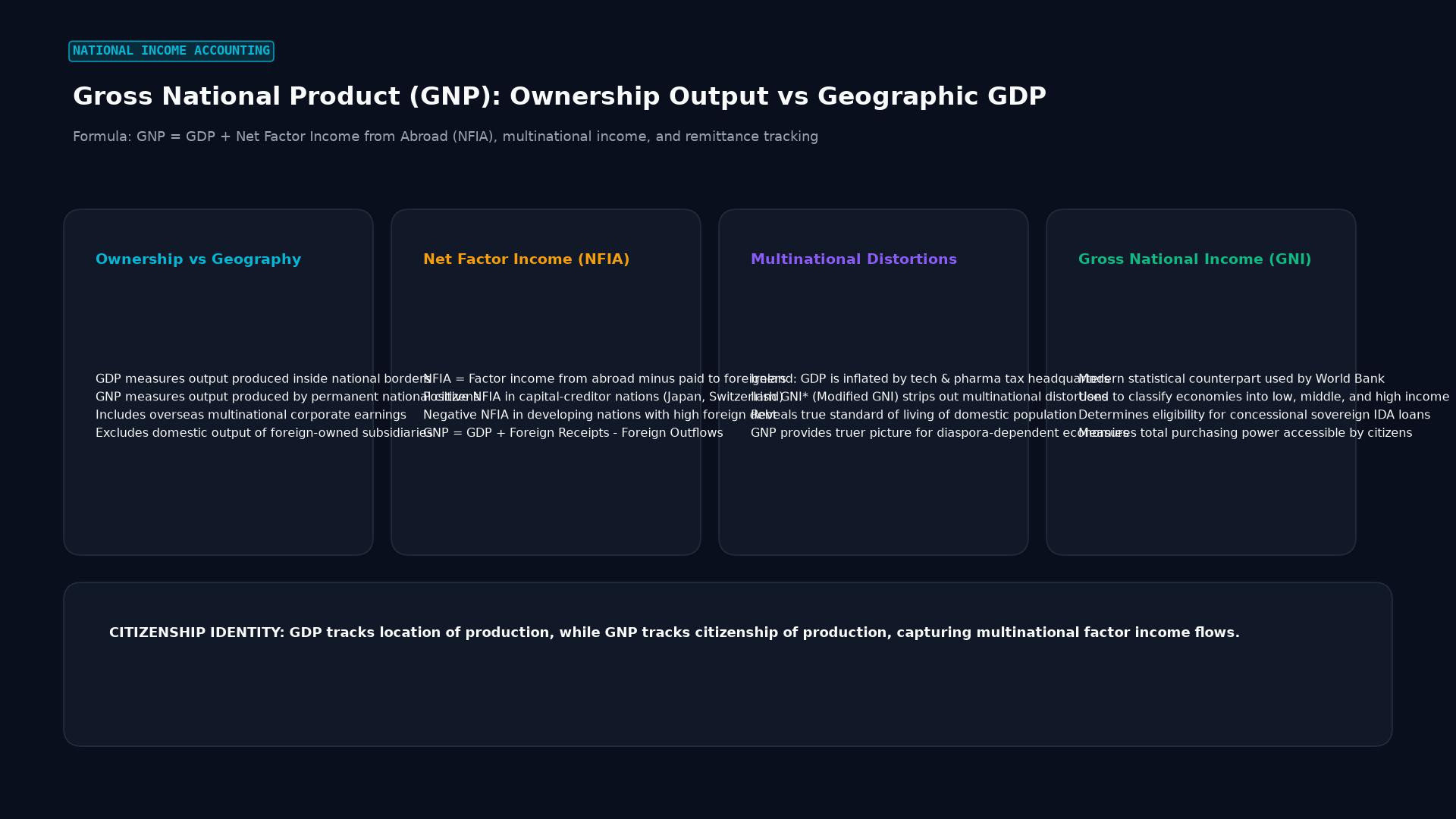 Figure: Formula: GNP = GDP + Net Factor Income from Abroad (NFIA), multinational income, and remittance tracking
Key Takeaways
- Ownership vs. Geography: GDP is defined by location (where the output is produced); GNP is defined by ownership (who owns the factors of production).
- Mathematical Formula: $\text{GNP} = \text{GDP} + \text{Net Foreign Factor Income (NFFI)}$.
- The 1991 Shift: Until 1991, the United States utilized GNP as its primary headline measure of national economic growth, before switching to GDP to harmonize with global international standards.
- The Remittance Lifeline: In emerging market economies with large expatriate workforces abroad (such as the Philippines, Mexico, and Egypt), GNP/GNI is substantially larger than GDP due to massive inbound personal remittance inflows.
- The Multinational Tax Distortion: In low-tax corporate hubs like Ireland, GDP is artificially inflated by multinational intellectual property routing, making GNP/GNI the only accurate reflection of true domestic household living standards.
The Mathematics of Gross National Product
GNP begins with Gross Domestic Product and adjusts for cross-border income flows:
$$\text{GNP} = \text{GDP} + \text{Net Foreign Factor Income (NFFI)}$$
Where: $$\text{NFFI} = \text{Factor Income Received from the Rest of the World} - \text{Factor Income Paid to the Rest of the World}$$
Factor income includes:
- Employee Compensation: Wages earned by domestic residents working temporarily overseas.
- Investment Income: Dividends, interest payments, and corporate profits earned on foreign subsidiaries, real estate, and overseas securities held by domestic residents.
- Net Subsidies and Taxes: Taxes on production paid to foreign governments minus foreign production subsidies.
GDP vs. GNP: Real-World Divergences
For most large, balanced continental economies (such as the United States, Japan, and Germany), the difference between GDP and GNP is typically less than 2%. However, for specialized economies, the divergence is immense:
| Country | Economic Dynamic | GDP vs. GNP Relationship | Macroeconomic Significance |
|---|---|---|---|
| Ireland | Multinational Tech/Pharma Tax Inversions (Apple, Google, Pfizer) | GDP is ~35% LARGER than GNP/GNI | Foreign firms route billions in global profits through Irish subsidiaries, artificially inflating GDP without enriching local Irish residents. |
| Philippines | Overseas Filipino Workers (OFWs) sending remittances home | GNP/GNI is ~10% LARGER than GDP | Over 10 million Filipinos working abroad remit over $35 billion annually, providing vital foreign exchange reserves that support the Philippine Peso (PHP). |
| Kuwait / Norway | Massive Sovereign Wealth Funds (NBIM, KIA) investing abroad | GNP/GNI is substantially LARGER than GDP | Enormous foreign dividend, interest, and real estate cash flows repatriated from international investments. |
| United States | Balanced global leader; world’s largest consumer economy | GDP and GNP are within 1.0% | Massive foreign earnings of U.S. multinationals are balanced by massive foreign ownership of U.S. domestic assets. |
Why Currency Traders and Debt Analysts Watch GNP / GNI
- True Sovereign Debt Sustainability: Credit rating agencies (such as S&P, Moody’s, and Fitch) calculate national debt ratios against GNI rather than GDP. A government cannot service sovereign foreign-currency debt using the profits of foreign multinationals that will be repatriated abroad; debt must be serviced from national income that can be legitimately taxed.
- Current Account and Currency Support: Persistent, high positive Net Factor Income (a large positive gap between GNP and GDP) creates a steady, structural commercial demand for the home currency, providing long-term structural appreciation support in foreign exchange markets.
Frequently Asked Questions
Why did the United States switch from GNP to GDP in 1991?
The Bureau of Economic Analysis (BEA) switched to GDP in December 1991 to align with the United Nations System of National Accounts (SNA). Furthermore, GDP is closely correlated with other domestic economic indicators—such as domestic industrial production, domestic factory employment, and retail sales—making it a superior metric for short-term monetary policy formulation by the Federal Reserve.
What is “Leprechaun Economics”?
“Leprechaun Economics” was a term coined in 2016 by Nobel laureate Paul Krugman after Ireland reported a bizarre, astronomical 26.3% single-year GDP growth rate. The surge was an accounting illusion caused by Apple restructuring its intellectual property assets onto its Irish balance sheet. The scandal forced the Irish Central Statistics Office to invent a new metric called Modified GNI (GNI)* to strip out multinational distortions.
Does GNP account for the underground or informal economy?
No. Standard GNP and GDP calculations capture only formal, documented economic transactions. Unreported cash transactions, informal labor, household domestic work, and illegal black-market activities are excluded from official national statistics.
Ready to trade forex?
Open a free demo account with a regulated broker. Practice with virtual funds before risking real money.