Gross
In finance, economics, and trading, gross denotes the total, unadjusted monetary sum of income, return, transaction volume, or economic output prior to any deductions for taxes, commissions, financing costs, or offsetting liabilities.
What Does “Gross” Mean in Finance and Trading?
In financial accounting, macroeconomic analysis, and market trading, the term gross refers to an overall, unadjusted total calculated before any deductions, expenses, fees, taxes, or depreciation have been factored in. It represents the raw, top-line monetary figure of an economic activity.
The term operates across four vital domains in global financial markets:
- Trading Performance: Gross Profit/Loss is the pure trading return generated from buy and sell prices before deducting broker execution commissions, bid-ask spread costs, and overnight financing swap fees.
- Portfolio Risk Management: Gross Exposure is the absolute sum of all long and short positions combined, measuring total leverage and balance-sheet utilization regardless of market direction.
- Banking & Interbank Clearing: Gross Settlement describes financial systems (like Real-Time Gross Settlement - RTGS) where each payment is processed individually without offsetting opposing balances.
- Macroeconomics: Gross Output (such as Gross Domestic Product - GDP) measures total national production before deducting capital consumption and physical asset depreciation.
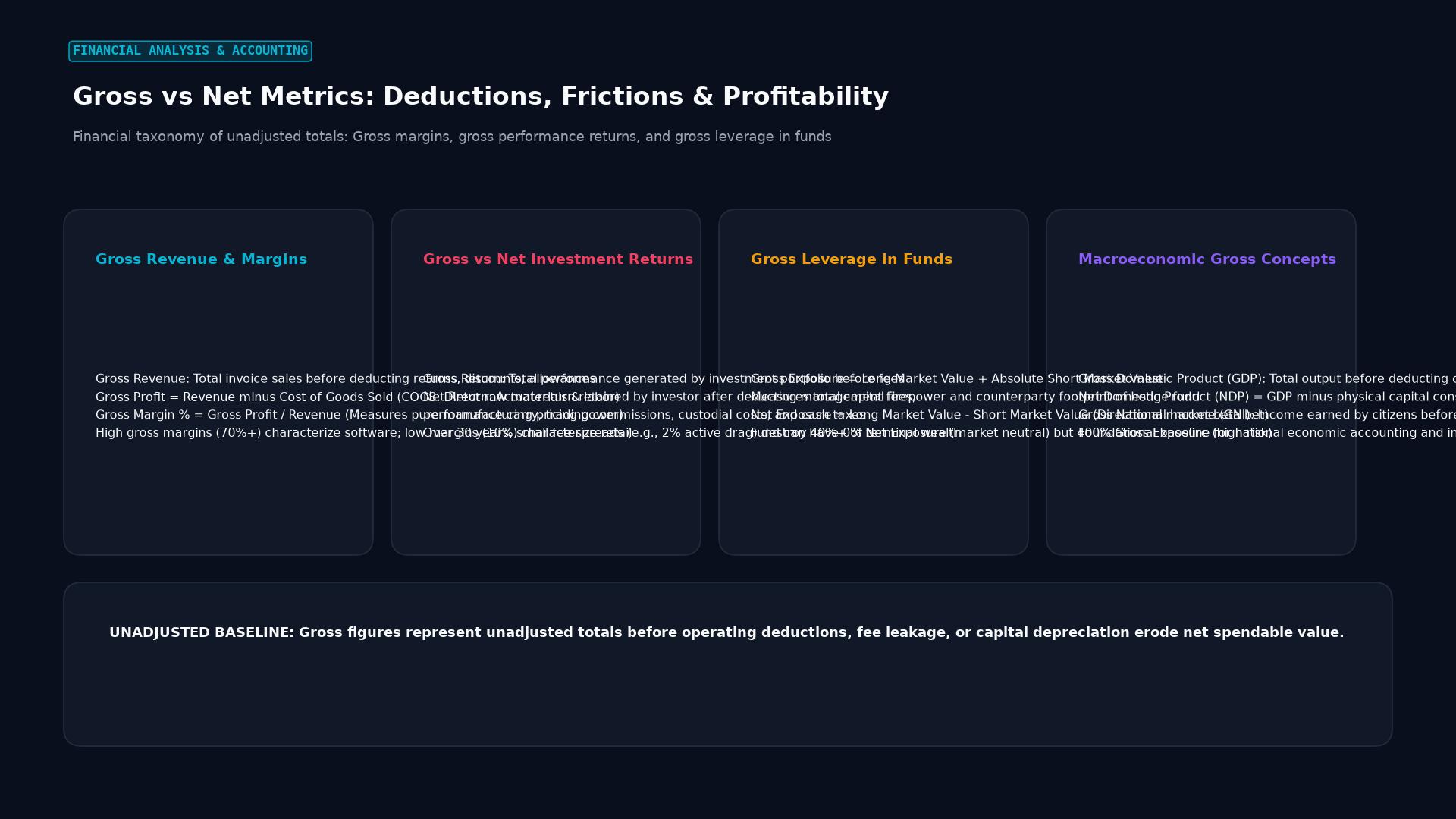 Figure: Financial taxonomy of unadjusted totals: Gross margins, gross performance returns, and gross leverage in funds
Key Takeaways
- Pre-Deduction Metric: Gross figures reflect top-line magnitude; net figures reflect the true, bottom-line financial reality after deducting friction costs.
- The Trading Reality Gap: A trading strategy showing high gross returns can be severely unprofitable on a net basis if high turnover incurs excessive execution commissions and overnight swap fees.
- Gross Leverage Risk: While a hedge fund might have zero net directional exposure (being equally long and short), a massive gross exposure exposes the fund to severe margin calls and prime brokerage liquidity shocks.
- RTGS Interbank Architecture: Large-value interbank wire transfer networks—such as the U.S. Federal Reserve’s Fedwire or the Eurozone’s TARGET2—operate on a Real-Time Gross Settlement model to eliminate systemic settlement credit risk.
Gross vs. Net Across Core Financial Disciplines
| Financial Domain | Gross Concept | Net Concept | Key Deductions Applied |
|---|---|---|---|
| Active Trading | Gross P&L: Pure market price variance ($\Delta P \times Q$) | Net P&L: Cash credited to account balance | Broker commissions, ECN ticket fees, slippage, and overnight swaps |
| Portfolio Risk | Gross Exposure: Absolute sum of all positions ($ | \text{Longs} | + |
| Banking Payments | Gross Settlement (RTGS): Transactions settled one-by-one | Net Settlement: Batch netting of opposing multilateral flows | Bilateral and multilateral clearing offsets |
| Fixed Income | Gross Yield: Coupon rate divided by bond price | Net Yield: Total yield after foreign withholding tax | Host nation sovereign withholding taxes |
| Macroeconomics | Gross Domestic Product (GDP): Total market value produced | Net Domestic Product (NDP): GDP minus asset depreciation | Consumption of Fixed Capital (economic wear and tear) |
Gross Exposure vs. Net Exposure: The Hedge Fund Vulnerability
In quantitative currency and long/short equity hedge funds, misunderstanding gross exposure can lead to catastrophic liquidations:
Real-World Example
A quantitative macro fund manages $100,000,000 in investor equity:
- The fund goes Long $300,000,000 in EUR/USD.
- The fund simultaneously goes Short $300,000,000 in GBP/USD as a relative-value cross hedge.
- Net Market Exposure: $$\text{Net Exposure} = $300,000,000 - $300,000,000 = $0 \text{ (0% Directional Bias)}$$
- Gross Market Exposure: $$\text{Gross Exposure} = |$300,000,000| + |-$300,000,000| = $600,000,000 \text{ (600% / 6x Leverage)}$$
The Risk: While the fund appears immune to general U.S. Dollar trends (net delta is zero), its 6x gross leverage means that if the historical correlation between EUR and GBP breaks down, prime brokers will demand hundreds of millions in collateral margin, potentially forcing an immediate insolvency liquidation.
Real-Time Gross Settlement (RTGS) in Foreign Exchange
In high-value sovereign interbank clearing, the Gross Settlement mechanism is critical to eliminating counterparty Herstatt risk:
- In an RTGS system (such as Fedwire or CHAPS), transactions are not batched together to wait for the end of the day.
- Every payment order is processed individually, immediately, and irrevocably on the books of the central bank.
- While RTGS requires participating banks to hold significantly more intra-day central bank liquidity than deferred netting systems, it ensures that the collapse of one bank cannot trigger a cascade of payment defaults across the financial system.
Frequently Asked Questions
Why do bond issuers quote gross coupon rates?
Bond issuers quote gross coupon rates (the stated coupon percentage) because institutional investors reside in dozens of different tax jurisdictions around the world. Because international tax treaties and domestic withholding tax rates vary widely across investors, the bond issuer quotes the gross unadjusted coupon, leaving tax calculations to individual bondholders.
What is the “Gross Margin” in corporate financial analysis?
Gross margin is the percentage of revenue remaining after deducting the direct Cost of Goods Sold (COGS) (such as raw materials and factory labor): $\text{Gross Margin} = (\text{Revenue} - \text{COGS}) / \text{Revenue}$. It measures how efficiently a company manufactures products before general administration, marketing, research, and taxes are deducted.
How does high trading frequency affect the gap between gross and net P&L?
For high-frequency scalpers and algorithmic intraday traders, transaction costs accumulate exponentially. A trader executing 50 trades a day might generate $2,000 in gross market profits, but incur $1,500 in broker commissions, ECN liquidity fees, and spread friction, leaving an actual net profit of only $500. Professional traders optimize strategies based entirely on net expectancy.
Ready to trade forex?
Open a free demo account with a regulated broker. Practice with virtual funds before risking real money.