Currency Risk
Currency risk, also referred to as foreign exchange or FX risk, is the potential for financial loss resulting from adverse fluctuations in exchange rates. It affects international businesses, investors, and traders holding assets, liabilities, or cash flows denominated in foreign currencies.
What Is Currency Risk?
In global commerce and investment management, currency risk (also termed foreign exchange risk or FX risk) describes the financial exposure that arises whenever a business transaction, portfolio asset, or corporate liability is denominated in a currency other than the entity’s home operating currency.
Because exchange rates between floating currencies fluctuate continuously based on shifting interest rate expectations, trade balances, inflation differentials, and geopolitical events, the future domestic-currency value of a foreign cash flow is inherently uncertain. An international investment that generates an attractive 10% return in local terms can transform into a net loss if the foreign currency depreciates by 15% against the investor’s home currency before capital is repatriated.
Managing currency risk is a paramount priority for corporate treasuries, sovereign wealth funds, multinational enterprises, and retail portfolio managers operating in an interconnected global economy.
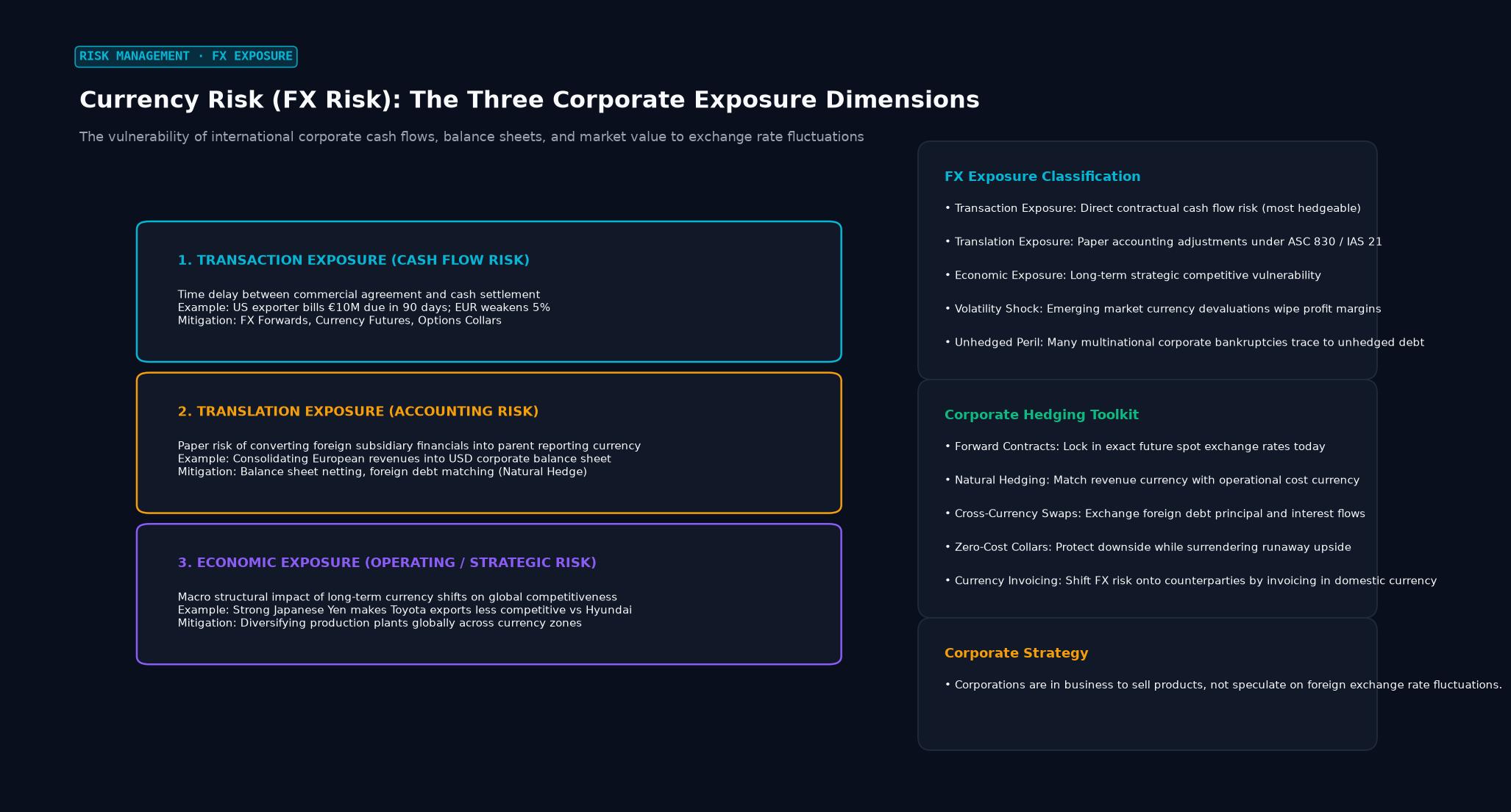 Figure: The vulnerability of international corporate cash flows, balance sheets, and market value to exchange rate fluctuations
The Three Fundamental Pillars of Currency Risk
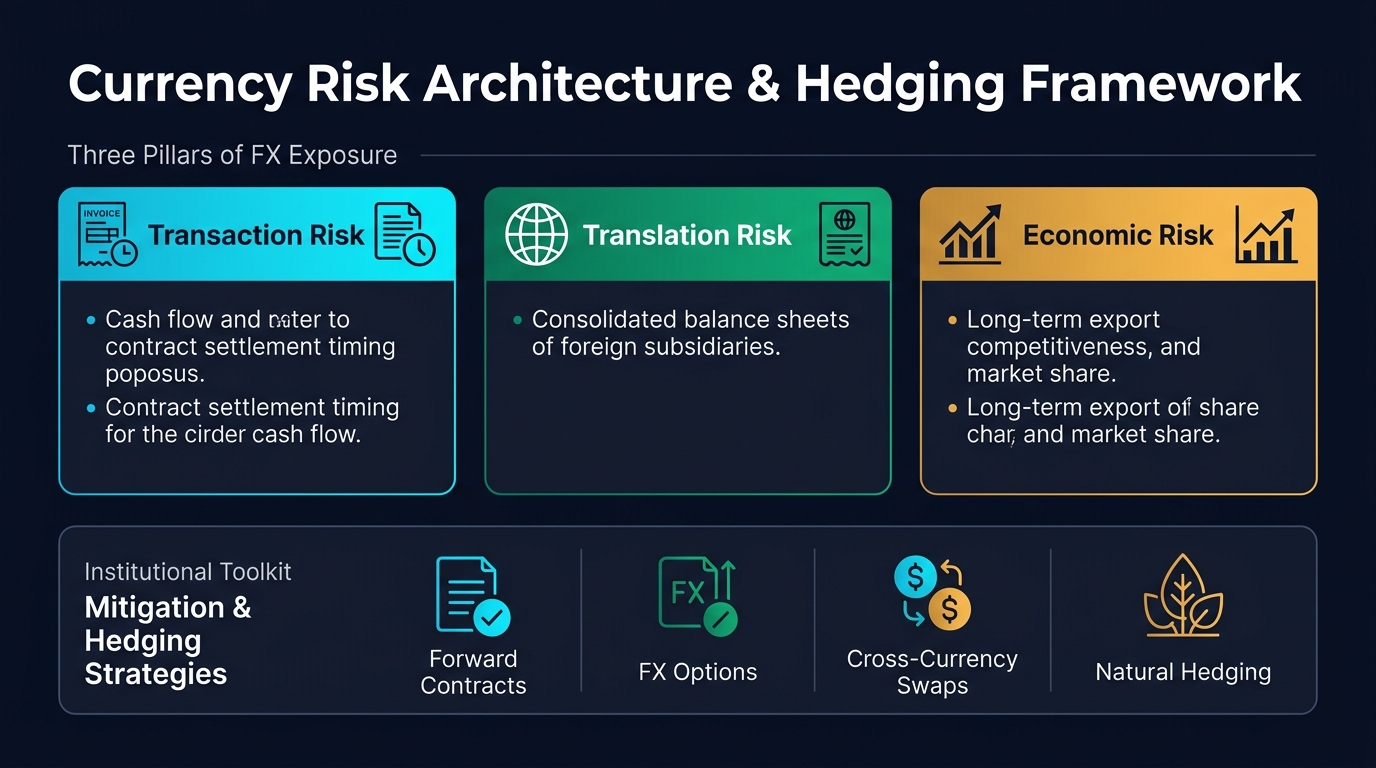
Risk managers categorize foreign exchange exposure into three distinct dimensions, each demanding unique analytical frameworks and mitigation strategies:
1. Transaction Risk
Transaction risk is the most common and immediate form of foreign exchange exposure. It arises from the time delay between entering into a binding cross-border commercial contract and the actual physical settlement of payment in cash.
Consider a German industrial manufacturer that agrees to sell specialized automotive robotics to a US automaker for $10,000,000, with invoice payment due in 90 days:
- At contract signing, the spot exchange rate is EUR/USD = 1.1000, meaning the German firm expects to receive €9,090,909 ($10M / 1.10).
- Over the next three months, the US Dollar weakens, pushing EUR/USD up to 1.1600.
- When the American buyer transfers the $10,000,000 upon delivery, the German manufacturer converts the proceeds at 1.1600, receiving only €8,620,689.
- The German firm loses €470,220 in revenue purely due to exchange rate movement—an adverse outcome that can entirely erase the profit margin of the industrial project.
2. Translation Risk (Accounting / Balance Sheet Risk)
Translation risk—often called accounting exposure—affects multinational corporations with foreign subsidiaries that maintain their financial accounts in local currencies.
At the conclusion of each fiscal quarter, the parent company must consolidate the financial statements of all global subsidiaries into its domestic reporting currency (such as US Dollars for a US-headquartered corporation under GAAP or IFRS rules):
- Even if a subsidiary in Tokyo or London experiences zero change in physical revenue, a sharp depreciation in the Japanese Yen or British Pound automatically shrinks the converted asset values, revenues, and net equity reported on the parent company’s consolidated balance sheet.
- While translation risk primarily creates non-cash accounting paper adjustments, it directly impacts key financial ratios, credit ratings, and perceived shareholder value.
3. Economic Risk (Operating / Competitive Risk)
Economic risk represents the structural, long-term threat that persistent, multi-year exchange rate trends will permanently impair a corporation’s international competitiveness, market share, and future cash flows.
For instance, if the Swiss Franc (CHF) experiences sustained, multi-year appreciation against the Euro, Swiss precision watchmakers and pharmaceutical manufacturers find their export prices significantly higher than competing German or French products. Even if a Swiss firm hedges all short-term transactions, long-term currency strength forces the company to lower profit margins, move manufacturing abroad, or lose market share permanently to foreign rivals.
Core Strategies for Mitigating Currency Risk
Institutions deploy two overarching methodologies to neutralize or manage foreign exchange risk:
Financial Hedging Techniques
- Forward Contracts: The most widely utilized corporate hedging tool. An entity enters an agreement with an interbank dealer to buy or sell a specific volume of foreign currency at a fixed rate (the forward rate) on a specified future date, completely locking in cash flows and eliminating uncertainty.
- FX Futures: Standardized exchange-traded contracts (such as CME Euro FX futures) that allow firms and portfolio managers to hedge currency exposure with transparent pricing and centralized clearing.
- Currency Options: Purchasing vanilla puts or calls establishes a guaranteed “worst-case” exchange rate floor or ceiling while preserving the flexibility to participate in favorable exchange rate movements if the market moves beneficially.
- Cross-Currency Swaps: Long-term agreements to exchange principal and interest debt streams in different currencies, sterilizing foreign liabilities over 5 to 30 years.
Operational and “Natural” Hedging
Corporations frequently mitigate risk structurally through operational design rather than derivative contracts:
- Natural Hedging: Matching foreign currency revenues with foreign currency expenses. If an American corporation generates substantial revenues in Euros, it can establish manufacturing facilities in Europe, source raw materials locally, and borrow from European banks in Euros. The Euro revenues directly service the Euro operating costs and debt payments, naturally neutralizing net currency exposure.
- Multi-Currency Invoicing: Negotiating cross-border contracts denominated in the firm’s home currency, effectively transferring transaction risk onto the foreign counterparty.
Practical Forex Trader Context: Base Currency Risk
Retail forex traders encounter currency risk directly through their account’s base denomination.
If a European trader maintains a brokerage account denominated in Euros (€) but actively trades currency pairs that do not involve the Euro (such as USD/JPY or AUD/CAD):
- All profits and losses are computed initially in the quote currency of the traded pair (e.g., Japanese Yen).
- The trading terminal instantly converts those Yen profits or losses back into Euros at the prevailing EUR/JPY market rate.
- If the Euro strengthens sharply against the Yen while the trader holds open positions, the converted Euro value of those trading profits will decline, demonstrating how currency risk impacts leveraged market participants on every execution.
Key Takeaways
- Currency risk is the danger that unpredictable shifts in exchange rates will negatively impact foreign assets, revenues, or commercial profits.
- The three primary types of FX risk are Transaction Risk (short-term cash settlement), Translation Risk (balance sheet accounting consolidation), and Economic Risk (long-term competitive positioning).
- Forward contracts and options represent the primary financial derivative tools used to hedge transaction exposure.
- Natural hedging aligns foreign revenues with local foreign operating costs and debt obligations to neutralize currency swings without derivatives.
- Retail forex traders face base-currency risk whenever they trade pairs denominated in non-account currencies.
FAQ
Can small businesses manage currency risk effectively? Yes. Small businesses can open multi-currency commercial bank accounts to hold foreign revenues until favorable conversion rates emerge, request that suppliers invoice in stable currencies, or utilize simple fixed forward contracts through commercial banking partners.
Is it always beneficial to hedge 100% of currency risk? Not necessarily. Hedging incurs financial costs—option premiums, forward point spreads, and administrative overhead. Additionally, over-hedging eliminates the potential to profit from favorable exchange rate movements. Many institutional treasuries adopt selective hedging policies, hedging between 50% and 80% of forecasted exposures.
How does inflation influence currency risk? According to the economic theory of Purchasing Power Parity (PPP), nations experiencing persistently high inflation typically see their currencies depreciate against low-inflation peers over the long run to re-establish trade balance, magnifying currency risk for investors holding assets in high-inflation economies.
Ready to trade forex?
Open a free demo account with a regulated broker. Practice with virtual funds before risking real money.