Hierarchy of Cost Assignability
The hierarchy of cost assignability is a managerial accounting framework within Activity-Based Costing that categorizes resource expenditures into unit, batch, product-sustaining, and facility-sustaining tiers based on their cause-and-effect relationship to cost objects.
The hierarchy of cost assignability, originally formulated by Harvard Business School professors Robin Cooper and Robert S. Kaplan and formalized by the Consortium for Advanced Management-International (CAM-I), is a foundational framework within Activity-Based Costing (ABC) and Activity-Based Management (ABM). The hierarchy organizes organizational activities and overhead expenditures into four distinct hierarchical levels: unit-level, batch-level, product-sustaining, and facility-sustaining. By aligning resource consumption with the precise organizational level at which costs are triggered, this structure eliminates the severe product cross-subsidization and distorted profit margins typical of traditional volume-based overhead allocation systems.
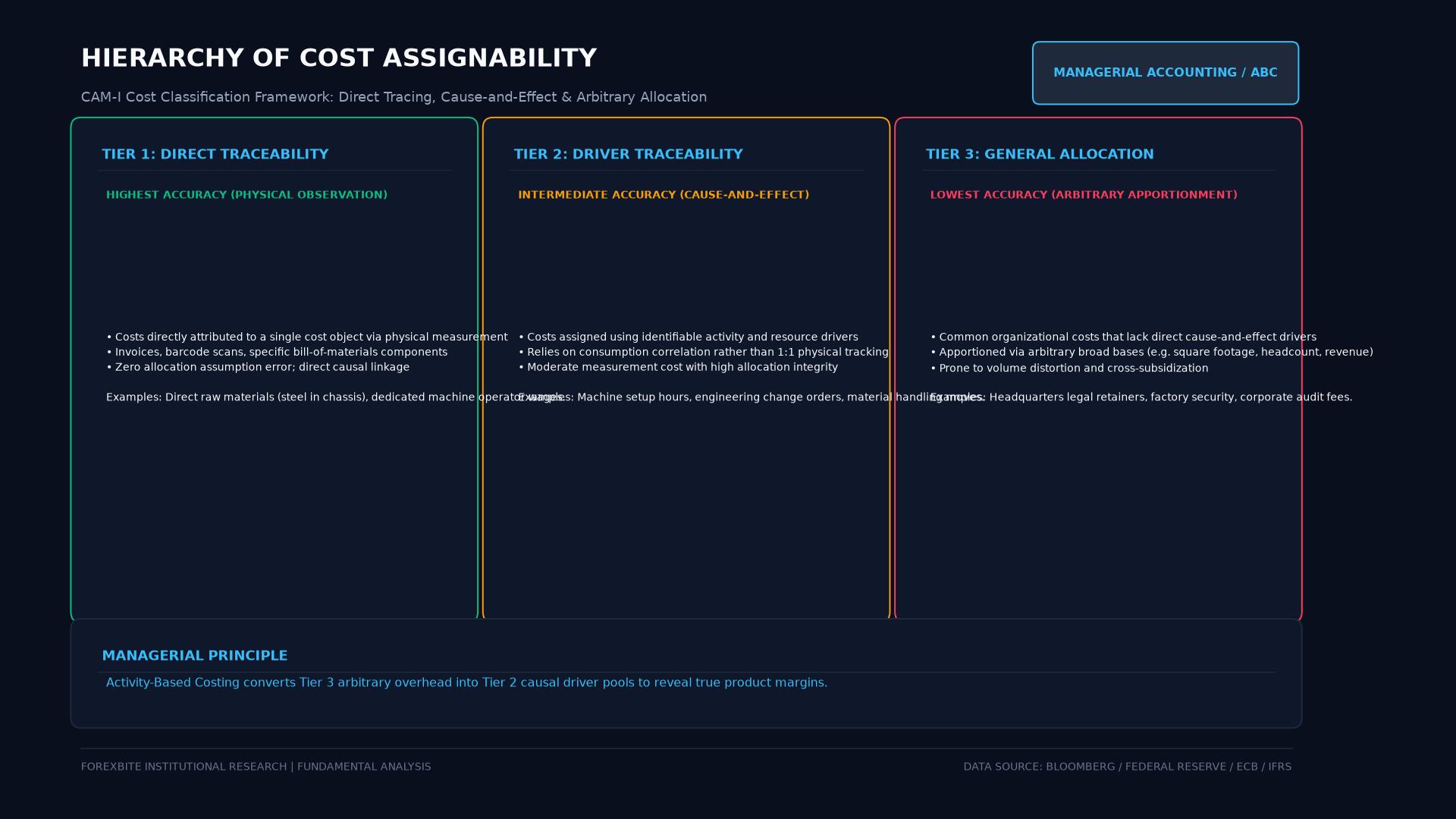 Figure: The three-tier hierarchy of cost assignability in cost accounting, contrasting physical direct tracing, cause-and-effect activity driver assignment, and arbitrary overhead allocation.
The Four Tiers of Cost Assignability
Traditional standard cost accounting allocates factory overhead by applying a single blanket rate based on direct labor hours or machine hours. This assumption presumes that all overhead is driven purely by volume. Cooper and Kaplan demonstrated that modern manufacturing overhead is predominantly driven by complexity, batch frequency, and product variety rather than physical unit volume. The hierarchy of cost assignability classifies activities into four tiers:
1. Unit-Level Activities
Unit-level activities are performed each and every time a single unit of product or service is created. The resources consumed at this tier vary in direct, linear proportion to production volume:
- Operational Examples: Electricity consumed by an automated drill press, machine operating wear, stamping a metal sheet, or the physical assembly of a circuit board.
- Appropriate Cost Drivers: Direct machine hours, direct labor hours, or total physical units produced.
2. Batch-Level Activities
Batch-level activities are performed each time a group or production run of goods is processed, regardless of how many individual units reside within the batch:
- Operational Examples: Calibrating and resetting industrial tooling on an assembly line (machine setup), issuing a procurement purchase order to an external supplier, staging raw materials from warehouse racks to the shop floor, or performing quality assurance testing on the first three items of a production run.
- Appropriate Cost Drivers: Number of machine setups, setup hours, number of purchase orders, or material movement requisitions.
- The Economic Dynamic: Producing a customized batch of 5 specialized medical sensors requires the exact same setup effort and documentation as running a standard batch of 5,000 units. Traditional volume-based systems allocate 1,000 times more setup cost to the large batch, artificially under-costing the short-run custom product.
3. Product-Sustaining Activities
Product-sustaining (or service-sustaining) activities are performed to support the existence, design, and regulatory compliance of an entire product line or stock-keeping unit (SKU), regardless of the number of batches or units manufactured:
- Operational Examples: Engineering change notices (ECNs), computer-aided design (CAD) revisions, drafting technical user manuals, product patent maintenance, and specialized testing fixtures.
- Appropriate Cost Drivers: Number of distinct engineering modifications, hours spent on product development, or active SKU counts.
- The Economic Dynamic: A complex, low-volume aerospace component may consume dozens of engineering hours each quarter, while a high-volume mature part requires zero engineering attention. Allocating engineering overhead based on machine hours completely distorts reality.
4. Facility-Sustaining Activities
Facility-sustaining activities sustain a manufacturing plant, corporate office, or administrative infrastructure as a viable operating entity. These expenditures are common to all operations and cannot be traced to specific products, batches, or product lines through any demonstrable cause-and-effect relationship:
- Operational Examples: Building rent, property insurance, plant security services, factory groundskeeping, corporate legal retainers, and the plant manager’s salary.
- Strategic Treatment: In strategic Activity-Based Management, facility-sustaining expenses are treated as period capacity costs. Forcing arbitrary allocation of factory rent to individual products based on labor or machine hours distorts product discontinuation and pricing decisions.
$$\text{Total Activity Cost} = \sum C_{\text{Unit}} + \sum C_{\text{Batch}} + \sum C_{\text{Product}} + \sum C_{\text{Facility}}$$
| Cost Hierarchy Level | Cost Behavior Relative to Volume | Common Operational Driver | Strategic Decision Scope |
|---|---|---|---|
| Unit-Level | Strictly proportional to output | Machine hours, labor hours | Incremental pricing, variable contribution |
| Batch-Level | Proportional to number of runs | Setup count, purchase orders | Economic Order Quantity (EOQ), run sizing |
| Product-Sustaining | Proportional to product complexity | Engineering changes, SKU count | Product rationalization, portfolio pruning |
| Facility-Sustaining | Fixed relative to production activity | Square footage, headcount | Long-term plant capacity, site consolidation |
Resolving Distortions: The High-Volume Subsidization Trap
The primary managerial objective of applying the hierarchy of cost assignability is eliminating the “high-volume subsidization trap.”
         HOW TRADITIONAL COSTING DISTORTS PRODUCT MARGINS
         ================================================

    HIGH-VOLUME COMMODITY PRODUCT           LOW-VOLUME CUSTOMIZED PRODUCT
    (Large runs, standard specs)            (Short runs, complex setups)
   +------------------------------+        +------------------------------+
   | TRADITIONAL VOLUME-BASED:    |        | TRADITIONAL VOLUME-BASED:    |
   | Absorbs massive overhead     |        | Absorbs tiny overhead share  |
   | because it runs many hours.  |        | because it runs few hours.   |
   | -> Appears UNPROFITABLE.     |        | -> Appears HIGHLY PROFITABLE.|
   +------------------------------+        +------------------------------+
                  |                                       |
                  |     APPLY COOPER-KAPLAN HIERARCHY     |
                  v                                       v
   +------------------------------+        +------------------------------+
   | ABC HIERARCHY REALITY:       |        | ABC HIERARCHY REALITY:       |
   | Consumes minimal setups or   |        | Consumes excessive setups,   |
   | engineering revisions.       |        | purchase orders, & changes.  |
   | -> TRUE MARGIN IS EXCELLENT. |        | -> TRUE MARGIN IS NEGATIVE.  |
   +------------------------------+        +------------------------------+
When an enterprise replaces traditional allocation with the four-tier hierarchy:
- Batch-level expenses (setups, order handling) are assigned directly to the short-run, complex batches that generated them.
- Product-sustaining expenses (design, compliance) are loaded onto the specific low-volume, customized SKUs that require continuous engineering oversight.
- High-volume commodity lines are freed from absorbing disproportionate overhead burdens.
Consequently, executives discover that standard commodity products, previously deemed low-margin, are actually the primary profit drivers, whereas complex, low-volume “specialty” products are destroying shareholder value due to unbilled batch and product-sustaining overhead.
Managerial Decision Applications
Categorizing costs through the hierarchy alters strategic decision-making across the enterprise:
- Order Sizing and Minimum Order Quantities (MOQs): By quantifying batch-level setup costs, sales teams can enforce price surcharges or minimum order sizes for customers requesting small, non-standard delivery runs.
- Product Portfolio Pruning: If a low-volume product’s gross profit fails to cover its dedicated product-sustaining engineering and testing costs, management can eliminate the SKU without impacting remaining operations.
- Make-or-Buy Analysis: In evaluating whether to outsource a component, executives assess whether outsourcing eliminates batch- and product-sustaining expenses, or merely reduces direct unit-level costs while leaving batch overhead intact.
Frequently Asked Questions
Can facility-sustaining costs be allocated to individual products for external GAAP reporting?
Yes. For external statutory financial reporting under US GAAP and IFRS, absorption costing requires all factory overhead, including facility-sustaining costs like factory depreciation and plant rent, to be allocated to inventory and Cost of Goods Sold. However, for internal managerial decision-making, allocating facility-sustaining costs to individual products is avoided because it creates misleading signals regarding product profitability.
What is the difference between a batch-level cost driver and a unit-level cost driver?
A unit-level driver increases with every single unit manufactured (e.g., each widget consumes 2 kilowatt-hours of electricity). A batch-level driver increases only when a new production run or order is initiated, regardless of the quantity in that batch (e.g., retooling a press takes 4 hours, whether the machine stamps 10 parts or 10,000 parts).
How does the hierarchy of cost assignability apply to service companies?
In commercial banking, healthcare, and logistics, the hierarchy applies directly:
- Unit-level: Processing an individual credit card swipe or ATM withdrawal.
- Batch-level: Clearing a daily batch of corporate payroll checks or dispatching a delivery truck route.
- Customer/Product-sustaining: Maintaining a specialized institutional corporate cash-management banking platform or updating regulatory compliance for a specialized loan product.
- Facility-sustaining: Operating the bank’s corporate headquarters building or regional branch branches.
Ready to trade forex?
Open a free demo account with a regulated broker. Practice with virtual funds before risking real money.