Horizontal Spread
A horizontal spread (commonly termed a calendar spread or time spread) is an options strategy that involves the simultaneous purchase and sale of options of the same underlying asset, type (both calls or both puts), and strike price, but with differing expiration dates.
What Is a Horizontal Spread?
A horizontal spread—widely known as a calendar spread or time spread—is a multi-leg options strategy designed to exploit differences in the rate of time decay (Theta) and implied volatility sensitivity (Vega) across different expiration cycles. The strategy is constructed by simultaneously buying and selling options on the exact same underlying asset with the identical strike price, but differing expiration dates.
The term “horizontal” originates from standard options quotation matrices:
- Vertical Spreads: Trade options across different strike prices within the same expiration month (a vertical column on the quote board).
- Horizontal Spreads: Trade options across different expiration months at the same strike price (a horizontal row across the quote board).
- Diagonal Spreads: Combine both, trading across different strikes and different expirations simultaneously.
Options Board Geometry:
                    EXPIRATION: JUNE            EXPIRATION: SEPTEMBER
STRIKE 1.0800:     [ Sell Short-Term ] ───────► [ Buy Long-Term ]
                         ▲                              ▲
                         │                              │
                         └────── HORIZONTAL SPREAD ─────┘
                               (Same Strike: 1.0800)
                               (Different Expirations)
Key Takeaways
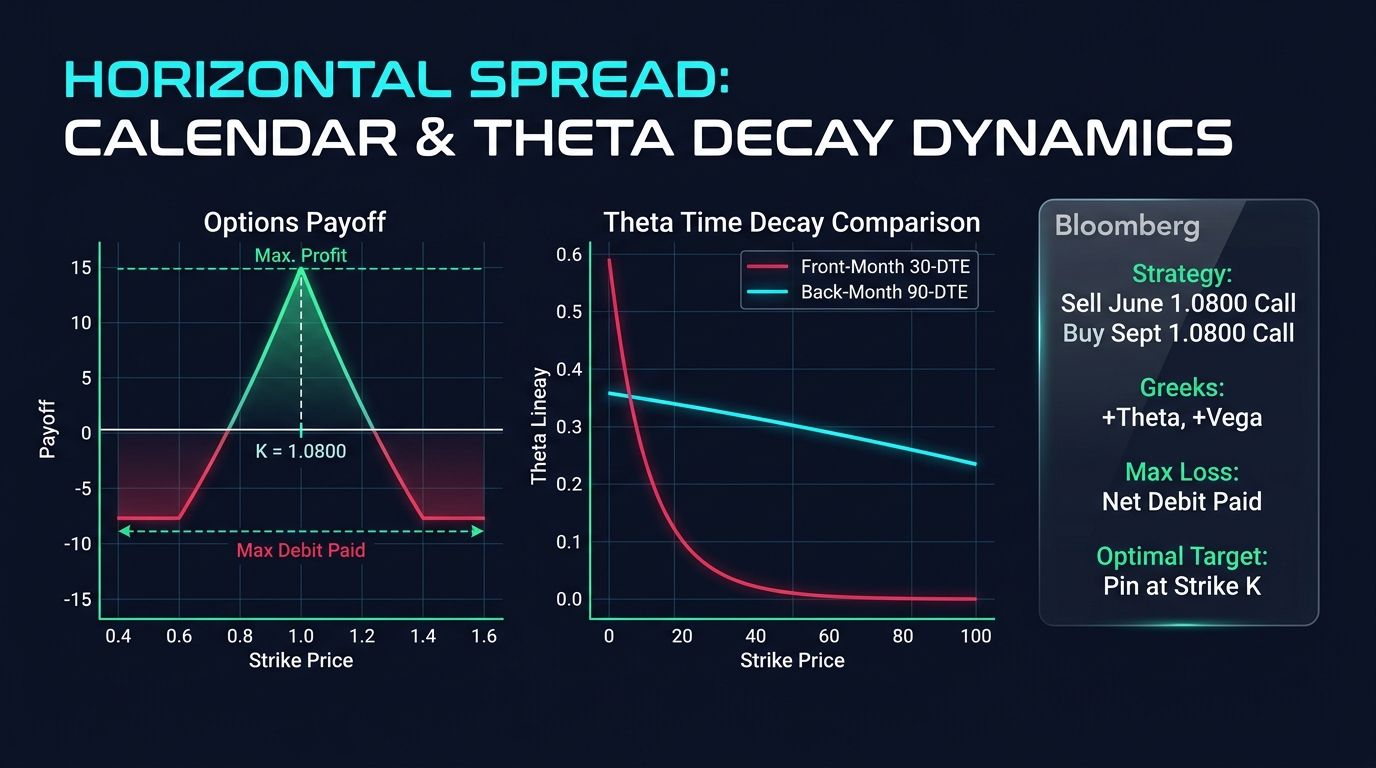
- Theta Exploitation: The foundation of a standard (long) horizontal spread is that near-term options suffer time decay exponentially faster than longer-dated options.
- Construction (Long Calendar): The trader sells a near-term option (e.g., 30 days to expiry) and buys a longer-term option (e.g., 90 days to expiry) at the exact same strike price.
- Peak Profit Zone: Maximum profit is achieved if the underlying currency or asset closes precisely at the strike price on the date the front-month option expires.
- Positive Vega Exposure: Horizontal spreads benefit from an increase in implied volatility in the longer-dated contract.
Mechanics: The Asymmetry of Option Time Decay
An option’s time decay curve is non-linear. During the final 30 to 45 days before expiration, an option’s time value decays rapidly. Conversely, an option with 90 to 180 days to expiration experiences much slower daily time decay.
Exponential Time Decay (Theta) Acceleration:
Option Time Value ($)
  ▲
  │   Slow, Linear Decay
  │   (90 to 60 Days Out) ──────╮
  │                             ╰╮
  │                               ╰╮  EXPONENTIAL THETA ACCELERATION
  │                                ╰╮ (Last 30 Days before Expiration)
  │                                 ╰╮
  │                                  ▼
──┴──────────────────────────────────────────────────────► Time to Expiration
  90 Days                           30 Days                0 Days (Expiry)
By selling the rapidly decaying front-month contract and holding the slowly decaying back-month contract, the horizontal spread trader captures net positive daily time decay while keeping directional risk relatively contained.
Horizontal vs. Vertical vs. Diagonal Spreads
| Spread Type | Strike Prices | Expiration Dates | Primary Trading Catalyst |
|---|---|---|---|
| Horizontal (Calendar) | Identical (e.g., both at 1.0800) | Different (e.g., 30 days vs 90 days) | Time decay differential & rising implied volatility |
| Vertical Spread | Different (e.g., 1.0800 vs 1.1000) | Identical (e.g., both expiring in June) | Directional market movement (Bullish or Bearish) |
| Diagonal Spread | Different (e.g., 1.0700 vs 1.0900) | Different (e.g., 30 days vs 90 days) | Directional bias combined with time decay harvesting |
Real-World Example: Long EUR/USD Call Calendar Spread
Assume spot EUR/USD trades at 1.0800. An institutional derivatives trader expects EUR/USD to remain range-bound near 1.0800 over the next month:
- Sell to Open: 30-Day 1.0800 Call at a premium of 0.0080 ($800 credit).
- Buy to Open: 90-Day 1.0800 Call at a premium of 0.0150 ($1,500 debit).
- Net Debit Paid: $0.0150 - 0.0080 = 0.0070$ ($700 total capital at risk).
What Happens at Front-Month Expiry (Day 30)?
- Ideal Scenario (EUR/USD sits at exactly 1.0800): The short 30-day call expires 100% worthless; the trader retains the entire $800 credit. Meanwhile, the long 90-day call still has 60 days of valuable time value remaining (worth roughly $1,200). The spread can be closed for a net profit of $500, or the trader can sell another 30-day call against it.
- Adverse Scenario (EUR/USD crashes to 1.0200 or explodes to 1.1500): The short call expires worthless, but the long call loses substantial value. The trader’s maximum loss is strictly capped at the initial net debit paid ($700).
Managing Implied Volatility (Vega) in Foreign Exchange
Horizontal spreads are highly sensitive to changes in implied volatility (IV):
- Rising IV (Beneficial): Longer-dated options possess higher Vega than short-dated options. If market volatility spikes, the value of the long back-month option increases faster than the short option, producing a profit boost.
- Pre-Event Hedging: Currency options desks frequently sell horizontal spreads prior to major central bank announcements (such as a Federal Reserve rate meeting), capturing the sharp volatility crush that occurs immediately after the decision is published.
Frequently Asked Questions
What is a “Reverse Calendar Spread”?
A reverse calendar spread is the opposite trade: the trader buys the near-term option and sells the longer-dated option. This is a negative-theta, high-gamma strategy deployed when a trader expects an explosive, violent directional breakout in the immediate near term followed by prolonged consolidation.
Can horizontal spreads be constructed with Put options?
Yes. A calendar spread constructed with put options (selling a near-term put and buying a long-term put at the same strike) functions almost identically to a call calendar spread, sharing a nearly identical profit-and-loss profile.
What is the maximum risk of a long horizontal spread?
The maximum financial loss on a standard long horizontal spread is strictly limited to the net debit paid to establish the trade, plus broker commissions. Unlike naked option writing, horizontal spreads carry zero unlimited loss risk.
Ready to trade forex?
Open a free demo account with a regulated broker. Practice with virtual funds before risking real money.