Housing Starts
Housing starts is a vital leading macroeconomic indicator published monthly by the U.S. Census Bureau that measures the total annualized number of new privately owned residential housing projects that commenced physical excavation or construction.
What Are Housing Starts?
The Housing Starts report (officially titled New Residential Construction) is a premier monthly macroeconomic indicator published jointly by the U.S. Census Bureau and the U.S. Department of Housing and Urban Development (HUD). The report tracks the number of new privately owned residential housing units that broke ground—meaning the physical excavation for footings or foundation commenced—during the prior calendar month.
Because residential real estate represents one of the most interest-rate-sensitive sectors in any modern economy, housing starts serve as an exceptionally powerful leading indicator of the broader business cycle. Turning points in the housing sector historically precede broad economic recessions and recoveries by six to twelve months, making this release a focal point for foreign exchange traders, bond investors, and central bank monetary policy committees.
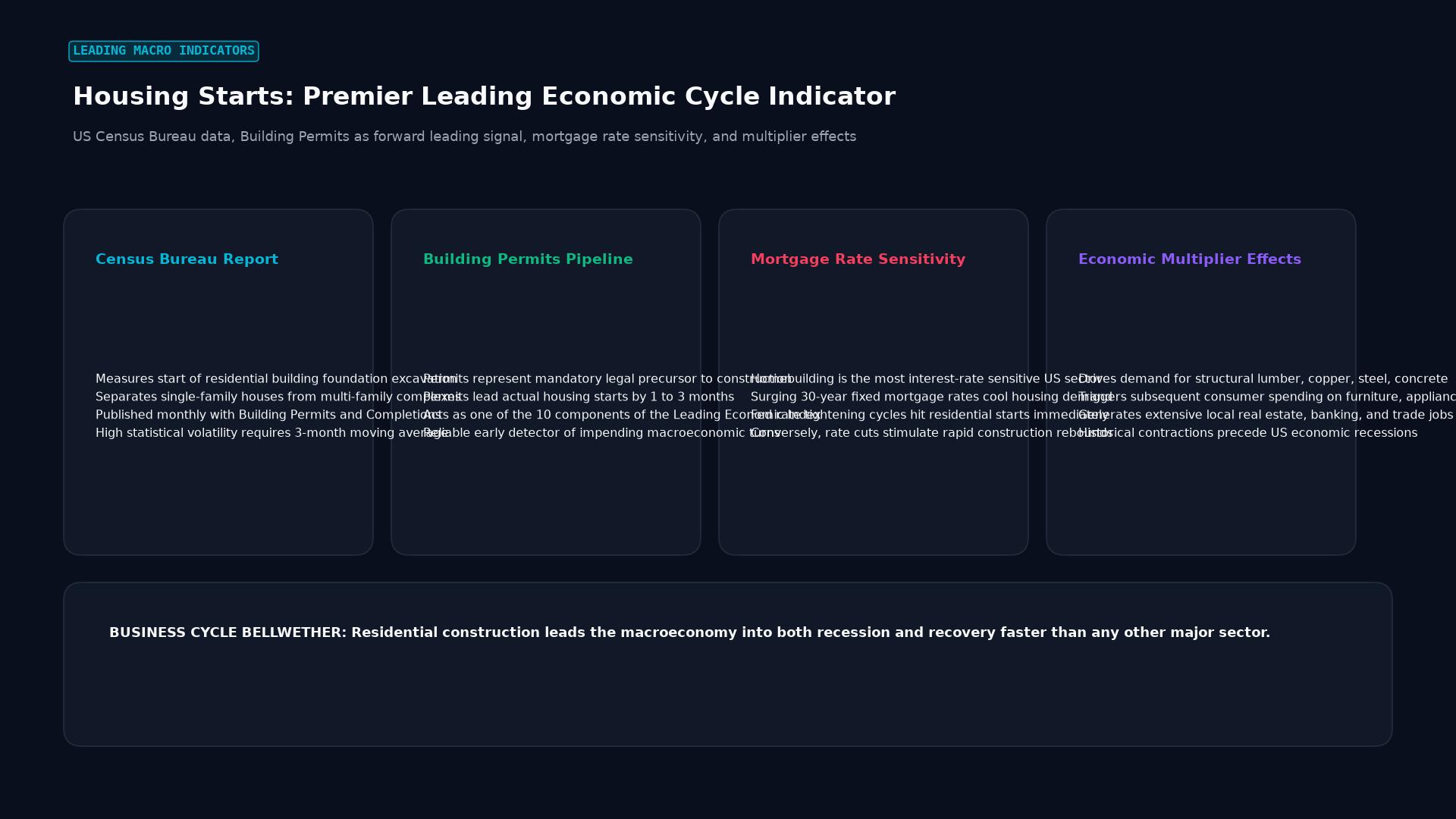 Figure: US Census Bureau data, Building Permits as forward leading signal, mortgage rate sensitivity, and multiplier effects
Key Takeaways
- Seasonally Adjusted Annual Rate (SAAR): Data is quoted as an annualized rate (e.g., “1.45 million units”), representing the total number of homes that would be built over a full year if that month’s construction pace persisted.
- The Economic Multiplier: Residential construction stimulates massive downstream economic activity, driving demand for raw materials (timber, concrete, steel, copper wiring), heavy machinery, architectural services, and consumer durable goods (appliances, furniture).
- Extreme Interest Rate Sensitivity: When the Federal Reserve raises benchmark interest rates, commercial mortgage rates surge immediately, cooling buyer affordability and causing housing starts to contract sharply.
- Permits Lead Starts: While housing starts track physical construction, Building Permits—released in the identical report—represent the true leading edge, as builders must secure legal municipal permits before breaking ground.
The Three Tiers of the Housing Report
The monthly New Residential Construction report decomposes housing into three distinct development stages:
| Construction Stage | Metric Tracked | Economic Role | Sensitivity to Weather |
|---|---|---|---|
| Building Permits | Number of legal municipal construction permits authorized | Pure Leading Indicator: Signals future construction pipeline over 1–3 months | Low: Paper permits filed regardless of rain or snow |
| Housing Starts | Number of homes that physically began foundation excavation | Coincident / Leading Hybrid: Measures active industrial activity | High: Extreme blizzards or hurricanes cause temporary plunges |
| Housing Completions | Number of residential units finished and ready for sale | Lagging Indicator: Measures finalized housing stock hitting the market | Moderate: Reflects past multi-month building cycles |
Single-Family vs. Multi-Family Housing Starts
Economists separate housing starts into two structural categories:
- Single-Family Starts: Standalone detached houses built for individual families. This represents roughly 65% to 75% of the total housing market. Single-family construction has a vastly higher economic multiplier effect, requiring more land, appliances, landscaping, and infrastructure per unit.
- Multi-Family Starts: Apartment complexes, condominiums, and multi-unit residential towers (buildings with 5+ units). Multi-family data is notoriously volatile month-to-month because the approval or groundbreaking of a few massive urban high-rises can heavily skew national headline numbers.
Impact on Foreign Exchange and Central Bank Policy
Foreign exchange traders monitor housing starts to assess the real-world transmission of central bank monetary policy:
$$\text{Housing Surprise} = \text{Actual SAAR Number} - \text{Consensus Forecast}$$
- Stronger-Than-Expected Starts (Bullish for USD): Robust housing construction indicates consumer wealth resilience and strong domestic credit demand. If the economy is booming, the Federal Reserve is more likely to keep interest rates elevated, supporting U.S. Treasury yields and strengthening the U.S. Dollar against the Euro and Yen.
- Weakening Housing Starts (Bearish for USD): A persistent, multi-month decline in housing starts is historically one of the most reliable harbingers of an impending macroeconomic recession. Bond traders aggressively reprice future interest rate cuts, weakening the currency.
Frequently Asked Questions
Why does severe winter weather distort housing starts?
Physical groundbreaking requires excavating frozen ground and pouring concrete. Severe winter blizzards or historic rainfall in January and February frequently cause housing starts in the Northeast and Midwest to collapse by 10% to 20%. Economists look at Building Permits during these months, as permits are unaffected by frozen construction sites.
What is the relationship between mortgage rates and housing starts?
The relationship is strongly inversely correlated. When 30-year fixed mortgage rates rise from 3% to 7%, monthly mortgage payments on an average home double, locking out first-time buyers. Homebuilders respond by halting land acquisitions and delaying groundbreaking on new developments.
Where is the Housing Starts report released?
The report is published monthly at 8:30 AM Eastern Time (typically around the 17th of each month) by the U.S. Census Bureau and can be accessed publicly on the Census Bureau’s official economic indicator database (census.gov/construction/nrc).
Ready to trade forex?
Open a free demo account with a regulated broker. Practice with virtual funds before risking real money.