Identifiable asset
An identifiable asset is any tangible or intangible resource acquired in a business combination that can be independently recognized and assigned a fair value under ASC 805 or IFRS 3.
In corporate mergers and acquisitions (M&A) and financial accounting, an identifiable asset is any tangible or intangible economic resource acquired in a business combination that satisfies the rigorous recognition criteria required to be separately recorded on the consolidated balance sheet at its acquisition-date fair value. Governed by Financial Accounting Standards Board (FASB) Accounting Standards Codification Topic 805 (ASC 805) under US GAAP and International Financial Reporting Standard 3 (IFRS 3), the identification and valuation of these assets represents the core of the Purchase Price Allocation (PPA) process. Accurately segregating identifiable assets from residual goodwill directly dictates an acquiring corporation’s post-deal earnings per share, future depreciation and amortization schedules, and balance sheet solvency.
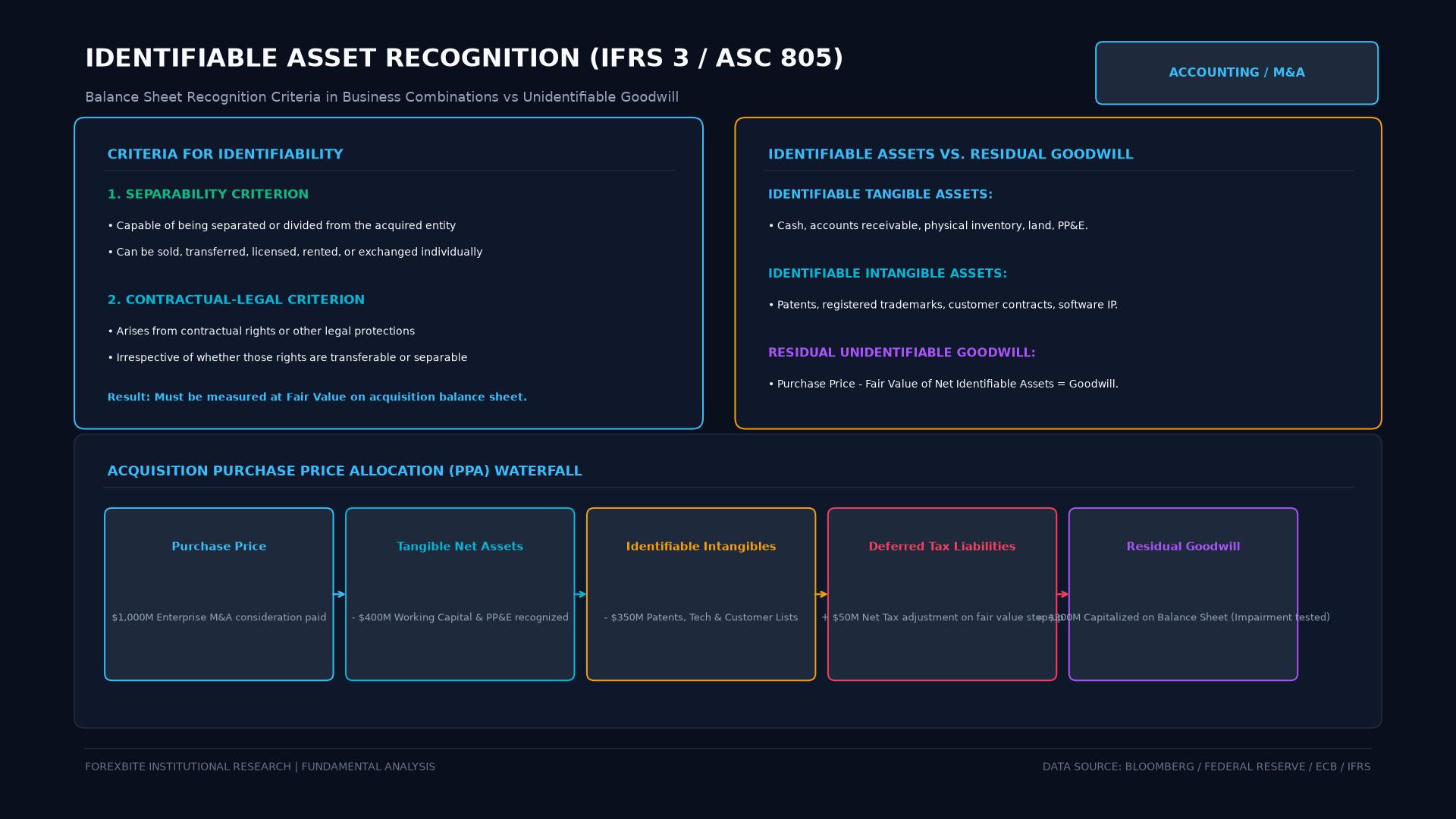 Figure: Purchase Price Allocation (PPA) waterfall under IFRS 3 and ASC 805, demonstrating the contractual-legal and separability criteria required to recognize identifiable tangible and intangible assets versus residual goodwill.
The Statutory Criteria for Identifiability
Under both US GAAP (ASC 805) and IFRS (IFRS 3), an asset cannot be recorded on an acquiring company’s balance sheet simply because management believes it possesses commercial value. To qualify as an “identifiable asset,” the resource must satisfy at least one of two statutory criteria:
1. The Separability Criterion
An asset is separable if it is capable of being divided, separated, or detached from the acquired enterprise and sold, transferred, licensed, rented, or exchanged.
- The separability test applies regardless of whether the acquiring corporation actually intends to sell or license the asset.
- The critical question is whether the asset could be separated independently, either individually or in combination with a related contract, identifiable asset, or liability.
- Examples: Physical machinery, industrial warehouses, mineral extraction rights, customer lists (where industry precedent demonstrates such lists are traded), and patented formulas.
2. The Contractual-Legal Criterion
An asset satisfies the contractual-legal criterion if it arises from explicit contractual rights or other legally recognized protections, regardless of whether those rights are transferable or separable from the acquired entity or from other rights and obligations.
- Examples: Operating leases, long-term supply agreements, employment non-compete covenants, registered trademarks, broadcasting licenses, and software copyrights.
$$\text{Identifiable Asset Test} = \text{Separable} \lor \text{Contractual-Legal Right}$$
If an acquired economic resource fails both criteria, it cannot be recognized as an independent asset. Instead, its economic value must be absorbed into residual goodwill.
Tangible vs Intangible Identifiable Assets
The purchase price allocation process divides identifiable assets into two broad operational categories:
1. Tangible Identifiable Assets
Tangible assets represent physical resources and recognized financial instruments. In a business combination, these assets must be revalued to current market fair value, often resulting in balance sheet step-ups:
- Cash and Cash Equivalents: Recorded at verified face value.
- Accounts Receivable: Recorded at fair value, which discounts the face value of outstanding invoices for expected credit losses (eliminating the target’s pre-acquisition allowance for doubtful accounts).
- Inventory Step-Up: Finished goods inventory is stepped up from historic manufacturing cost to net realizable value minus a reasonable selling profit margin, resulting in temporarily depressed gross profit margins when that inventory is sold in post-acquisition periods.
- Property, Plant, and Equipment (PP&E): Land, commercial buildings, factory complexes, and manufacturing equipment are appraised at replacement cost or market comparison value. This creates a new, higher depreciation basis for future reporting periods.
2. Intangible Identifiable Assets
Intangible assets lack physical substance but represent identifiable legal or economic rights. Standard valuation methodologies (such as the Relief-from-Royalty method or the Multi-Period Excess Earnings Method) are deployed by independent appraisal firms to establish fair values for:
- Patented and unpatented proprietary technology.
- Customer relationship contracts and enterprise order backlogs.
- Registered trademarks, trade names, and domain portfolios.
- Regulatory operating permits, airport landing slots, and franchise agreements.
| Asset Class | Recognition Standard | Fair Value Appraisal Method | Post-Deal Income Statement Impact |
|---|---|---|---|
| Inventory Step-Up | Tangible; Separable | Net Realizable Value minus selling cost | Increased Cost of Goods Sold in months 1-6 |
| Property & Machinery | Tangible; Separable | Cost Approach / Market Approach | Higher annual depreciation expense |
| Customer Contracts | Intangible; Contractual | Multi-Period Excess Earnings Method (MPEEM) | Annual amortization expense over useful life |
| Patents & Tech | Intangible; Contractual | Relief-from-Royalty Method | Annual amortization expense over useful life |
| Residual Goodwill | Unidentifiable Residual | Purchase Price minus Net Identifiable Assets | Zero amortization; annual impairment test |
The Mathematical Derivation of Goodwill
Goodwill is not an identifiable asset; it is the unidentifiable accounting residual of an acquisition. It represents the premium an acquirer pays for synergies, corporate culture, future growth expectations, assembled workforce capabilities, and market dominance that cannot be recognized under ASC 805:
$$\text{Goodwill} = \text{Purchase Consideration Paid} - (\text{Fair Value of Identifiable Assets} - \text{Fair Value of Liabilities Assumed})$$
Every dollar that forensic valuation appraisers successfully assign to an identifiable asset reduces the final balance sheet goodwill balance.
Financial Reporting and Earnings Per Share Implications
The allocation of purchase price to identifiable assets has profound long-term consequences for corporate financial performance:
1. Amortization and Depreciation Drag
Identifiable tangible assets (like factories) and finite-lived identifiable intangibles (like customer lists or developed software) must be depreciated or amortized over their estimated useful lives. This creates a persistent non-cash expense on the post-deal Income Statement, reducing reported operating income (EBIT), net income, and GAAP earnings per share (EPS).
2. The Non-Amortization of Goodwill
Under current US GAAP and IFRS rules for public corporations, goodwill is not amortized. Instead, it remains on the balance sheet indefinitely, subject to at least an annual impairment test under ASC 350 / IAS 36. As a result, corporate management teams historically preferred maximizing goodwill over finite-lived identifiable assets to avoid post-deal amortization charges against GAAP earnings. However, independent valuation auditors strictly enforce the separability and contractual-legal criteria to prevent corporate acquirers from misclassifying identifiable intangibles as goodwill.
Frequently Asked Questions
Can an assembled workforce be recognized as an identifiable asset in an acquisition?
No. Under ASC 805 and IFRS 3, an assembled skilled workforce does not satisfy either the contractual-legal criterion or the separability criterion. An employer cannot own or legally control employees under contract in a manner that allows the workforce to be separated and sold independently. The economic value of an assembled workforce must be subsumed into residual goodwill.
What is the difference between an asset purchase and a stock purchase regarding identifiable assets?
In a stock purchase for tax purposes, the buyer inherits the target’s historic tax basis in its assets, meaning the fair value write-ups of identifiable assets create deferred tax liabilities (DTLs) on the GAAP balance sheet. In an asset purchase (or a stock acquisition structured as an asset purchase under Internal Revenue Code Section 338(h)(10)), the buyer steps up the tax basis of the identifiable assets to fair value, enabling tax-deductible depreciation and amortization that generates significant cash tax savings.
What happens if the fair value of net identifiable assets exceeds the purchase price?
When an acquiring company purchases a distressed enterprise for a total price that is less than the aggregate fair value of its net identifiable assets, the transaction is classified as a “bargain purchase.” After reassessing the valuation of all assets and liabilities to confirm accuracy, the acquirer recognizes the difference immediately as a non-operating gain on the Income Statement (Gain on Bargain Purchase), resulting in zero goodwill.
Ready to trade forex?
Open a free demo account with a regulated broker. Practice with virtual funds before risking real money.