Identifiable intangible asset
An identifiable intangible asset is a non-monetary asset lacking physical substance that can be separately distinguished and valued under ASC 805 or IAS 38 via contractual-legal rights or separability.
An identifiable intangible asset is an economic resource lacking physical substance that can be separately identified, measured, and recognized on an enterprise’s balance sheet under Financial Accounting Standards Board (FASB) Accounting Standards Codification Topic 805 (ASC 805) and International Accounting Standard 38 (IAS 38). Unlike unidentifiable goodwill, an intangible asset is deemed identifiable if it arises from explicit contractual or legal rights, or if it is capable of being separated or divided from the entity and sold, transferred, licensed, rented, or exchanged. In modern corporate transactions, where technological intellectual property, brand equity, and customer relationships constitute the vast majority of enterprise valuation, the accurate appraisal of identifiable intangibles dictates post-merger earnings quality, balance sheet durability, and tax optimization.
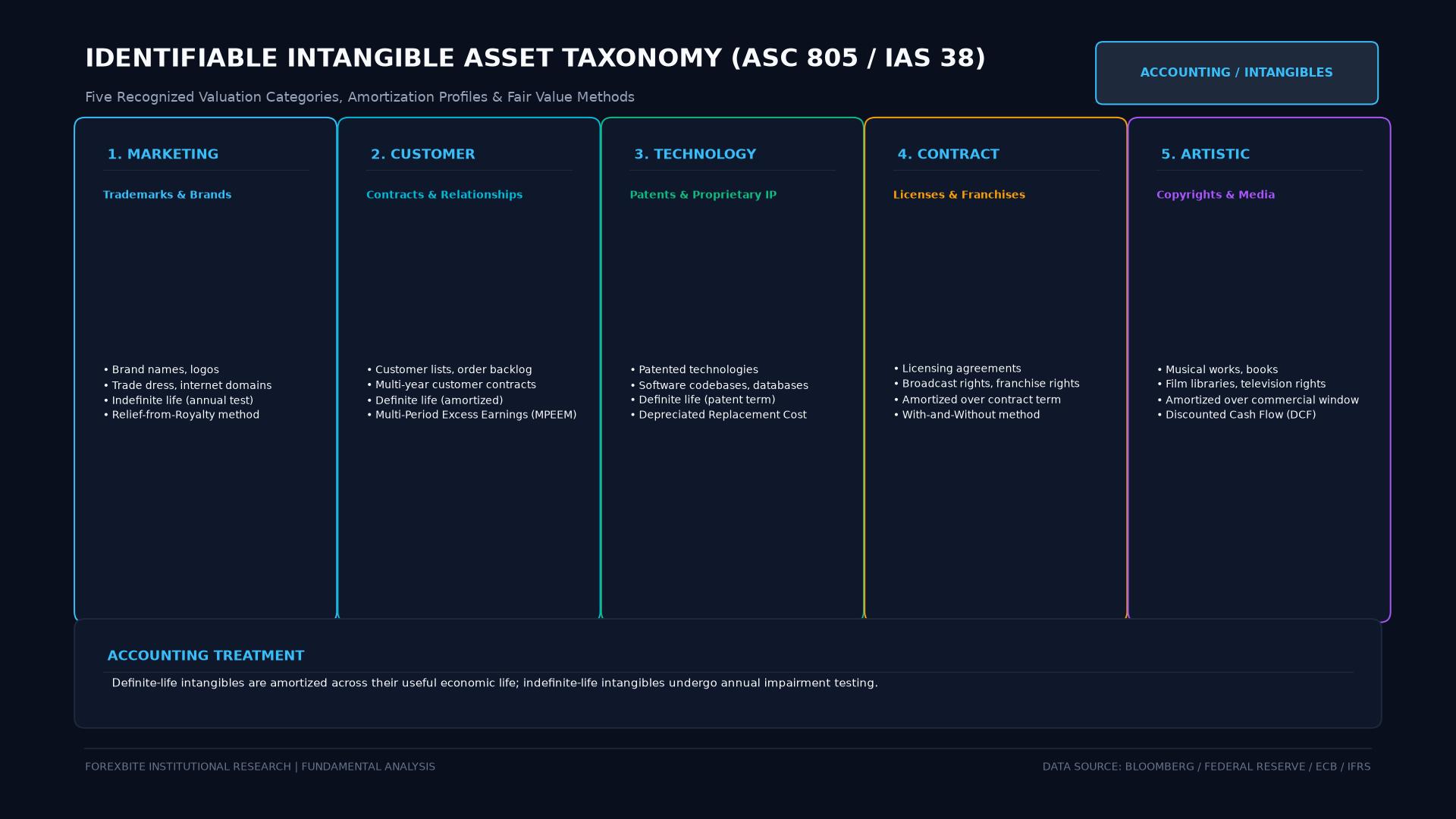 Figure: Five recognized categories of identifiable intangible assets (Marketing, Customer, Technology, Contract, and Artistic) alongside their respective valuation methodologies and amortization schedules.
The Five Statutory Taxonomy Categories
Accounting standards classify identifiable intangible assets into five operational categories based on their commercial function within the enterprise:
1. Marketing-Related Intangible Assets
Marketing assets are deployed primarily in the branding, marketing, and commercial promotion of an enterprise’s products or services:
- Core Assets: Trademarks, registered service marks, commercial trade names, collective marks, internet domain names, and non-competition agreements.
- Valuation Methodology: Commonly appraised using the Relief-from-Royalty Method. This approach hypothesizes that if the company did not own the trademark, it would be forced to license it from an external owner. The value of the asset is the present value of the after-tax royalty payments saved by owning the mark outright.
2. Customer-Related Intangible Assets
Customer assets represent the commercial value embedded in established relationships with recurring buyers, institutional clients, and distribution channels:
- Core Assets: Customer contracts, uncontracted recurring customer relationships, customer lists (where trading precedent exists), order backlogs, and distributor networks.
- Valuation Methodology: Typically appraised via the Multi-Period Excess Earnings Method (MPEEM). The appraiser isolates the cash flows generated exclusively by the existing customer base, deducts annual customer attrition rates (churn), and subtracts contributory asset charges (returns on working capital, fixed assets, and workforce) to determine the net excess cash flows attributable solely to the customer relationship.
3. Contract-Based Intangible Assets
Contract assets represent the economic value of favorable contractual agreements that grant rights to operate, access resources, or generate recurring revenues:
- Core Assets: Franchise agreements, television and streaming broadcast rights, mineral and timber extraction rights, operating and servicing rights, and favorable lease contracts (where the company pays rent below prevailing market rates).
- Valuation Methodology: Valued using the With-and-Without Method or discounted cash flow differentials comparing the contracted cash flows against current market terms.
4. Technology-Based Intangible Assets
Technology assets comprise scientific, engineering, and digital innovations that provide competitive production or operational advantages:
- Core Assets: Patented technology, unpatented proprietary technology, corporate computer software, algorithmic codebases, proprietary databases, and trade secrets.
- Valuation Methodology: Appraised using the Relief-from-Royalty method or the Replacement Cost Approach (calculating the current cost to recreate or reproduce software code with equivalent functionality, adjusted for technical obsolescence).
5. Artistic-Related Intangible Assets
Artistic assets encompass creative and cultural works protected by statutory copyright:
- Core Assets: Theatrical plays, books, musical compositions, sound recordings, motion pictures, television programs, and video game intellectual property.
| Intangible Asset Category | Primary Examples | Standard Valuation Technique | Useful Life Designation |
|---|---|---|---|
| Marketing-Related | Trademarks, Brand Names, URLs | Relief-from-Royalty Method | Indefinite or 10-20 Years |
| Customer-Related | Enterprise Contracts, Order Backlog | Multi-Period Excess Earnings (MPEEM) | Finite (5 to 15 Years) |
| Technology-Related | Software Codebases, Patents | Relief-from-Royalty / Cost Approach | Finite (3 to 10 Years) |
| Contract-Based | Franchise Licenses, Favorable Leases | Differential Cash Flow Modeling | Contract Term (Finite) |
| Artistic-Related | Musical Rights, Film Libraries | Discounted Cash Flow (DCF) | Copyright Duration (Finite) |
Useful Life: Finite vs Indefinite-Lived Intangibles
Once an identifiable intangible asset is recognized and assigned an acquisition-date fair value, financial accounting standards require management to determine its useful economic life:
1. Finite-Lived Intangible Assets
An intangible asset has a finite useful life if its economic benefit to the enterprise is bounded by statutory expiration, contract expiration, or anticipated technological obsolescence:
- Accounting Treatment: The capitalized asset value must be systematically amortized over its estimated useful life on a straight-line basis (or an accelerated pattern that reflects the consumption of economic benefits).
- Income Statement Impact: Amortization appears as an operating expense, reducing operating profit (EBIT) and net income.
- Impairment Testing: Tested for impairment only when triggering events occur (e.g., loss of a major customer, adverse regulatory rulings) under ASC 360 / IAS 36.
2. Indefinite-Lived Intangible Assets
An intangible asset is classified as indefinite-lived if there is no foreseeable limit to the period over which it is expected to generate net cash inflows:
- Examples: Global flagship trademarks (such as Coca-Cola or Apple), perpetual broadcast licenses, or operating permits that can be renewed indefinitely for negligible cost without substantial modification.
- Accounting Treatment: Indefinite-lived intangibles are never amortized.
- Impairment Testing: Under ASC 350 and IAS 36, indefinite-lived intangibles must be tested for impairment at least annually (or more frequently if an adverse event occurs). If the fair value drops below the balance sheet carrying value, an immediate non-cash impairment loss is recognized on the Income Statement.
$$\text{Impairment Loss} = \max(0, ; \text{Carrying Value} - \text{Fair Value})$$
Tax Amortization under Internal Revenue Code Section 197
The financial accounting treatment (US GAAP) of identifiable intangibles diverges fundamentally from United States federal income tax law:
            GAAP FINANCIAL REPORTING VS IRS TAX ACCOUNTING
            ==============================================

      GAAP FINANCIAL REPORTING (ASC 805)           IRS TAX ACCOUNTING (IRC § 197)
     +----------------------------------+       +----------------------------------+
     | VARYING AMORTIZATION PERIODS     |       | UNIFORM 15-YEAR AMORTIZATION     |
     | Software: 3 - 5 Years            |       | Regardless of GAAP useful life:  |
     | Patents: 7 - 12 Years            |       | Goodwill, Trademarks, Software,  |
     | Customers: 8 - 15 Years          |       | and Customer Lists MUST be       |
     | Trademarks: Often Indefinite     |       | amortized over exactly 180 months|
     +----------------------------------+       +----------------------------------+
Under Internal Revenue Code Section 197, when an acquisition is structured as a taxable asset purchase:
- Virtually all acquired intangible assets, including customer lists, trademarks, patents, and goodwill, must be amortized for federal income tax purposes over a statutory period of exactly 15 years (180 months) on a straight-line basis.
- This divergence creates substantial Book-Tax Differences (temporary timing differences), generating deferred tax assets (DTAs) or deferred tax liabilities (DTLs) on the corporate balance sheet.
Frequently Asked Questions
Can internally developed software or brand names be capitalized as identifiable intangibles?
Under US GAAP (ASC 350-40), internal-use software development costs can be capitalized during the application development stage once technological feasibility is established. However, internally generated brand names, trademarks, and customer lists cannot be capitalized; their development costs must be expensed as incurred. They can only appear on a balance sheet when acquired from an external party in a business combination.
What is a contributory asset charge (CAC) in intangible asset valuation?
In the Multi-Period Excess Earnings Method (MPEEM) used to value customer relationships, the business requires other “contributory assets” (such as working capital, factories, software, and assembled workforce) to service those customers. A contributory asset charge is a fair rental charge deducted from total cash flows to compensate the enterprise for the use of those other assets, isolating the residual earnings generated solely by the customer relationship.
How does the amortization of identifiable intangibles affect adjusted earnings metrics like EBITDA?
Because amortization is a non-cash expense reflecting historical purchase price allocation, financial analysts and corporate executives frequently add intangible amortization back to net income when calculating EBITDA (Earnings Before Interest, Taxes, Depreciation, and Amortization) or Adjusted Net Income. This presentation allows investors to evaluate underlying operational cash generation without the distortion of deal-related accounting write-offs.
Ready to trade forex?
Open a free demo account with a regulated broker. Practice with virtual funds before risking real money.