Illiquid
An illiquid market or asset is characterized by low trading activity, a scarcity of participating buyers and sellers, wide bid-ask spreads, and shallow order book depth, preventing trades from executing quickly without causing severe price distortion or slippage.
What Does “Illiquid” Mean in Financial Markets?
In financial trading, an asset or market is classified as illiquid when it cannot be readily bought, sold, or converted into cash without incurring substantial transaction costs, lengthy execution delays, or severe adverse price movements. In an illiquid market, the order book lacks market depth—meaning there are few resting limit orders on either the bid or ask side.
Although the global foreign exchange (FX) market is celebrated as the most liquid financial market in the world—clearing over $7.5 trillion in daily turnover—that liquidity is heavily concentrated in a handful of G10 currency pairs (EUR/USD, USD/JPY, GBP/USD). Many exotic currency pairs, emerging market crosses, and minor currency forwards operate in chronically illiquid conditions. Furthermore, even major currency pairs can become dangerously illiquid during specific hours of the day or surrounding unexpected geopolitical shocks.
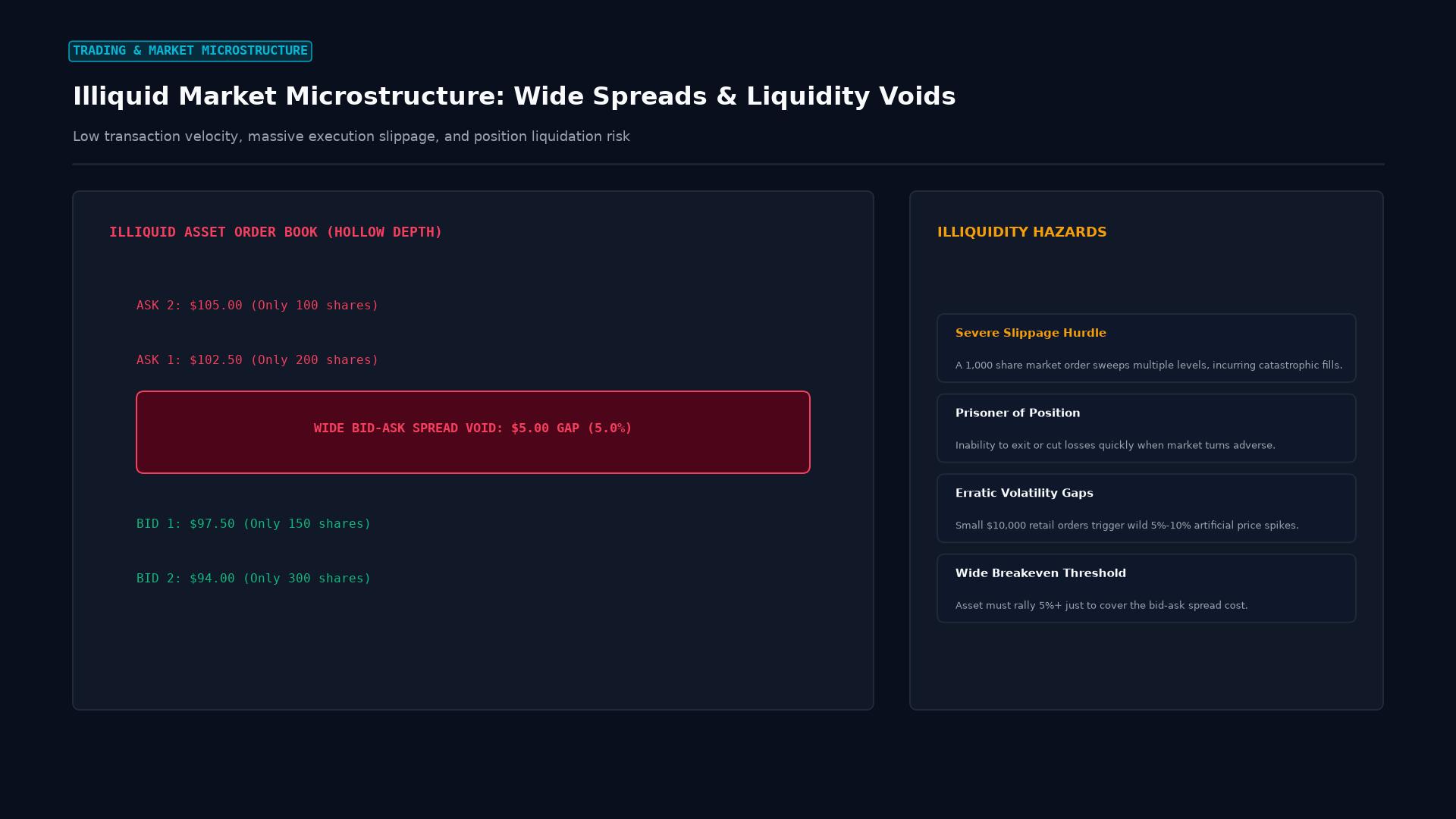 Figure: Microstructure of illiquid markets: wide bid-ask spreads, hollow limit order book depth, severe execution slippage, and high liquidation exit barriers.
Key Takeaways
- The Liquidity Illusion: A market that appears calm can instantly become illiquid if electronic market makers abruptly withdraw quotes during a news shock.
- Wide Bid-Ask Spreads: In illiquid pairs, transaction costs are punitive; brokers and dealers widen spreads from fractions of a pip to dozens or hundreds of pips to compensate for inventory risk.
- High Market Impact: In an illiquid market, a relatively modest order (e.g., $5 million) can sweep all available depth, moving the market price dozens of pips against the trader.
- The “Twilight Zone” Phenomenon: Foreign exchange liquidity routinely collapses to its lowest daily ebb between 5:00 PM and 6:00 PM EST, when New York dealing desks have closed but Tokyo and Sydney interbank desks have not yet reached full staffing.
Liquid vs. Illiquid Trading Environments
| Trading Parameter | Highly Liquid Market (e.g., EUR/USD) | Illiquid Market (e.g., USD/ZAR, EUR/TRY) |
|---|---|---|
| Trading Volume | Hundreds of billions daily | Tens of millions daily |
| Bid-Ask Spread | Razor-thin (0.1 to 0.5 pips) | Extremely wide (30 to 150+ pips) |
| Slippage Frequency | Rare during normal sessions | Common, even with modest lot sizes |
| Order Book Depth | Millions available at every single pip increment | Sparse, fragmented depth with large empty price tiers |
| Chart Geometry | Smooth, continuous candlestick formations | Jagged candles, missing ticks, frequent price gaps |
| Leverage Permitted | High leverage permitted (1:30 to 1:100) | Strictly capped leverage (1:5 to 1:20) by brokers |
When Do Major Currency Pairs Become Illiquid?
Even the most heavily traded G10 currencies experience severe liquidity evaporation under specific calendar and operational conditions:
- The Daily Rollover (5:00 PM EST): As New York banks close their daily books and rollover swaps are computed, interbank algorithms pull quotes for 10 to 20 minutes, causing spreads on major pairs to artificially widen by 5 to 15 pips.
- Holiday Sessions: Trading during major global holidays (such as Christmas Day, New Year’s Day, or the Japanese Golden Week) is notoriously illiquid. With European and Japanese bank desks closed, speculative retail flows can trigger sudden, violent Flash Crashes.
- The 2016 GBP Flash Crash Case Study: On October 7, 2016, during the low-liquidity Asian morning hours, the British Pound plunged over 6% (more than 700 pips) against the U.S. Dollar in two minutes. A few large sell orders struck an empty order book, triggering automated stop-loss cascades that fed on themselves until European desks opened.
Rules for Navigating Illiquid Markets
- Never Use Market Orders: Always execute using Limit Orders to prevent an illiquid order book sweep from filling your position at catastrophic slippage.
- Reduce Position Sizes by 60%–80%: Account for wider stop-losses. Trading standard position sizes in an illiquid currency cross exposes the account to disproportionate volatility risk.
- Avoid Holding Positions Across Weekend Closes: Weekend news breaks hitting an illiquid Sunday 5:00 PM market open can cause price gaps that completely bypass your stop-loss orders.
Frequently Asked Questions
Can a stock or cryptocurrency be completely illiquid?
Yes. Micro-cap “penny stocks” and low-volume crypto tokens frequently become 100% illiquid, meaning there are literally zero buyers willing to purchase shares at any price, leaving investors completely unable to exit their holdings.
Why do brokers charge higher overnight swap rates on illiquid currencies?
Brokers and liquidity providers charge higher overnight financing rates (swaps) on illiquid currencies because borrowing and holding those currencies in the offshore interbank money market incurs higher credit, counterparty, and sovereign transfer risk.
What is “Liquidity Risk”?
Liquidity risk is the danger that an investor or institution will be unable to meet short-term financial obligations or close an open losing derivative position because the market for that instrument has frozen, preventing liquidation at any reasonable fair-market price.
Ready to trade forex?
Open a free demo account with a regulated broker. Practice with virtual funds before risking real money.