Intrinsic Value
Intrinsic value represents the true, inherent economic worth of an asset, defining the immediate exercisable cash value of an option contract, or the discounted fundamental fair value of an asset based on its underlying cash flows.
What Is Intrinsic Value?
In finance and investing, intrinsic value refers to the objective, fundamental worth of an asset or financial contract, independent of its prevailing market price. While market prices fluctuate continuously in response to short-term trader psychology, speculative fads, liquidity imbalances, and headline news, intrinsic value represents the underlying economic reality.
The term carries two distinct definitions across different financial disciplines:
- In Options and Derivatives: Intrinsic value is the tangible, immediate cash profit that could be realized if an option contract were exercised right now against the prevailing spot market price.
- In Fundamental Analysis and Asset Valuation: Intrinsic value is the calculated present value of all future cash flows an investment is expected to generate, discounted back to the present day at an appropriate risk-adjusted rate.
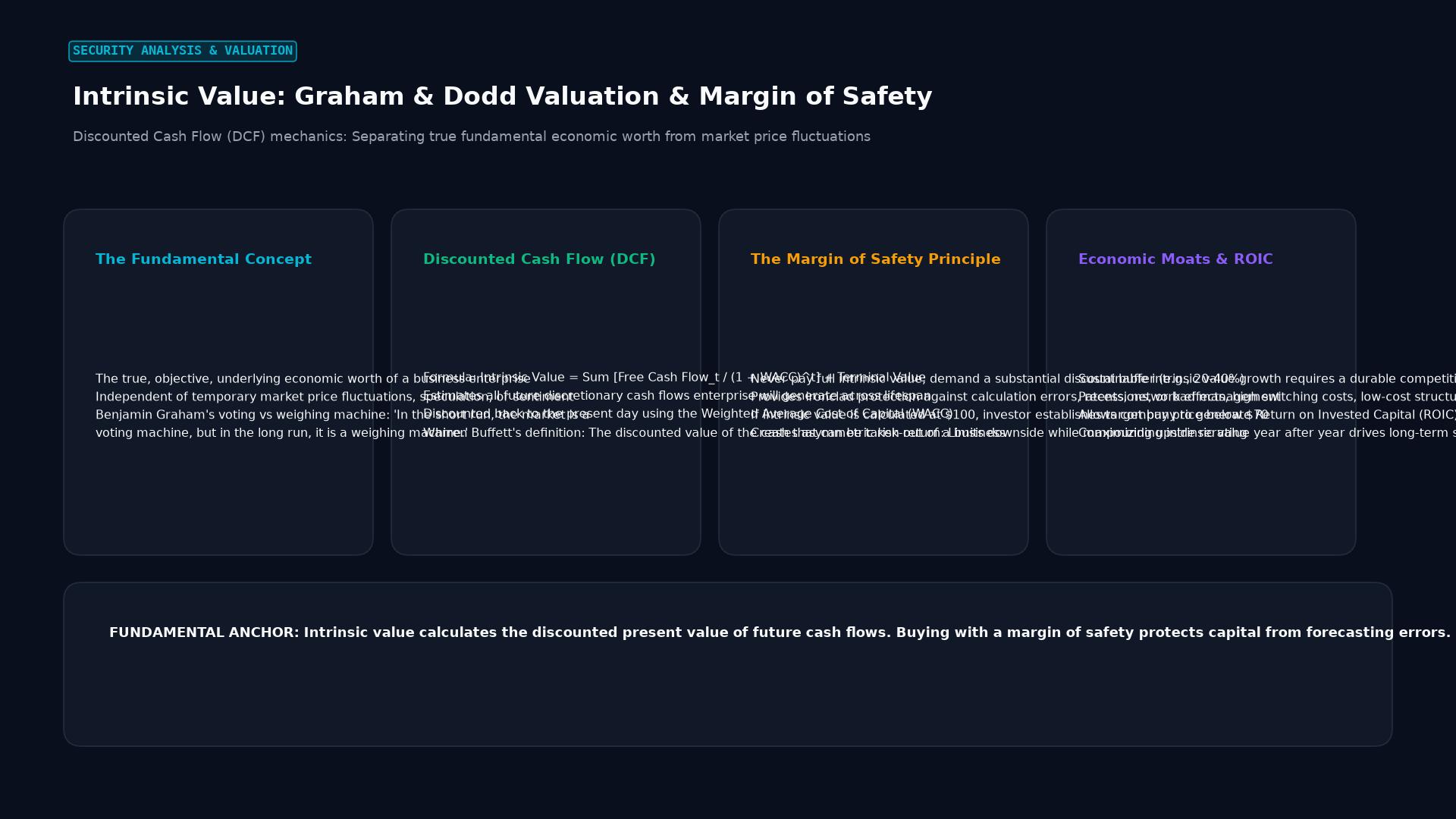 Figure: Discounted Cash Flow (DCF) mechanics: Separating true fundamental economic worth from market price fluctuations
1. Intrinsic Value in Options Trading
In derivatives pricing, an option contract’s total premium is divided into two distinct components:
$$\text{Option Premium} = \text{Intrinsic Value} + \text{Extrinsic (Time) Value}$$
Intrinsic value represents the “in-the-money” portion of the contract:
- Call Option Intrinsic Value: $$\text{Intrinsic Value}_{\text{call}} = \max(0, S - K)$$
- Put Option Intrinsic Value: $$\text{Intrinsic Value}_{\text{put}} = \max(0, K - S)$$
Where:
- $S$ = Prevailing spot exchange rate
- $K$ = Option strike price
Practical Options Example
Assume EUR/USD is trading at 1.0850 on the spot market:
- A 1.0700 Call Option has an intrinsic value of +150 pips ($1.0850 - 1.0700$). If the total market price of this call is 185 pips, it contains 150 pips of intrinsic value and 35 pips of extrinsic (time) value.
- A 1.0950 Call Option has an intrinsic value of 0 pips ($\max(0, 1.0850 - 1.0950) = 0$). Any premium paid for this option consists 100% of extrinsic time value.
An option’s intrinsic value can never be negative. If an option is out-of-the-money, its intrinsic value is simply zero.
2. Intrinsic Value in Currency Valuation and Macroeconomics
In foreign exchange markets, sovereign fiat currencies do not produce dividend cash flows or earnings reports, making standard Discounted Cash Flow (DCF) equity models inapplicable. Instead, macroeconomists and institutional currency desks calculate a currency’s intrinsic value using economic equilibrium models:
1. Purchasing Power Parity (PPP) Fair Value
Purchasing Power Parity posits that in the long run, exchange rates should adjust so that an identical basket of goods costs the exact same amount in two different countries when converted into a common currency. If a consumer basket costs $100 in the US and €80 in Germany, the theoretical intrinsic PPP exchange rate is 1.2500 EUR/USD. If the spot exchange rate trades at 1.0800, the euro is fundamentally undervalued by 13.6% relative to its intrinsic purchasing power.
2. Real Effective Exchange Rate (REER) Models
Central banks (such as the Bank for International Settlements, BIS) evaluate currency intrinsic value by tracking the Real Effective Exchange Rate. REER measures a currency against a trade-weighted basket of partner currencies adjusted for domestic inflation disparities. Significant deviations from the historical 10-year REER baseline indicate that a currency is overvalued or undervalued relative to its export competitiveness.
Market Price vs. Intrinsic Value: The Margin of Safety
The philosophical foundation of value investing—formulated by Benjamin Graham and David Dodd in Security Analysis (1934) and championed by Warren Buffett—rests on the divergence between market price and intrinsic value:
Benjamin Graham's Framework
------------------------------------------------------------------------
"Price is what you pay; value is what you get."
- Market Price < Intrinsic Value  ===> Undervalued (High Margin of Safety)
- Market Price > Intrinsic Value  ===> Overvalued (Speculative Risk)
In currency trading, prolonged deviations of spot exchange rates from their intrinsic macroeconomic fair values eventually correct. Macro hedge funds identify these valuation extremes to construct multi-year position trades, buying deeply undervalued currencies and shorting artificially overvalued ones as economic fundamentals force mean reversion.
Key Takeaways
- Intrinsic value represents the objective, fundamental worth of an asset or contract.
- In options trading, intrinsic value is the immediate exercisable cash value ($\max(0, S - K)$ for calls).
- Options with positive intrinsic value are classified as “in-the-money”; out-of-the-money options have zero intrinsic value.
- In foreign exchange, currency intrinsic value is calculated using Purchasing Power Parity (PPP) and Real Effective Exchange Rates (REER).
- Buying assets when market price trades substantially below intrinsic value provides a structural “margin of safety.”
Frequently Asked Questions
Can an option have zero intrinsic value and still have a high market price?
Yes. An at-the-money or slightly out-of-the-money option with 12 months remaining until expiration and high implied volatility can command a substantial market premium. That price consists entirely of extrinsic (time) value, reflecting the probability that the contract will move into the money before expiration.
How does time decay (Theta) impact intrinsic value?
Time decay has zero effect on intrinsic value. Theta decays only the extrinsic (time) component of an option’s premium. If spot prices remain unchanged, an option’s intrinsic value remains constant right up to expiration day.
Why do exchange rates diverge from their intrinsic PPP value for years?
In the short to medium term, exchange rates are dominated by capital account flows, cross-border interest rate differentials (carry trades), and geopolitical risk rather than physical trade flows. While goods arbitrage is slow, financial capital moves in milliseconds, allowing spot rates to diverge from PPP fair values for extended periods.
Ready to trade forex?
Open a free demo account with a regulated broker. Practice with virtual funds before risking real money.