Index Funds
An index fund is a passively managed mutual fund or Exchange-Traded Fund (ETF) designed to match the performance and risk characteristics of a specific financial market benchmark by holding constituent securities in exact proportion to the index.
What Is an Index Fund?
An index fund is a collective investment vehicle—structured either as a traditional mutual fund or an Exchange-Traded Fund (ETF)—constructed to replicate the return profile of a designated financial market benchmark (such as the S&P 500, the MSCI World Index, or the Bloomberg U.S. Aggregate Bond Index). Championed in the 1970s by Vanguard founder John C. Bogle, index funds embody the philosophy of passive investing: rather than paying high fees to active fund managers attempting to “beat the market,” index funds aim to own the entire market at rock-bottom operational expense.
In the global foreign exchange (FX) market, the multi-trillion-dollar scale of international index funds exerts massive systemic influence. Whenever global equity or bond benchmark indices add or remove foreign countries, or when international equity indices surge or fall, index fund managers must execute billions in cross-border currency conversions to rebalance their foreign currency allocations.
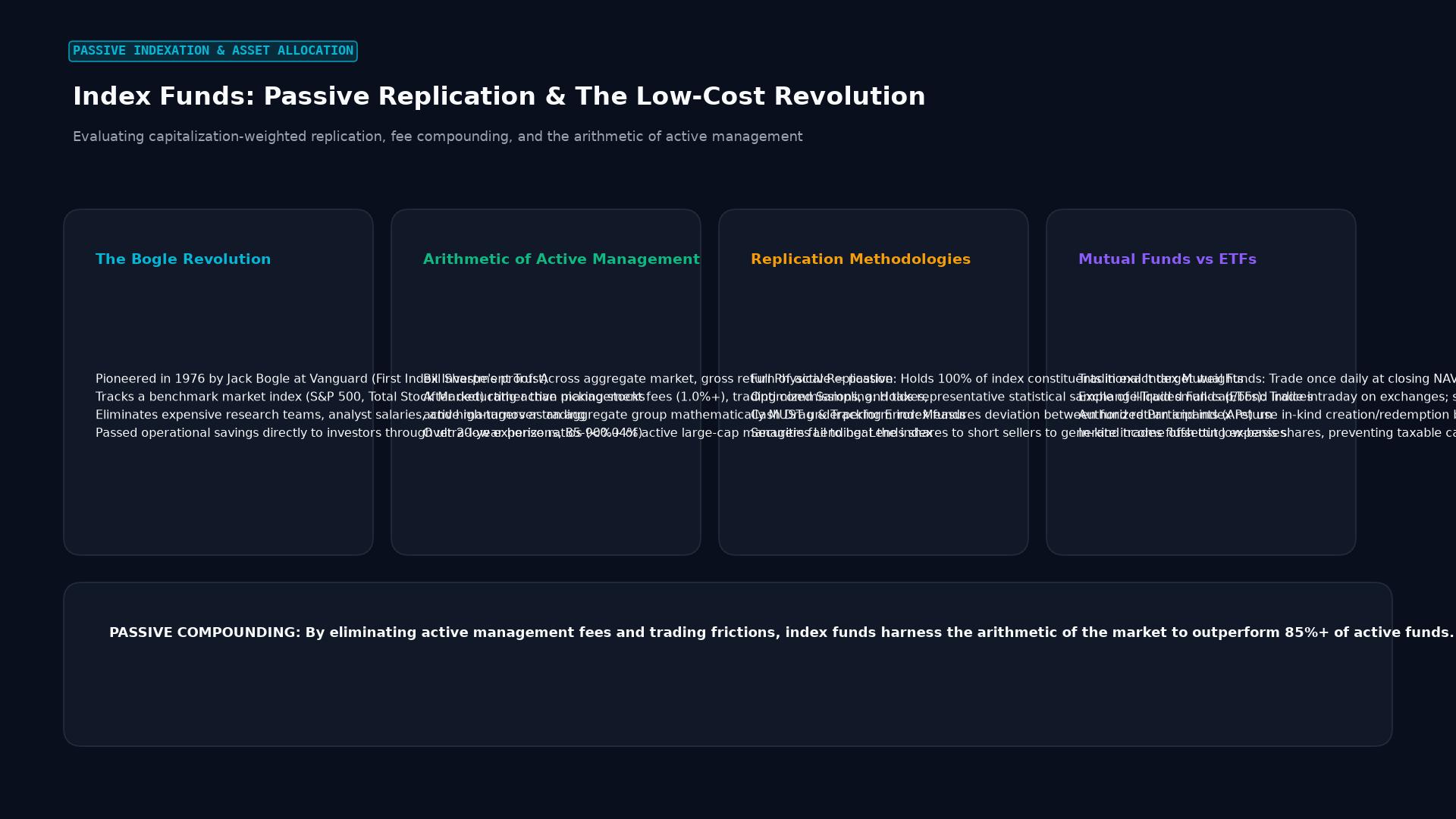 Figure: Evaluating capitalization-weighted replication, fee compounding, and the arithmetic of active management
Key Takeaways
- Passive Replication: Index funds buy and hold securities in the exact proportion dictated by the underlying index rules, eliminating active manager forecasting and trading churn.
- Low Expense Ratios: Because they require no active research teams, index funds charge annual management fees as low as 0.03% (compared to 1.0%–2.0% for active funds).
- The Month-End FX Rebalancing Surge: On the final trading business days of each month, global equity index funds rebalance their foreign currency currency hedges at the 4:00 PM London Fix, creating predictable institutional order flows across EUR/USD, GBP/USD, and USD/JPY.
- Tracking Error: The primary performance metric of an index fund is tracking error—the statistical divergence between the fund’s net return and the official benchmark index return.
Active Mutual Funds vs. Passive Index Funds
| Dimension | Passive Index Funds | Active Mutual Funds |
|---|---|---|
| Primary Goal | Match the benchmark index return exactly | Beat the benchmark to generate positive alpha |
| Portfolio Turnover | Minimal; trades only when index constituents change | High; continuous buying and selling by managers |
| Expense Ratios | Very low (0.03% – 0.20% annually) | High (0.75% – 2.00%+ annually) |
| Performance Reality | Outperforms ~85% to 90% of active managers over 10+ years | Majority fail to match benchmark after deducting fees |
| Tax Efficiency | High (few realized capital gains distributions) | Low (frequent taxable turnover distributions) |
Weighting Methodologies in Index Funds
Index providers (such as S&P Dow Jones, MSCI, and FTSE Russell) construct benchmarks using distinct weighting architectures:
- Market-Capitalization Weighting (Float-Adjusted): The standard model. A company’s weight is proportional to the total market value of its publicly tradeable shares (e.g., Apple and Microsoft comprising disproportionately large weights in the S&P 500).
- Equal Weighting: Every constituent security receives an identical percentage allocation (e.g., each stock in the S&P 500 Equal Weight Index receives exactly 0.20%). Equal-weighted funds must rebalance regularly, buying underperforming stocks and trimming winners.
- Price Weighting: Weight is determined strictly by share price (e.g., the Dow Jones Industrial Average), meaning a high-priced stock exerts more influence than a low-priced stock regardless of company market valuation.
Currency-Hedged Index Funds vs. Unhedged Funds
When retail and institutional investors allocate capital to international index funds (such as an American investor buying an ETF tracking European or Japanese equities), they face foreign currency risk:
- Unhedged International Index Fund: Returns equal the performance of the foreign stocks plus or minus the fluctuation of the foreign currency against the domestic dollar.
- Currency-Hedged Index Fund (e.g., Hedged JPY ETF): The fund manager enters into rolling 1-month FX Forward contracts to sell the foreign currency forward, neutralizing the foreign currency effect and allowing investors to capture purely the local stock market return.
Frequently Asked Questions
What happens when a stock is added to a major index fund?
When a stock is officially added to a prominent index (such as the S&P 500), hundreds of index funds managing trillions of dollars are legally required to buy millions of shares of that company simultaneously. This programmatic buying surge frequently causes the company’s share price to rally sharply upon the announcement—a phenomenon known as the “Index Effect.”
Can an index fund fail or go bankrupt?
An index fund itself cannot go bankrupt in the traditional corporate sense because it holds a diversified portfolio of physical underlying securities held in custody by an independent third-party bank. If one company in the index goes bankrupt, it simply drops out of the index and is replaced by another firm, with minimal impact on total fund valuation.
What is the difference between an Index Mutual Fund and an Index ETF?
An Index Mutual Fund prices and executes transactions only once per day after the market closes at 4:00 PM EST at Net Asset Value (NAV). An Index ETF trades continuously throughout the trading day on a public stock exchange, allowing investors to buy, sell, short, or place stop-loss orders just like an individual stock.
Ready to trade forex?
Open a free demo account with a regulated broker. Practice with virtual funds before risking real money.