International Monetary Market (IMM)
The International Monetary Market (IMM) is a specialized division of the Chicago Mercantile Exchange (CME) established in 1972 that pioneered the modern financial futures industry, creating the world's first standardized exchange-traded currency and interest rate futures contracts.
What Is the International Monetary Market (IMM)?
The International Monetary Market (IMM) is a historic operating division of the Chicago Mercantile Exchange (CME) that revolutionized modern financial risk management. Founded in May 1972 under the visionary leadership of CME Chairman Leo Melamed, the IMM created the world’s first exchange-traded financial futures contracts, transforming futures trading from agricultural commodities (such as pork bellies and wheat) into currencies, interest rate instruments, and stock market indices.
Prior to the founding of the IMM, foreign exchange trading was the exclusive domain of an elite, opaque cartel of international commercial banks trading Over-the-Counter (OTC). The IMM introduced democratic price transparency, centralized counterparty clearing, and standardized contract specifications, allowing multinational corporations, commodity trading advisors (CTAs), hedge funds, and independent traders to trade and hedge currency risk with zero counterparty credit concerns.
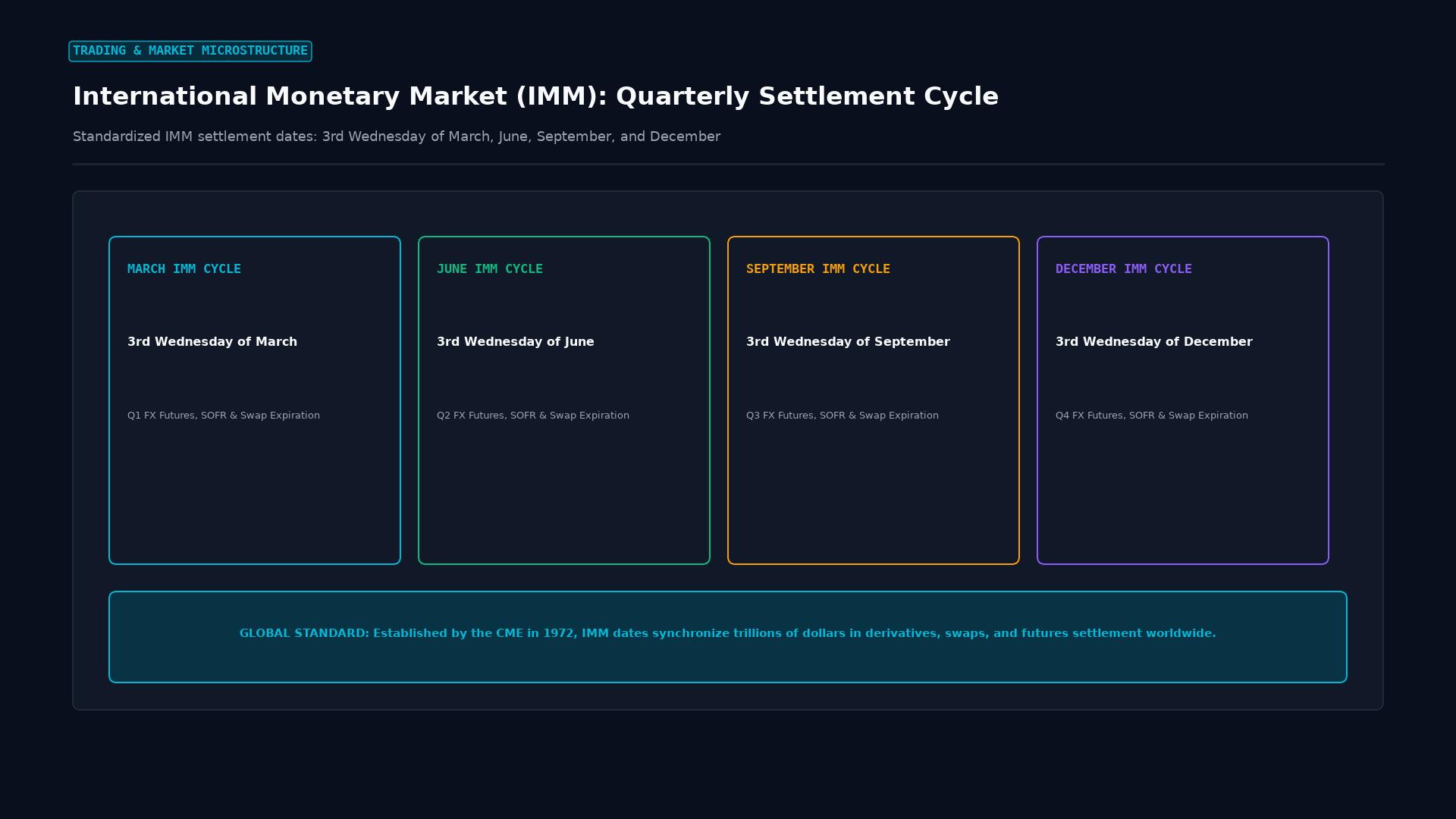 Figure: Standardized quarterly IMM derivatives cycle: third Wednesday of March, June, September, and December anchoring global futures and swap settlement dates.
Key Takeaways
- The Financial Futures Pioneer: Launched in 1972, the IMM was the first market in human history to list and settle financial futures contracts.
- The “IMM Date” Standard: The IMM established the third Wednesday of March, June, September, and December as its quarterly expiration cycle—a schedule that remains the universal settlement benchmark across both exchange-traded futures and Over-the-Counter (OTC) FX forwards.
- Elimination of Counterparty Default Risk: Unlike bilateral OTC currency forwards, all IMM contracts are cleared through CME Clearing, which acts as the buyer to every seller and seller to every buyer, backing contracts through a multi-billion-dollar default guaranty fund.
- The Foundation of the COT Report: The weekly Commitments of Traders (COT) report published by the U.S. CFTC derives its foundational institutional currency positioning data directly from open interest on the IMM.
The “IMM Dates” Quarterly Cycle
In the global derivatives industry, the term “IMM Date” refers to the third Wednesday of the four quarterly contract months:
$$\text{IMM Expiration Schedule} = {\text{March}, \text{June}, \text{September}, \text{December}} \text{ on the 3rd Wednesday}$$
The IMM date serves as the primary liquidity magnet for rolling forward risk:
- Futures Rolling: Institutional CTAs and macro hedge funds holding active currency futures positions roll their open contracts from the front-month contract into the next deferred IMM month several days prior to the IMM date.
- OTC Forward Harmonization: Even in the non-exchange Over-the-Counter market, large corporate treasurers align long-term forward and swap expiration dates with IMM Wednesdays to ensure maximum secondary market liquidity and minimize broken-date pricing penalties.
IMM Currency Futures vs. Over-the-Counter (OTC) Spot Forex
| Feature | IMM Currency Futures (CME) | Spot Forex (OTC Retail/Interbank) |
|---|---|---|
| Trading Venue | Centralized exchange (CME Globex) | Decentralized, fragmented Over-the-Counter network |
| Counterparty | CME Clearing (AAA-rated clearinghouse) | Your retail broker or bilateral dealing bank |
| Contract Sizes | Standardized (e.g., €125,000 for Euro futures) | Customizable (Micro, Mini, or Standard lots) |
| Price Transparency | 100% Centralized: All traders see the same Time & Sales | Fragmented; each broker quotes their own proprietary spread |
| Volume Transparency | Real empirical volume and Open Interest reported | Tick volume only (indicative activity proxy) |
| Settlement | Daily Mark-to-Market cash sweep; quarterly physical delivery | Rolling overnight financing swaps; continuous |
The Commitments of Traders (COT) Legacy
Because the IMM operates as a federally regulated U.S. futures exchange under the oversight of the Commodity Futures Trading Commission (CFTC), large participants are legally required to report their open positions daily.
Every Friday at 3:30 PM EST, the CFTC publishes the Commitments of Traders (COT) report, breaking down IMM open interest into:
- Commercial Hedgers: Multinational corporations and banks hedging physical operational currency exposures.
- Non-Commercial Traders (Large Speculators): Commodity Trading Advisors (CTAs), hedge funds, and institutional money managers.
- Non-Reportable Traders (Small Speculators): Retail futures participants.
Currency swing traders analyze the net positioning of Large Speculators on the IMM to spot extreme speculative sentiment extremes that frequently precede major multi-month trend reversals.
Frequently Asked Questions
Which currencies trade on the IMM today?
Today, the IMM division of the CME lists futures and options on all major G10 currencies (EUR, JPY, GBP, AUD, CAD, CHF, NZD) as well as prominent emerging market currencies such as the Mexican Peso (MXN), Brazilian Real (BRL), and South African Rand (ZAR).
What happens if an IMM currency futures contract is held to expiration?
If an IMM currency futures position is held past the final trading day through expiration, it enters physical delivery. The short position holder delivers the foreign currency into an approved international commercial bank account, and the long position holder delivers U.S. Dollars through CME Clearing. In practice, over 98% of speculative traders close or roll their contracts before delivery.
What was the Eurodollar contract on the IMM?
Launched in December 1981, the IMM Eurodollar futures contract was the first cash-settled futures contract in history, settling based on the 3-month London Interbank Offered Rate (LIBOR). For decades, it was the most actively traded short-term interest rate derivative contract in the world, before transitioning to SOFR futures in 2023.
Ready to trade forex?
Open a free demo account with a regulated broker. Practice with virtual funds before risking real money.