International Organization for Standardization (ISO)
The International Organization for Standardization (ISO) is an independent, non-governmental international federation of national standards bodies that establishes universal commercial, financial, and technical specifications to ensure global interoperability.
What Is the International Organization for Standardization (ISO)?
Headquartered in Geneva, Switzerland, the International Organization for Standardization (ISO) is the world’s largest developer of voluntary international standards. Composed of representatives from national standards institutes across more than 170 member countries, the ISO establishes universally recognized technical, operational, and commercial specifications that enable cross-border trade, technology integration, and financial market interoperability.
In the global foreign exchange (FX), banking, and capital markets, ISO standards provide the foundational data language that makes automated electronic trading possible. From the three-letter currency codes used on trading screens (ISO 4217) to the rich data messaging syntax that powers cross-border SWIFT payments (ISO 20022), ISO frameworks ensure that computers, clearing houses, and central banks across diverse languages and legal jurisdictions execute and settle multi-trillion-dollar transactions with zero ambiguity.
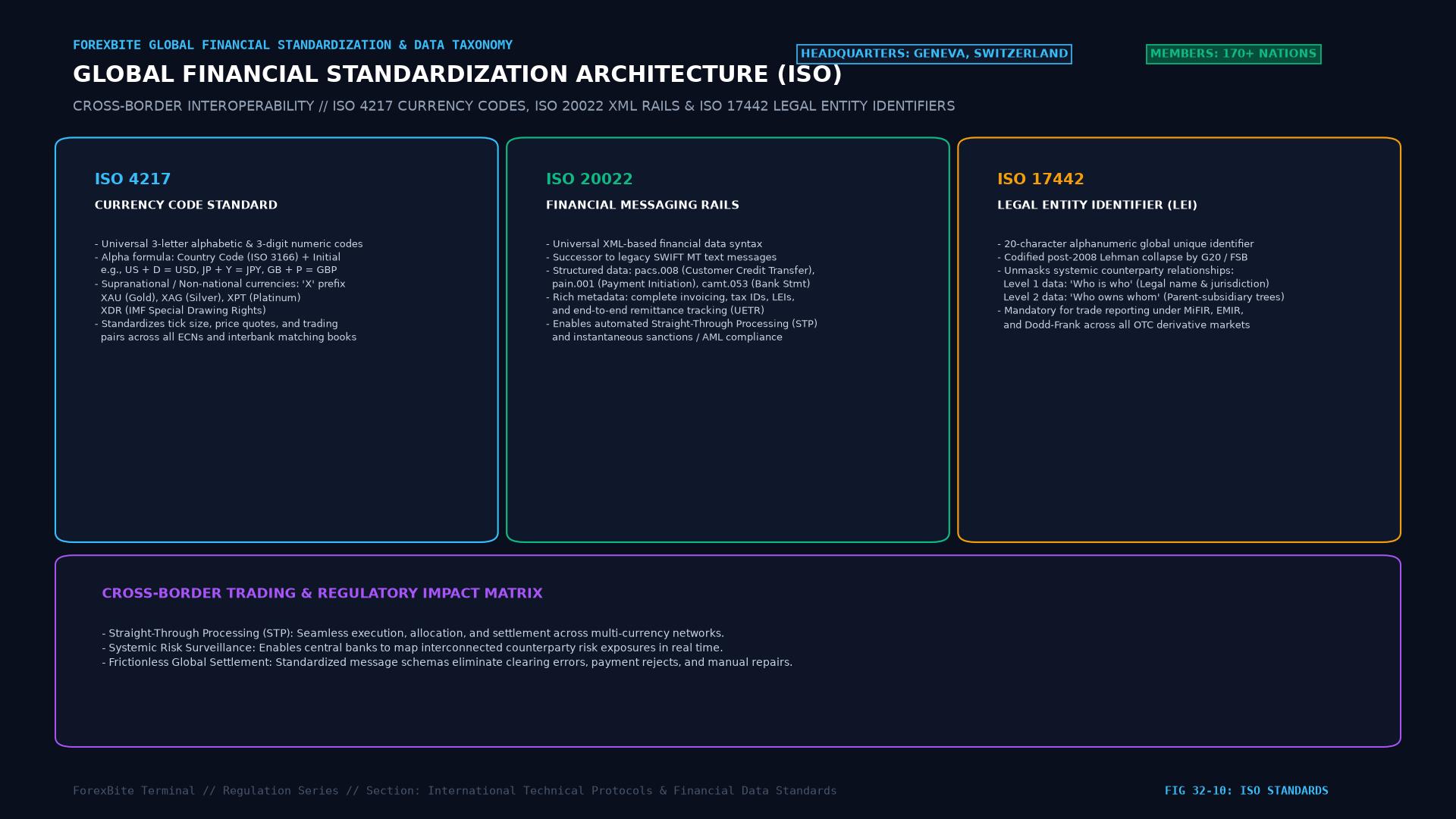 Figure: Universal financial standards developed by the ISO: ISO 4217 currency codes, ISO 20022 XML financial messaging rails, and ISO 17442 Legal Entity Identifiers.
Key Takeaways
- The Language of Finance: Without ISO standards, automated electronic trading, straight-through processing (STP), and international wire transfers would be paralyzed by conflicting national nomenclatures.
- ISO 4217 Currency Codes: The universal three-letter standard defining national currencies (e.g., USD, EUR, JPY) and supranational or precious metal assets (XAU, XAG, XDR).
- The ISO 20022 Revolution: The global interbank financial network is undergoing a historic multi-year migration to ISO 20022, replacing legacy character-limited SWIFT messages with structured XML data containing complete invoice and compliance details.
- Risk Mitigation via LEI (ISO 17442): Mandated after the 2008 Lehman Brothers collapse, the Legal Entity Identifier (LEI) provides a unique alphanumeric fingerprint for every legal entity trading derivatives worldwide.
Essential ISO Standards in Foreign Exchange and Banking
Financial market participants operate under several core ISO standard protocols:
| ISO Standard | Formal Name | Practical Application in Trading & Banking |
|---|---|---|
| ISO 4217 | Currency Codes | Defines 3-letter alphabetic codes and 3-digit numeric codes for all sovereign currencies and commodities (e.g., USD = 840, EUR = 978). |
| ISO 20022 | Universal Financial Industry Message Scheme | Rich-data XML messaging standard replacing legacy SWIFT MT formats for cross-border wires, RTGS systems, and securities clearing. |
| ISO 17442 | Legal Entity Identifier (LEI) | 20-character alphanumeric code identifying corporate counterparties to prevent hidden systemic risk under Dodd-Frank and EMIR. |
| ISO 6166 | International Securities Identification Number (ISIN) | Standardized 12-character alphanumeric code identifying specific stocks, bonds, futures, and commercial paper worldwide. |
| ISO 10962 | Classification of Financial Instruments (CFI) | Standardized 6-character code categorizing derivative instrument structures (e.g., options, swaps, forwards). |
Inside ISO 4217: The Anatomy of a Currency Code
The construction of an ISO 4217 currency code follows strict mathematical and geographic rules:
$$\text{ISO 4217 Code} = [\text{Country Code (2 Letters)}] + [\text{Currency Initial (1 Letter)}]$$
- USD: US (United States) + D (Dollar).
- GBP: GB (Great Britain) + P (Pound).
- JPY: JP (Japan) + Y (Yen).
- AUD: AU (Australia) + D (Dollar).
The “X” Prefix for Non-National Assets
If a code begins with the letter “X”, ISO rules denote that the asset has no sovereign national issuing country:
- XAU: Physical Gold (Chemical symbol: Aurum).
- XAG: Physical Silver (Chemical symbol: Argentum).
- XPT: Platinum; XPD: Palladium.
- XDR: Special Drawing Rights (IMF supranational reserve basket).
The ISO 20022 Migration: Modernizing Global Banking
For decades, the global SWIFT payment network operated on legacy MT (Message Type) formats (such as MT103 for customer wires or MT300 for FX confirmations), which restricted transaction descriptions to tiny blocks of unstructured text.
The global transition to ISO 20022 (MX messages) revolutionizes payment infrastructure:
- Rich Structured Data: Contains complete sender and recipient details, invoice numbers, tax IDs, and ultimate beneficial ownership (UBO) data inside structured XML tags.
- Automated Sanctions Screening: Eliminates false-positive compliance rejections, speeding up international cross-border trade settlements from days to seconds.
- Interoperability: Connects domestic Real-Time Gross Settlement (RTGS) systems (such as Fedwire, CHIPS, and TARGET2) with private payment rails and CBDCs.
Frequently Asked Questions
Why is the Euro coded as “EUR” instead of following the 2-letter country rule?
The Euro is issued by the European Union, which is a supranational bloc rather than a single country. ISO designated EU as the exceptional reserve code for the European Union, resulting in EUR.
Who assigns ISO currency codes?
The official maintenance agency for ISO 4217 is the SIX Interbank Clearing agency on behalf of the Swiss Association for Standardization (SNV) and the International Organization for Standardization.
Are ISO standards legally mandatory?
While ISO itself is a non-governmental organization that cannot enact laws, national governments and regulatory authorities (such as the U.S. SEC, European ESMA, and the Bank for International Settlements) regularly incorporate ISO standards directly into statutory financial regulations (e.g., requiring LEIs under EMIR or ISO 20022 for central bank wire access).
Ready to trade forex?
Open a free demo account with a regulated broker. Practice with virtual funds before risking real money.