Kiwi
Kiwi is the ubiquitous financial market slang for the New Zealand Dollar (NZD), named after the flightless national bird stamped on the country's iconic one-dollar coin.
What Is the “Kiwi” in Forex Trading?
In the international foreign exchange market, “Kiwi” is the universal industry nickname for the New Zealand Dollar (currency code: NZD). The moniker originated in 1990 when the Reserve Bank of New Zealand introduced a new one-dollar coin featuring the likeness of the kiwi—a flightless bird native to New Zealand and the recognized national emblem of the country.
When institutional dealers and retail traders speak of “the Kiwi,” they most frequently refer to the NZD/USD currency pair. The New Zealand Dollar ranks among the ten most actively traded currencies globally, offering deep institutional liquidity, transparent monetary policy, and high sensitivity to global economic growth.
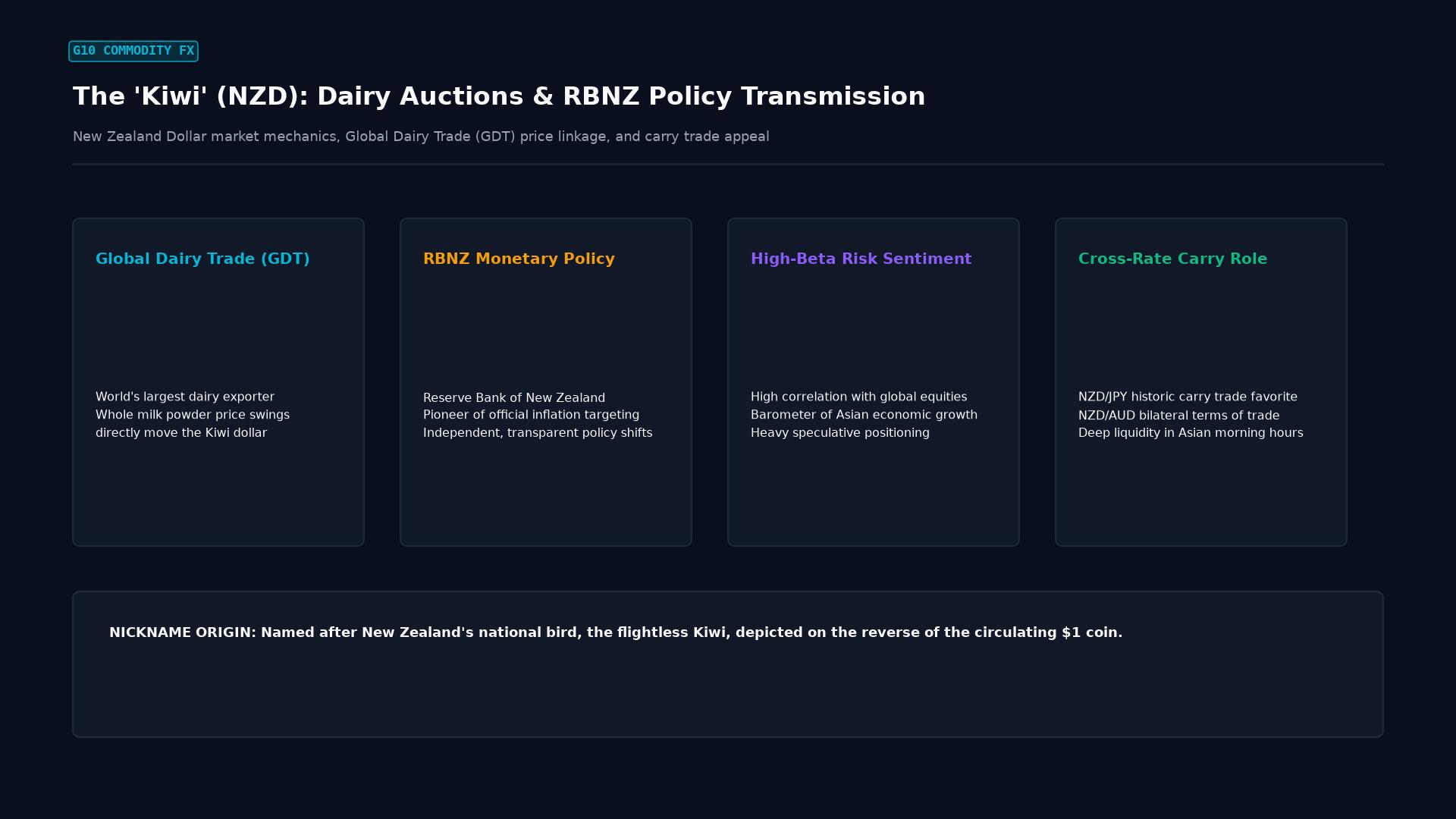 Figure: New Zealand Dollar market mechanics, Global Dairy Trade (GDT) price linkage, and carry trade appeal
Fundamental Drivers of the Kiwi
The New Zealand Dollar does not behave like a traditional industrial manufacturing currency. Its valuation is dictated by four distinct macroeconomic engines:
1. Dairy Exports and GlobalDairyTrade (GDT) Auctions
Agriculture is the backbone of New Zealand’s export economy, with dairy products (predominantly whole milk powder) accounting for over 25% of total merchandise export revenue. The multinational dairy cooperative Fonterra conducts the bi-weekly GlobalDairyTrade (GDT) auction. Forex desks monitor the GDT Price Index with intense scrutiny:
- Surging dairy auction prices expand New Zealand’s terms of trade, lifting the Kiwi.
- Slumping dairy prices or Chinese import bans create immediate downward pressure on NZD exchange rates.
2. The China Economic Nexus
China is New Zealand’s single largest bilateral trading partner, absorbing massive volumes of New Zealand dairy, meat, timber, and wine. As a result, the Kiwi operates as a direct liquid proxy for Chinese macroeconomic health. When Chinese industrial production, retail sales, or PMI figures exceed expectations, the Kiwi rallies; conversely, economic deceleration or real estate debt crises in Beijing trigger immediate selloffs in NZD/USD.
3. The Reserve Bank of New Zealand (RBNZ)
The Reserve Bank of New Zealand holds a storied place in monetary history: in 1989, it became the world’s first central bank to formally introduce an official inflation targeting framework. The RBNZ has a reputation for proactive, decisive monetary policy. When New Zealand’s tight domestic labor market or housing sector overheats, the RBNZ rarely hesitates to embark on aggressive rate-hiking campaigns, setting benchmark interest rates well above those of European peers.
4. Risk Sentiment (High-Beta Commodity Currency)
The Kiwi is classified as a “risk-on” commodity currency. During periods of global optimism characterized by advancing equity markets and expanding global trade volumes, capital flows enthusiastically into the Kiwi. During global panics, geopolitical escalations, or credit freezes, investors dump the Kiwi in favor of traditional safe havens like the US Dollar, Swiss Franc, and Japanese Yen.
Trading Characteristics of NZD/USD
| Characteristic | NZD/USD Metric | Trading Implication |
|---|---|---|
| Typical Spread | 0.8 to 1.8 pips | Slightly wider than EUR/USD or USD/JPY, but highly liquid. |
| Daily Pip Range | 50 to 80 pips | Moderate daily volatility with clear directional trend legs. |
| Active Session | Asian / Wellington Open | Begins the global trading week every Sunday at 5:00 PM ET. |
| Correlation | Highly correlated with AUD/USD (~0.85) | Both currencies move in tandem against the US Dollar. |
The AUD/NZD Cross: The Trans-Tasman Battle
The currency cross between the Australian Dollar and New Zealand Dollar (AUD/NZD) is one of the most popular range-trading pairs in financial markets. Because Australia and New Zealand share similar geographic locations, trade dependencies on China, and cultural ties, broad global shocks affect both economies similarly. Consequently, the AUD/NZD cross rate strips out global dollar sentiment, allowing traders to trade pure monetary divergence between the RBNZ and the Reserve Bank of Australia (RBA).
The Kiwi as a Classic Carry Trade Vehicle
Historically, the New Zealand Dollar has served as a premier target for the foreign exchange carry trade. Because New Zealand benchmark interest rates were historically sustained well above near-zero rates in Japan or Switzerland, international hedge funds borrowed Japanese Yen or Swiss Francs to purchase high-yielding New Zealand government bonds.
While this carry trade generates steady positive overnight rollover (swap) income during calm market regimes, it exposes traders to sharp, sudden liquidation crashes whenever global volatility spikes and carry trades are rapidly dismantled.
Key Takeaways
- “Kiwi” is the financial slang for the New Zealand Dollar (NZD), named after the bird on the $1 coin.
- The currency is fundamentally driven by dairy export prices (GDT auctions) and Chinese economic demand.
- The Reserve Bank of New Zealand (RBNZ) was the first central bank to pioneer modern inflation targeting.
- The Kiwi is a high-beta, risk-on commodity currency that strengthens during global economic expansions.
- NZD/USD and the AUD/NZD cross offer excellent opportunities for macro trend and carry trade strategies.
Frequently Asked Questions
What time does the Kiwi market open?
Trading in the New Zealand Dollar kicks off the global forex trading week. The Wellington market opens on Monday morning at 9:00 AM local time, which corresponds to Sunday afternoon at 5:00 PM Eastern Time (New York), marking the first major liquid pricing window of the week.
Why is NZD so closely tied to the Australian Dollar (AUD)?
Australia and New Zealand are close geographical neighbors with deeply integrated economies through the Closer Economic Relations (CER) trade agreement. Both nations export massive natural commodities to Asia, causing institutional algorithmic models to trade AUD and NZD in tandem.
What is the typical pip value for 1 standard lot of NZD/USD?
Because the US Dollar is the quote currency in the NZD/USD pair, the pip value for 1 standard lot (100,000 NZD) is fixed at exactly $10.00 USD per pip.
Ready to trade forex?
Open a free demo account with a regulated broker. Practice with virtual funds before risking real money.