Commodity Futures Trading Commission (CFTC)
The Commodity Futures Trading Commission (CFTC) is an independent US federal agency charged with regulating commodity, currency, and financial futures, options, and swaps markets. In retail forex, the CFTC enforces strict capital requirements, leverage caps, and publishes the weekly Commitments of Traders (COT) report.
What Is the Commodity Futures Trading Commission (CFTC)?
The Commodity Futures Trading Commission (CFTC) is an independent regulatory agency of the United States federal government, created by Congress through the Commodity Futures Trading Commission Act of 1974. Headquartered in Washington, D.C., the commission is tasked with fostering open, transparent, competitive, and financially sound derivative markets while protecting market participants and the public from fraud, manipulation, abusive practices, and systemic risk.
Historically, US derivative regulation focused predominantly on agricultural commodities such as wheat, corn, soybeans, and cotton, overseen by the Department of Agriculture. As international finance transformed following the collapse of the Bretton Woods system in the 1970s, derivative markets expanded into financial instruments—treasury bond futures, stock index futures, interest rate swaps, and foreign currency contracts. Congress created the CFTC as a specialized, independent watchdog to supervise this rapidly evolving financial derivative universe.
Today, working in close operational tandem with the National Futures Association (NFA)—the industry self-regulatory organization—the CFTC supervises multitrillion-dollar futures exchanges (such as the Chicago Mercantile Exchange - CME), swap execution facilities, derivative clearing organizations, and retail foreign exchange brokerages operating within the United States.
The CFTC’s Impact on Retail Forex Trading
Following the 2008 global financial crisis and the subsequent passage of the Dodd-Frank Wall Street Reform and Consumer Protection Act of 2010, the CFTC enacted some of the strictest consumer protection regulations in the world for over-the-counter (OTC) retail foreign exchange:
1. The 1:50 Leverage Cap
Prior to CFTC intervention, retail forex brokers in the United States routinely offered retail clients extreme leverage exceeding 1:200, 1:400, or even 1:500. While excessive leverage can magnify small gains, it frequently leads to rapid, total account liquidation during normal market volatility.
Under CFTC rules, retail leverage for US residents is capped at a strict maximum:
- 1:50 Maximum Leverage (2.0% Margin): Permitted only on major, highly liquid currency pairs (including EUR/USD, GBP/USD, USD/JPY, USD/CAD, AUD/USD, NZD/USD, and USD/CHF).
- 1:20 Maximum Leverage (5.0% Margin): Mandated on all non-major and exotic currency pairs.
2. Massive Broker Capital Requirements ($20 Million Net Capital)
To eliminate undercapitalized “bucket shops” that could vanish overnight during market panics, the CFTC requires any entity acting as a Retail Foreign Exchange Dealer (RFED) to maintain a minimum of $20,000,000 in adjusted net capital, plus additional funds calculated from retail customer liabilities. This stringent capital barrier consolidated the US retail industry into a handful of well-capitalized institutional brokerages.
3. The “No-Hedging” Rule and FIFO Execution
Under NFA Compliance Rule 2-43(b), enforced under CFTC authority, retail traders are prohibited from holding simultaneous, opposing long and short positions in the identical currency pair within the same account.
Additionally, brokers must observe the First In, First Out (FIFO) accounting rule: if a trader opens multiple positions of the same contract size in the same currency pair over time, the positions must be closed in the exact chronological sequence in which they were originally opened.
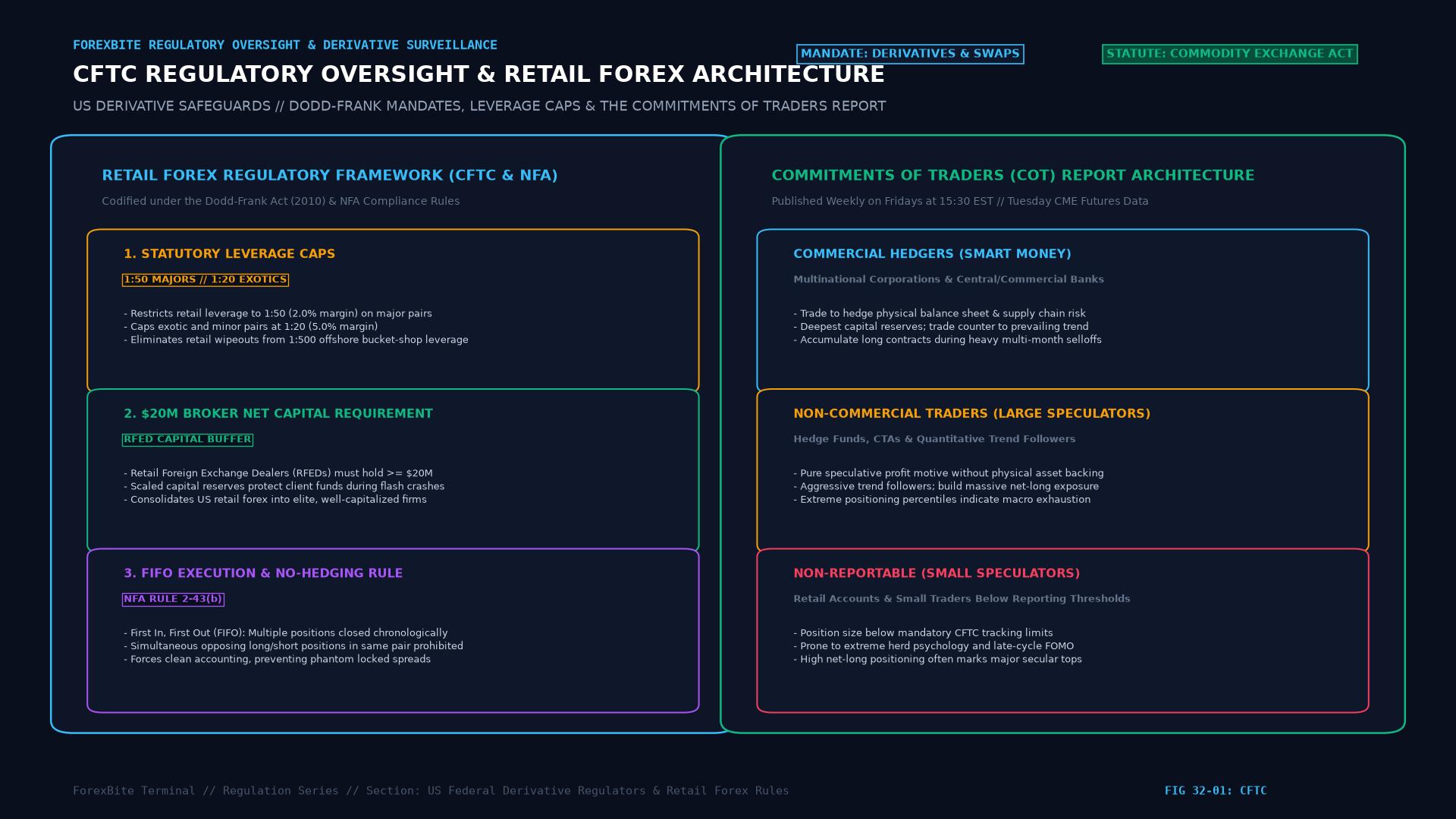 Figure: The CFTC and NFA regulatory architecture governing US retail forex leverage caps, broker net capital covenants, and weekly Commitments of Traders (COT) market intelligence.
The CFTC’s Gift to Traders: The Commitments of Traders (COT) Report
For foreign exchange and commodity traders worldwide, the CFTC’s most indispensable tool is the Commitments of Traders (COT) report.
Published every Friday at 15:30 Eastern Standard Time (EST), the COT report aggregates positioning data collected from major futures exchanges as of the previous Tuesday’s market close. Because centralized currency futures (such as CME Euro FX or Japanese Yen futures) mirror OTC spot forex movements, the COT report provides an unprecedented, legal window into where institutional capital is concentrated.
The report segments market participants into three primary categories:
1. Commercial Hedgers (“The Smart Money”)
Multinational corporations, international commercial banks, and agricultural refiners. Commercials use futures markets primarily to lock in forward prices and hedge physical balance sheet risk rather than to generate speculative profit. They are long-term, deep-pocketed participants whose positioning typically moves counter to the prevailing trend (accumulating long contracts during prolonged price declines and selling into multi-month rallies).
2. Non-Commercial Traders (Large Speculators)
Commodity Trading Advisors (CTAs), macro hedge funds, and quantitative institutional asset managers. Unlike commercials, large speculators hold no underlying physical business in the asset; they trade purely to capture capital gains. They are aggressive trend-followers: when a currency embarks on a powerful multi-month bull run, non-commercial net-long positions swell to extreme highs.
3. Non-Reportable Traders (Small Speculators)
Retail traders and small independent accounts whose individual positions fall below the CFTC’s mandatory reporting thresholds. Small speculators are historically prone to sentiment extremes, frequently holding heavy net-long positions at the exact top of a bull market and heavy net-short positions at market bottoms.
Practical Trading Application: Identifying Sentiment Extremes
Professional forex traders study the COT report not for daily timing, but to identify multi-month trend exhaustion and reversal zones:
- Track Net Speculative Positioning: $$ \text{Net Positioning} = \text{Non-Commercial Long Contracts} - \text{Non-Commercial Short Contracts} $$
- Monitor Historical Percentiles: When non-commercial net positioning reaches an extreme multi-year high (e.g., hedge funds are 90% net-long EUR futures contracts), it reveals that nearly every potential institutional buyer has already allocated capital to the trade.
- The Catalyst for Reversal: With no remaining sidelined buyers to drive the price higher, even a minor disappointing economic report can trigger aggressive profit-taking. As large funds unwind their massive long positions, a cascading sell-off begins.
- Trading the Divergence: When a currency pair pushes to a marginal new price high while COT speculative net-long positions decline, an institutional sentiment divergence forms, signaling an optimal setup for macro swing traders to initiate short positions.
Key Takeaways
- The CFTC is an independent US federal agency established in 1974 to regulate commodity, currency, and financial derivative markets.
- In retail forex, the CFTC mandates a maximum leverage cap of 1:50 on major pairs and requires brokers to maintain at least $20 million in net capital.
- US regulations enforce FIFO (First In, First Out) execution and prohibit holding conflicting long and short hedges in the same account.
- The CFTC publishes the weekly Commitments of Traders (COT) report every Friday, providing transparent institutional positioning data.
- Extreme positioning in the COT report serves as a reliable contrarian indicator for macro trend exhaustion and impending reversals.
FAQ
Can non-US residents trade with a CFTC-regulated broker? Yes. Non-US residents can open accounts with US-regulated brokerages, provided the broker accepts international clients. However, the client will be subject to US regulatory rules, including the 1:50 maximum leverage cap and FIFO restrictions.
Why does the CFTC restrict retail leverage to 1:50? The CFTC implemented the 1:50 leverage cap to protect retail traders from rapid, catastrophic account depletion. Market studies indicated that retail clients utilizing 1:200 or 1:400 leverage had an overwhelmingly high failure rate, frequently losing their entire capital deposit during minor intraday price fluctuations.
What is the difference between the CFTC and the SEC? The Securities and Exchange Commission (SEC) regulates public equities, corporate bonds, mutual funds, and traditional investment securities. The Commodity Futures Trading Commission (CFTC) regulates derivatives—futures contracts, options on futures, commodity swaps, and over-the-counter retail foreign exchange.
Ready to trade forex?
Open a free demo account with a regulated broker. Practice with virtual funds before risking real money.