Knock-In Option
A knock-in option is an exotic barrier option that remains dormant and only activates (comes into existence) if the underlying asset's market price reaches or breaches a specified barrier price level prior to expiration.
What Is a Knock-In Option?
A knock-in option is a specialized category of barrier option—a conditional derivative contract whose existence depends entirely on whether the underlying asset’s market price crosses a predetermined price threshold (the barrier level) before contract expiration.
Unlike a standard plain vanilla option, which is active and exercisable from the moment of purchase, a knock-in option begins its life in a dormant (inactive) state. The contract holder cannot exercise the option, nor does the contract possess standard delta or gamma exposure, unless the underlying spot market touches or breaches the specified barrier price. If the barrier is touched at any point during the observation window, the option “knocks in”—instantly transforming into an active, standard plain vanilla call or put option.
If the market never reaches the barrier price by the expiration date, the contract expires dormant and worthless, regardless of where the underlying spot price finishes relative to the strike price.
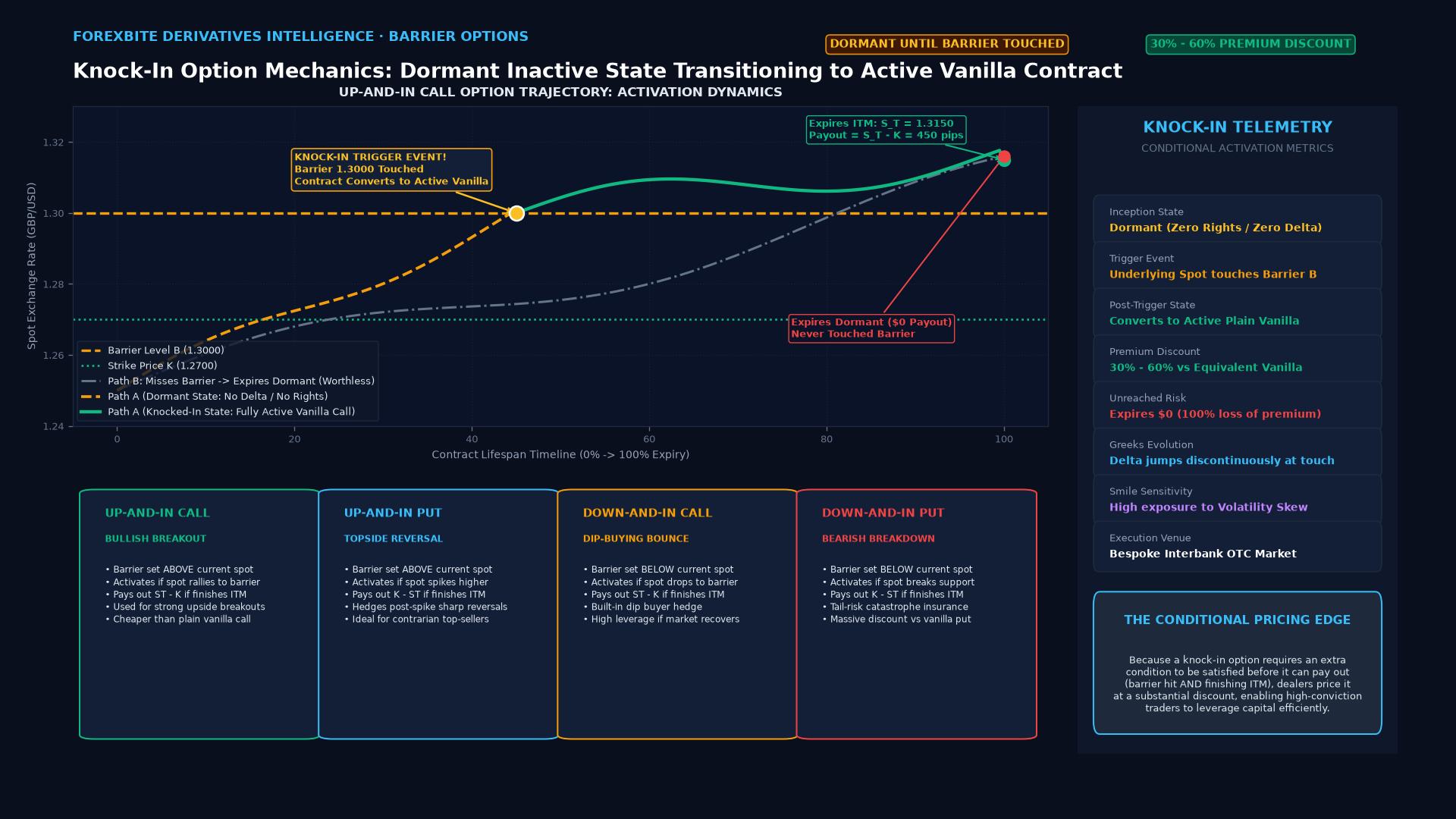 Figure: Knock-in barrier option lifecycle showing dormant contract activation upon touching barrier level B and comparative trajectory paths.
The Four Core Varieties of Knock-In Options
Knock-in options are categorized by the direction of price movement required to trigger activation and the right granted upon activation:
| Option Type | Strike vs. Barrier Setup | Activation Condition | Market Scenario |
|---|---|---|---|
| Up-and-In Call | Barrier is set above current spot | Spot rallies upward to hit barrier | Bullish breakout expectation |
| Up-and-In Put | Barrier is set above current spot | Spot rallies upward to hit barrier | Reversal hedge (shorting from highs) |
| Down-and-In Call | Barrier is set below current spot | Spot drops downward to hit barrier | Dip-buying / bounce play |
| Down-and-In Put | Barrier is set below current spot | Spot drops downward to hit barrier | Bearish breakdown hedge |
Pricing Mechanics: Why Traders Use Knock-In Options
The primary commercial attraction of knock-in options is cost efficiency.
Because a knock-in option requires an extra condition to be satisfied before it can pay out (the barrier must be touched and the option must finish in-the-money), the mathematical probability of a payout is lower than that of an equivalent plain vanilla option. Consequently, investment banks price knock-in options at a substantial discount—typically 30% to 60% cheaper than standard options.
Pricing Hierarchy:
Plain Vanilla Option (Guaranteed Existence)  ===> Higher Premium (Expensive)
Knock-In Barrier Option (Contingent Existence) ===> Discounted Premium (Cheaper)
Real-World Corporate Hedging Example
Consider a European luxury automotive manufacturer that exports vehicles to the United States. The company expects to receive $20,000,000 USD in revenue in 6 months, which it will convert back into Euros.
- Current EUR/USD Spot: 1.0800
- Budget Rate: The treasurer wants protection if EUR/USD surges above 1.1200 (which would erode euro profits upon repatriation).
If the treasurer buys a standard 6-month EUR/USD vanilla call option at a 1.1200 strike, the premium costs €400,000.
To reduce treasury expenses, the treasurer enters an Up-and-In Call Option:
- Strike Price: 1.1200
- Knock-In Barrier: 1.1050
- Option Premium: €220,000 (a 45% savings)
Potential Outcomes:
- EUR/USD trades quietly between 1.0700 and 1.0950: The barrier (1.1050) is never touched. The option expires dormant. The treasurer saved €180,000 compared to buying a vanilla option, and converts revenues at favorable spot rates.
- EUR/USD rallies aggressively to 1.1350: Along the way, spot price touches 1.1050, knocking the option in. The contract becomes an active 1.1200 call option, successfully capping the firm’s repatriation cost at 1.1200.
Knock-In vs. Knock-Out Options
| Feature | Knock-In Option | Knock-Out Option |
|---|---|---|
| Initial State | Inactive / Dormant | Active from Day 1 |
| Barrier Impact | Activates the option contract | Terminates / Kills the contract |
| Exposure to Volatility | Benefits if volatility reaches barrier | Threatened if volatility breaches barrier |
| Trader Objective | Pay less for a conditional breakout trade | Pay less by forfeiting extreme tail moves |
Key Takeaways
- A knock-in option is an exotic barrier option that remains dormant until spot price touches a predetermined barrier.
- If the barrier price is never touched during the life of the contract, the option expires worthless.
- Knock-in options trade at steep discounts relative to plain vanilla options due to the lower probability of activation.
- Varieties include Up-and-In and Down-and-In calls and puts.
- Institutional treasuries use knock-in options to design customized, cost-effective currency hedging programs.
Frequently Asked Questions
Can a knock-in option be exercised immediately upon touching the barrier?
Only if the option is an American-style contract and has intrinsic value at the moment of activation. Most institutional foreign exchange barrier options are European-style, meaning they can only be exercised on the final expiration date.
What is a “rebate” in barrier options?
A rebate is a pre-negotiated cash payment provided by the option seller to the option buyer if the option fails to knock in (or is knocked out). Including a rebate slightly increases the upfront purchase premium of the contract.
What happens if the market gaps past the barrier over the weekend?
If an economic or geopolitical shock causes the foreign exchange market to open on Sunday evening beyond the barrier level, the contract is officially triggered and knocked in at the market opening tick.
Ready to trade forex?
Open a free demo account with a regulated broker. Practice with virtual funds before risking real money.