Knock-Out Option
A knock-out option is an exotic barrier option that functions as an active contract from inception but is automatically cancelled and extinguished if the underlying asset's price touches a predetermined barrier level prior to expiration.
What Is a Knock-Out Option?
A knock-out option is an exotic barrier option that begins its lifecycle as a fully active, functioning option contract. However, it incorporates a built-in termination trigger: if the underlying asset’s market price touches or crosses a predetermined price threshold (the barrier level) at any point before expiration, the contract is instantly extinguished (knocked out).
Upon being knocked out, the contract ceases to exist. The buyer forfeits all rights to exercise the option, and the contract loses all intrinsic and extrinsic value, terminating without payout (unless a pre-agreed cash rebate was structured into the agreement).
Because the buyer accepts the risk that an adverse or extreme price swing could completely eliminate their contract, sellers price knock-out options at a significant discount compared to standard plain vanilla options.
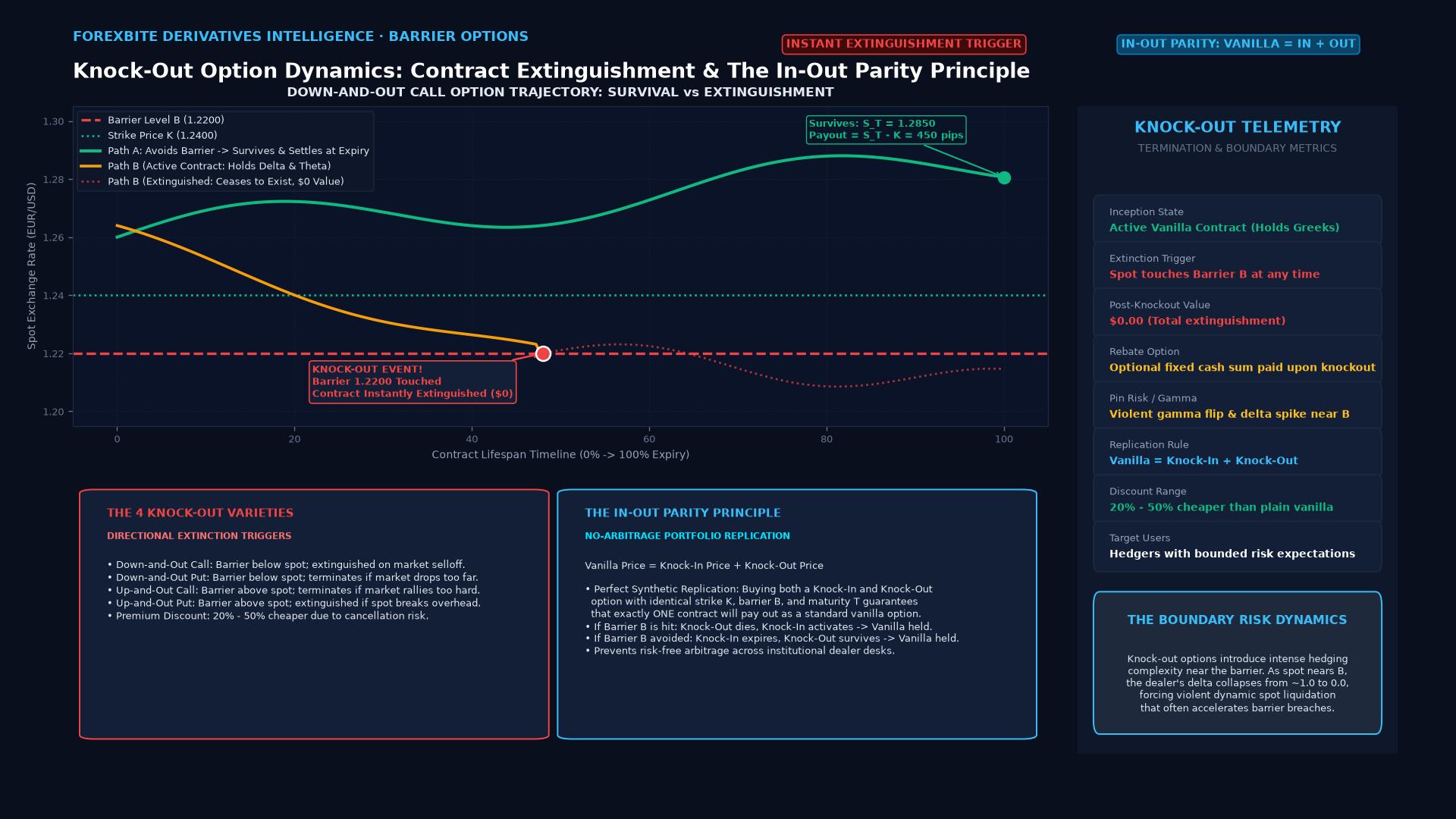 Figure: Knock-out barrier option mechanics illustrating active contract extinguishment upon barrier breach and the In-Out Parity Principle.
The Four Core Varieties of Knock-Out Options
Knock-out options are structured into four primary configurations based on strike location and the direction of the barrier:
| Option Type | Strike & Barrier Positioning | Termination Condition | Strategic Objective |
|---|---|---|---|
| Down-and-Out Call | Barrier placed below current spot | Spot drops and touches lower barrier | Bullish trade with a built-in stop-loss barrier. |
| Down-and-Out Put | Barrier placed below current spot | Spot drops and touches lower barrier | Bearish trade; buyer expects modest, not extreme, drops. |
| Up-and-Out Call | Barrier placed above current spot | Spot rallies and touches upper barrier | Bullish trade; buyer expects moderate upside below barrier. |
| Up-and-Out Put | Barrier placed above current spot | Spot rallies and touches upper barrier | Bearish trade with an overhead stop-loss barrier. |
The In-Out Parity Principle
In quantitative derivatives pricing, knock-out options and knock-in options are governed by an elegant no-arbitrage relationship known as the In-Out Parity Principle:
$$\text{Price}(\text{Plain Vanilla Option}) = \text{Price}(\text{Knock-In Option}) + \text{Price}(\text{Knock-Out Option})$$
Where both barrier options share identical strike prices, expiration dates, underlying assets, and barrier levels:
- If you buy both a Knock-In call and a Knock-Out call with the exact same barrier, you are guaranteed that exactly one of two things will happen:
- The market hits the barrier: the Knock-Out dies, but the Knock-In activates. You hold an active vanilla call.
- The market avoids the barrier: the Knock-In never activates, but the Knock-Out survives to expiration. You hold an active vanilla call.
- Because holding both barrier contracts perfectly replicates holding a single standard vanilla option, their combined premiums must equal the vanilla option price to prevent risk-free arbitrage.
The “Barrier Defense” Phenomenon in Foreign Exchange
In the multi-trillion-dollar interbank foreign exchange market, large barrier options generate visible microstructural price action around round-number exchange rates (e.g., 1.1000 on EUR/USD or 155.00 on USD/JPY).
When an investment bank writes a large Down-and-Out Call or Up-and-Out Call worth hundreds of millions of dollars to an institutional client, the bank faces an asymmetric payout profile:
- If the barrier is touched, the bank is relieved of its liability to pay out millions in option gains.
- If the barrier survives, the bank must fulfill the contract payout.
Consequently, as spot prices approach a heavily concentrated barrier level, the issuing bank’s proprietary trading desk has a powerful commercial incentive to defend the barrier. Dealers execute aggressive market orders in the spot market to push price away from the barrier, temporarily pinning currency rates and creating formidable artificial support or resistance zones.
Spot Approaching Institutional Barrier:
Spot Rate: 1.0995  ===> Bank sells heavy spot volume to defend 1.1000 barrier.
Spot Rate: 1.1000  ===> If breached by 1 tick, the option is KNOCKED OUT.
Knock-Out Options vs. Retail Stop-Loss Orders
Many institutional desks prefer knock-out options over traditional leveraged spot positions with stop-loss orders:
- Zero Slippage on Execution: With a spot stop-loss order, an illiquid weekend price gap can blow past the stop price, causing severe negative slippage.
- Capped Maximum Loss: The buyer of a knock-out option can never lose more than the upfront premium paid, providing guaranteed absolute risk containment.
Key Takeaways
- A knock-out option is an active option that terminates immediately if spot price touches a predetermined barrier.
- It is cheaper than a plain vanilla option because the buyer assumes the risk of premature contract cancellation.
- Under In-Out Parity, the price of a knock-in plus a knock-out equals an identical plain vanilla option.
- Institutional banks actively defend barrier levels in spot markets to avoid large option liabilities.
- Knock-out options eliminate weekend gap slippage risks inherent in standard stop-loss orders.
Frequently Asked Questions
Can a knocked-out option be revived if price reverses later?
No. Once a barrier price is touched even for a single fraction of a second, the knock-out event is irreversible. The contract is immediately and permanently extinguished, even if price instantly reverses and rallies into deep profitability.
What is a “reverse” knock-out option?
A standard knock-out is extinguished when price moves against the trade (out-of-the-money). A reverse knock-out is extinguished when price moves deeply in your favor (in-the-money), capping the maximum profit an option buyer can achieve in exchange for an exceptionally cheap upfront premium.
What is a window barrier option?
In a standard barrier option, the barrier is monitored continuously from day 1 to expiration. In a window barrier option, the barrier is only active during a specific timeframe—such as the final two weeks of the contract.
Ready to trade forex?
Open a free demo account with a regulated broker. Practice with virtual funds before risking real money.